Direct answer. The 30/5 bearing (5 × 14 × 7 mm) is a miniature 25° back-to-back (O-arrangement) double-row angular contact ball bearing rated at Cr = 1.78 kN (1,780 N) dynamic and C0r = 0.94 kN (940 N) static, with an open-type catalog reference speed of 51,000 rpm. Compared with a single-row 605 deep groove bearing (5 × 14 × 5 mm, Cr = 1.30 kN, C0r = 0.51 kN), adding just 2 mm of axial width lifts dynamic load capacity by 37%, static load capacity by 84%, and provides bidirectional axial locking plus cantilever overturning stiffness without needing two matched single-row bearings (10 mm total width) and a spacer. NLHB manufactures 30/5 in Open, 2Z shielded, and 2RS rubber-sealed executions in both GCr15 (52100) bearing steel and 440C (9Cr18Mo) martensitic stainless steel, alongside the full range of 0-class single-row miniature deep groove ball bearings (605, 685, 695, 688, 608, 6800, 6802, MR128) used across motors, gearboxes, robot vacuums, and floor scrubbers.
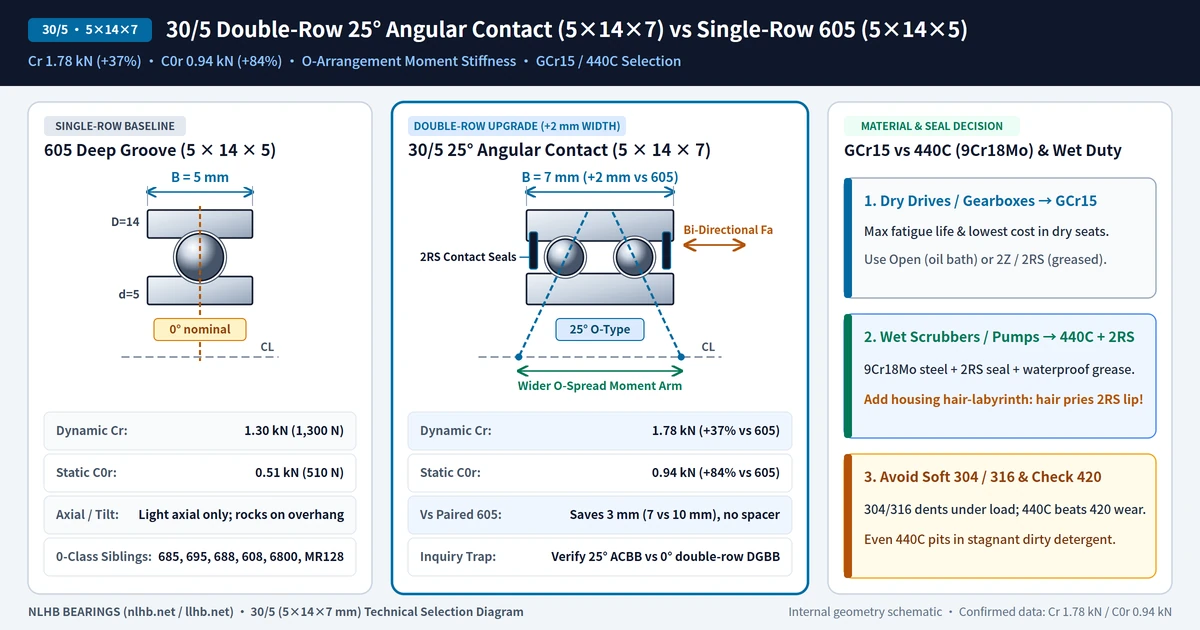
1. 30/5 (5×14×7) vs Single-Row 605 (5×14×5) and Paired 605s
Engineers rarely switch to a 30/5 because a 5 mm shaft ran out of pure radial capacity. They switch when axial endplay, helical gear thrust, or a cantilevered brush/roller arm causes a single 605 to wobble, fret the housing bore, or burn out its seal lip.
| Design Parameter | Single-Row 605 | Double-Row 30/5 | Two Paired 605s (Back-to-Back) |
|---|---|---|---|
Dimensions (d × D × B) |
5 × 14 × 5 mm |
5 × 14 × 7 mm |
5 × 14 × 10 mm (minimum without spacer) |
| Width vs 605 | Baseline (5 mm) |
+2 mm only |
+5 mm (plus shim/spacer tolerance stack) |
| Internal Geometry | Single row, 0° nominal |
Two rows, 25° O-arrangement |
Two separate bearings requiring preload control |
Dynamic Rating (Cr) |
1.30 kN (1,300 N) |
1.78 kN (1,780 N, +37%) |
Dependent on mounting & load sharing |
Static Rating (C0r) |
0.51 kN (510 N) |
0.94 kN (940 N, +84%) |
Dependent on mounting & alignment |
| Cantilever & Bidirectional Axial Rigidity | Low; requires radial play to take axial load | High; single unit resists tilting moment and bidirectional thrust | High, but vulnerable to shaft shoulder misalignment |
| Closure Options | Open / 2Z / 2RS |
Open / 2Z / 2RS |
Inner faces exposed unless double-sealed individually |
Because 30/5 uses an O-arrangement (25° contact lines diverging outward toward the shaft centerline), its effective pressure-cone spread is wider than the 7 mm bearing width itself. That wider spread resists overturning moments on short shafts where two separate bearings cannot fit. For larger shaft bores in the same miniature double-row 3000 Series, NLHB also produces:
| Model | Bore d (mm) |
O.D. D (mm) |
Width B (mm) |
Dynamic Cr (kN) |
Static C0r (kN) |
Open Catalog Ref Speed (rpm) |
|---|---|---|---|---|---|---|
| 30/5 | 5 |
14 |
7 |
1.78 |
0.94 |
51,000 |
| 30/6 | 6 |
17 |
9 |
Confirmed per inquiry | Confirmed per inquiry | Confirmed per inquiry |
| 30/7 | 7 |
19 |
10 |
3.65 |
1.69 |
39,500 |
| 30/8 | 8 |
22 |
11 |
5.10 |
2.60 |
34,500 |
Sourcing check before quoting "5×14×7 double-row": Some low-cost inquiries asking for a
5 × 14 × 7 mmdouble-row bearing actually specify a0°double-row deep groove geometry rather than a25°double-row angular contact30/5. Always verify the contact angle and internal groove structure from a sample or drawing before freezing tooling or comparing unit prices—see custom miniature double-row bearings and double-row vs paired single-row angular contact.
2. Real Applications: High-Rigidity Compact Drives and Cleaning-Appliance Edge Cases
Because 30/5 combines a small Ø5 mm bore with a 25° double-row core, its primary OEM demand comes from industrial and electromechanical assemblies that need stiff axial location inside a 7 mm pocket:
- Miniature planetary gearboxes and worm drives: Helical and worm gear teeth generate continuous bidirectional axial thrust when reversing direction. A single
30/5locks the output or intermediate shaft without external thrust washers. - Electric linear actuators and automotive micro-valves: Tight actuator housings benefit from single-bearing moment stiffness under vibration and reversing loads.
- Compact centrifugal pumps, screw pumps, and lab agitators: Impeller pressure differentials create constant axial load alongside radial shaft runout.
- High-speed mini spindles, robotics micro-joints, and textile guide rollers: Low radial runout and rigid axial positioning prevent tool chatter or belt/filament wander.
Where does 30/5 fit in floor scrubbers and robot vacuums? Most standard brush, wheel, and suction motor seats in consumer cleaning appliances use single-row 0-class miniature bearings (608, 688, 605, 685, 6800) because cost and narrow 4–5 mm pockets dominate. However, 30/5 makes direct engineering sense on cantilevered or thrust-loaded sub-assemblies restricted to 7 mm width—such as a single-sided edge-cleaning roller support, a swing-out mop-arm pivot experiencing downward scrub pressure, or a compact brush-drive gearbox output where a single 605 suffers radial sag and early seal wear.
3. Full Range of 0-Class Miniature Bearings for Robot Vacuums & Floor Scrubbers
If your cleaning appliance, small motor, or smart-drive project uses 30/5 in one high-load pivot alongside standard 0-class single-row bearings across the rest of the machine, sourcing both families from one factory simplifies lot traceability and mixed-container shipping. Alongside 30/5, NLHB manufactures the full lineup of miniature bearings, deep groove ball bearings, and MR thin-section miniature bearings (all ratings below reflect NLHB open catalog baselines; sealed configurations are reviewed against application speed and torque):
| Model (Open / Sealed) | Dimensions d × D × B (mm) |
Open Cr / C0r (kN) |
Typical Appliance & Micro-Drive Positions |
|---|---|---|---|
| 605 / 605-2RS | 5 × 14 × 5 |
1.30 / 0.51 |
Main roller driven ends, compact gear reductions, light fans |
| 685 / 685-2RS | 5 × 11 × 3 (open) · 5 × 11 × 5 (2RS/ZZ) |
0.60 / 0.28 (685 open) · 0.79 kN Cr (685ZZ) |
Side-brush gear stages, compact micro-motor shafts |
| 695 / 695-2RS | 5 × 13 × 4 |
0.83 / 0.39 |
Flat wheel/gearboxes, lateral guide rollers |
| 688 / 688-2RS | 8 × 16 × 4 (open) · 8 × 16 × 5 (2RS) |
1.23 / 0.63 (688 open) |
Drive wheel gearheads, medium-load roller brush ends |
| 608 / 608-2RS | 8 × 22 × 7 |
3.30 / 1.40 |
Heavy-duty floor scrubber main rollers, drive hubs, larger fan shafts |
| 6800 / 6800-2RS | 10 × 19 × 5 |
1.32 / 0.70 |
Thin-wall hub drives, hollow brush cores, compact pump shafts |
| 6802 / 6802-2RS | 15 × 24 × 5 |
1.59 / 0.98 |
Larger wet-scrubber brush drives and drive-axle sleeves |
| MR128 / MR128ZZ | 8 × 12 × 3.5 |
0.46 / 0.22 |
Tight radial-space roller brush ends and wheel hubs |
Width note on 685 and 688: Standard open
685(3 mm) and open688(4 mm) are narrower than theirZZ/2RSsealed versions (5 mm). Verify whether your housing pocket was designed for the open or sealed width before ordering. For full site-by-site appliance selection details, see our robot vacuum cleaner bearing guide.
4. Material Selection: GCr15 Chrome Steel vs 440C (9Cr18Mo) vs 420 Stainless
Choosing between chrome steel and stainless steel is where buyers most often overpay for dry gearboxes—or under-specify wet assemblies and face warranty returns within weeks.
| Steel Grade | Designation | Corrosion Behavior | Hardness & Load Capacity | Cost & Manufacturing Reality | Best-Fit Zone |
|---|---|---|---|---|---|
| Bearing Chrome Steel | GCr15 / 52100 / SUJ2 |
Rusts rapidly if moisture penetrates the seal | Highest fatigue life & hardness (100% baseline) |
Lowest raw bar cost, shortest heat-treat cycle, highest grinding yield | Dry gearboxes, oil-sealed drives, enclosed vacuum motors |
| Martensitic Stainless | 440C / 9Cr18Mo |
Resists fresh water, humidity, and mild cleaners; can still pit in prolonged dirty sewage or salt/chlorides | High hardness close to GCr15; full structural rolling duty |
Higher steel cost + vacuum hardening, sub-zero stabilization, low tempering, slower twin-groove grinding | Wet floor scrubber brush ends, washdown pumps, exposed damp actuators |
| Budget Martensitic Stainless | 420 (2Cr13/3Cr13) |
Mild moisture resistance; lower pitting margin than 440C |
Lower hardened ceiling and lower wear/fatigue margin | Lower alloy & grinding cost than 440C, but shorter loaded life |
Light-duty, low-speed damp pivots only; disclose life trade-off |
| Austenitic Stainless | 304 / 316 |
Best chemical & salt corrosion resistance | Soft (unhardenable); raceways dent under normal radial/axial load | Not suitable for precision 30/5 rolling raceways |
Do not specify for loaded 30/5 bearings |
Two engineering truths matter when comparing quotes (covered in depth in our 440C vs 9Cr18Mo stainless steel bearing guide):
- High-volume low-price
30/5inquiries are rarely vacuum-hardened440C: On a tiny5 × 14 × 7 mmdouble-row ring,9Cr18Mostock cost, vacuum heat treatment with sub-zero treatment, and slower stainless double-groove grinding create a real cost floor. If an inquiry demands commodity pricing for tens of thousands of sets per month, verify whether the end machine uses protected dryGCr15or budget420rather than true440C. - Stainless does not replace housing sealing—and plated steel is an alternative for larger bores: In dirty washdown environments,
440Cresists water splash far better thanGCr15, yet stagnant detergent or salt residue still attacks unsealed steel. When rust risk is external rather than submerged (or on larger bearings requiring fullGCr15core toughness), also review zinc-nickel plating vs 440C stainless steel.
5. Seals (Open / 2Z / 2RS) and the Wet-Appliance Hair-Wrap Failure Chain
Selecting 440C steel without fixing seal mechanics still fails in floor scrubbers and robot vacuums. Across wet cleaning returns, bearing seizure typically follows a predictable four-step mechanical chain rather than simple "bad steel":
- Hair and fiber wrap tight around the
Ø5 mmshaft shoulder right against the bearing end face. - Wrapped fibers wedge under the
2RSrubber lip, prying the elastomer contact edge away from the inner-ring land. - Detergent water and grit enter the cavity, washing out or emulsifying standard lithium grease.
- Mixed starvation and chemical pitting seize the balls, stalling the brush motor (
GCr15rusts within days; even440Csuffers localized pitting if stagnant dirty water stays trapped).
| Closure Option | Construction | Torque & Speed Fit | Wet / Dust Protection | Recommended Use |
|---|---|---|---|---|
| Open | No shields or seals | Lowest friction; up to catalog 51,000 rpm ref |
None (relies on housing) | Oil-bath miniature gearboxes or internal sealed housings |
2Z / ZZ |
Non-contact stamped metal shields | Low running drag (torque guide), high speed | Blocks coarse debris only | Dry motors, shielded gear stages, clean optical/textile idlers |
2RS / 2RSR |
Contact elastomer lip seals on both sides | Higher lip drag; speed bounded by seal lip surface speed | Best bearing-level water & fine-dust barrier | Exposed wet scrubber ends, washdown pumps, dusty actuator shafts |
The four-part wet-zone specification: Specify 440C (9Cr18Mo) rings and balls + contact 2RS seals + water-resistant synthetic grease + a molded plastic labyrinth or shaft sleeve in the housing end-cap so hair wraps on the replaceable sleeve instead of the seal lip. For detailed seal comparisons in double-row angular contact designs, see 2RS vs ZZ in double-row angular contact bearings.
6. In-House Inspection, Engineering Tools & RFQ Checklist
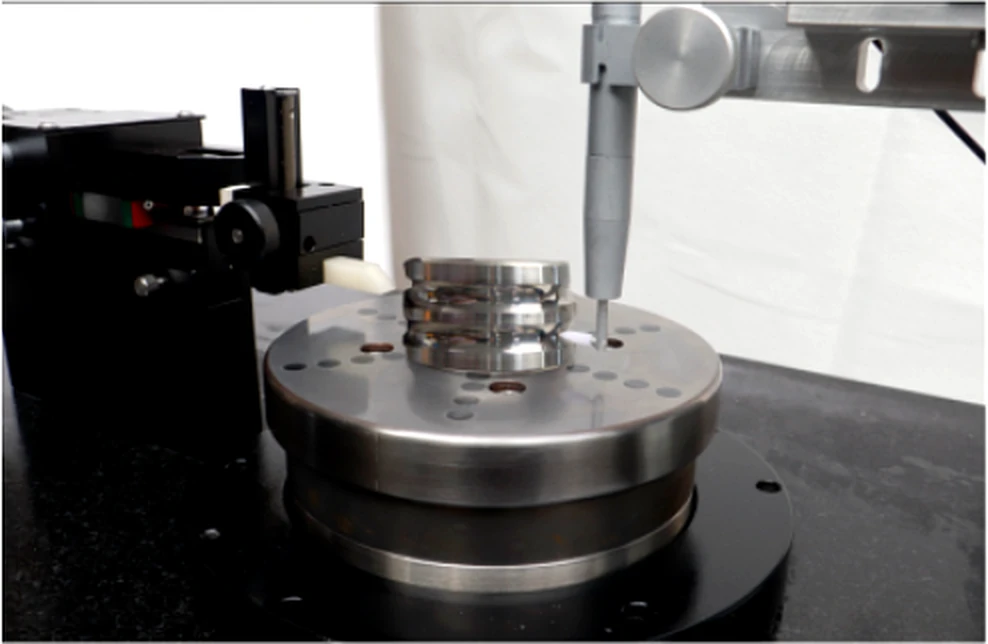
Before switching a production line or signing off first articles, verify your load ratios and operating life with our equivalent load calculator and bearing life calculator, and check housing interference shrinkage on aluminum or plastic seats with the fit and tolerance calculator. NLHB inspects miniature and double-row production in-house for inner/outer ring roundness, groove contour symmetry, and finished vibration/noise screening before packaging.
When sending an RFQ on the 30/5 product page or our quote request form, include these six points so we can confirm tooling, steel grade, and pricing accurately:
- Exact internal type: Confirm
25°double-row angular contact30/5(or attach a sample/drawing if an existing supplier quoted a0°double-row5×14×7). - Material grade: Specify
GCr15chrome steel (dry drives) or440C / 9Cr18Mostainless steel (wet/corrosive duty). - Closure & grease: Specify Open,
2Z, or2RS(plus any water-resistant, low-torque, or high-temp grease requirement). - Loads, speed & environment: Share radial load
Fr, bidirectional axial thrustFa, continuous rpm, and water/detergent/dust exposure. - Seat material & fits: Note shaft/housing material (steel vs aluminum vs molded plastic) so radial internal clearance matches mounting interference.
- Companion 0-class BOM items: List any companion
605,685,695,688,608,6800,6802, orMR128bearings on the same assembly for bundled sampling.
Frequently asked questions
What are the exact dimensions and load ratings of a 30/5 bearing?
A standard 30/5 double-row angular contact ball bearing measures 5 mm bore (d) × 14 mm outer diameter (D) × 7 mm width (B), with a 25° nominal contact angle in a back-to-back (O) arrangement. Its catalog ratings are Cr = 1.78 kN (1,780 N) dynamic and C0r = 0.94 kN (940 N) static, with an open-type reference speed of 51,000 rpm.
Can a 30/5 bearing directly replace a 605 bearing?
Only if your housing pocket and shaft shoulder allow an extra 2 mm of axial width (7 mm for 30/5 vs 5 mm for 605), since both share the 5 mm bore and 14 mm OD. When those 2 mm are available, 30/5 boosts dynamic rating by 37%, static rating by 84%, and adds bidirectional axial and overturning rigidity without installing two separate bearings.
Should I choose GCr15 bearing steel or 440C stainless steel for 30/5?
Choose GCr15 for enclosed motors, oil-sealed gearboxes, and dry transmissions where it delivers maximum fatigue life at the lowest cost. Choose 440C (9Cr18Mo) for wet floor scrubber brush ends, pumps, or humid actuators exposed to fresh water and mild cleaners—paired with 2RS rubber seals and water-resistant grease, since unsealed 440C can still pit in dirty stagnant detergent water.
Do floor scrubbers and robot vacuums use 30/5 or standard 0-class miniature bearings?
Mainstream roller brushes, drive wheels, and suction fans mostly use 0-class single-row miniature and thin-section deep groove ball bearings (605, 685, 695, 688, 608, 6800, 6802, MR128). 30/5 is typically used where a cantilevered brush end, swing-arm pivot, or compact brush gearbox requires bidirectional thrust and tilt stiffness inside a 7 mm width. NLHB manufactures both 30/5 and the 0-class miniature lineup.
Why does a low-price "5×14×7 double-row" quote sometimes behave differently from a true 30/5?
In bulk OEM inquiries, some factories quote a 0° double-row deep groove geometry inside the 5 × 14 × 7 mm envelope or substitute 420 stainless steel instead of vacuum-hardened 440C (9Cr18Mo). Always confirm 25° angular contact geometry, cage type, and steel grade before approving samples.
What seal option works best on a 30/5 bearing: 2Z or 2RS?
Select 2Z non-contact metal shields for dry, higher-speed motors and gearboxes where low running torque matters. Select 2RS contact rubber seals when blocking water splash, fine dust, or fibers—and add a mechanical shaft sleeve or housing labyrinth in brush assemblies so wrapped hair cannot pry open the rubber lip.
30/5 & Miniature Bearing Supply: NLHB manufactures 30/5 (5×14×7 mm, 25° double-row angular contact) in Open, 2Z, and 2RS designs using GCr15 or 440C (9Cr18Mo) stainless steel, along with full 0-class miniature bearings (605, 685, 695, 688, 608, 6800, 6802, MR128) at our Cixi, Ningbo plant. Request a quote or CAD files for your assembly.