A double row angular contact ball bearing such as a 5204 and a pair of single row 7204 bearings can support the same shaft, with the same bore and outside diameter. They are not interchangeable in every design. The choice affects axial space, how preload is set, how the bearing handles moment load and misalignment, and how the assembly is mounted. This guide compares the two arrangements from a design engineer's point of view.
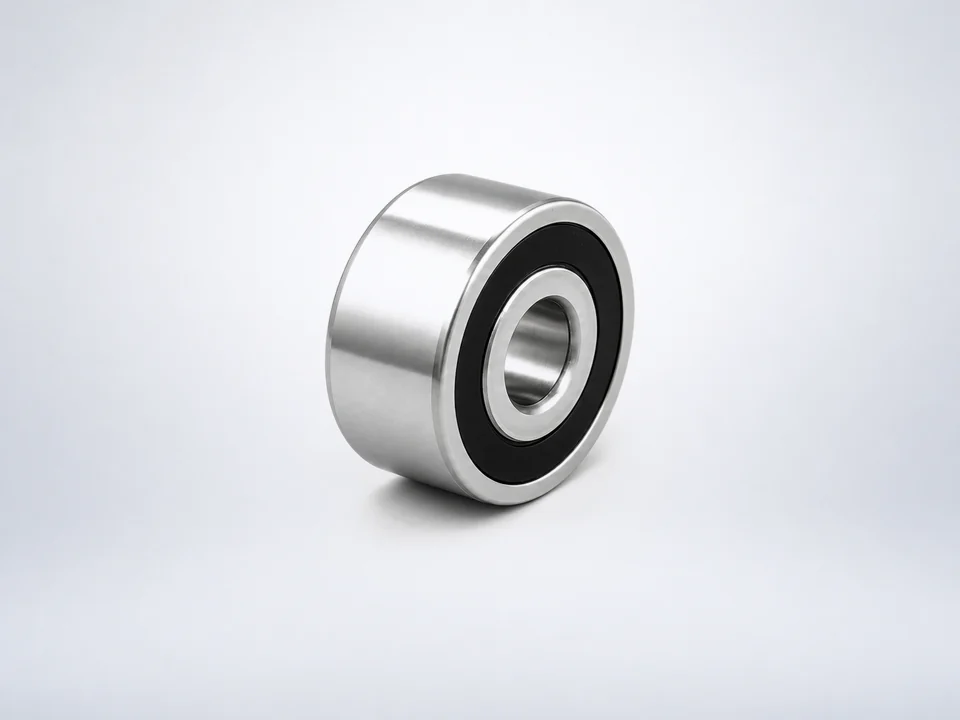
Two rows in one unit, or two units in one arrangement
A double row bearing is functionally close to two single row bearings mounted back-to-back, but its internal clearance is fixed at the factory and the two rows are ground in one pair of rings. A paired set gives the designer more freedom: arrangement, preload and spread can all be chosen.
Side-by-side comparison
| Criterion | One double row bearing (3200/5200) | Pair of single row bearings (7200) |
|---|---|---|
| Axial width | Narrower. Example: a 5204 is 20.6 mm wide, two 7204 bearings stack to 28 mm | Wider; the width of two bearings, plus any spacer |
| Axial load direction | Both directions | Both directions (back-to-back, face-to-face) or one direction with higher capacity (tandem) |
| Moment load | Good moment stiffness within a short width | Back-to-back with a spacer gives a larger effective spread and higher moment stiffness |
| Internal clearance / preload | Fixed at manufacture as axial clearance or light preload | Set by universally matched faces, ground spacers or nut adjustment |
| Misalignment tolerance | Low | Face-to-face tolerates more; back-to-back is similarly low |
| Mounting | One part, one fit, fewer assembly steps | Two parts must be mounted in the correct orientation and kept as a set |
| Parts count and inventory | One part number | Two bearings, possibly matched set code and spacers |
| Contact angle options | Fixed by the bearing design | Can be chosen per bearing series and suffix |
The catalogue widths above are standard boundary dimensions for these series; confirm the exact dimensions of the variant you use against the drawing. For the naming difference between 3200 and 5200, see 3200 vs 5200 designation.
Load direction and arrangement
Back-to-back (DB) arrangement: the lines of contact diverge towards the shaft axis, giving a wide effective spread and good resistance to tilting moment. A double row angular contact bearing is normally built on this principle. Face-to-face (DF): the lines of contact converge, the effective spread is small, and the arrangement accepts a little more misalignment but less moment. Tandem (DT): both bearings face the same way and share a heavy axial load in one direction; a separate bearing must take the reverse direction.
Double row fits best
Pulleys, idlers, pumps, compressor clutches, gearbox shafts and wheel-type applications that need moment stiffness in limited width.
Paired back-to-back fits best
Spindles and shafts where high moment stiffness and an adjustable preload are required, with room for a wider arrangement.
Tandem pair fits best
Shafts with a dominant one-direction axial load, such as some screw drives, combined with a separate locating bearing.
Preload and clearance: the practical difference
- Double row: axial clearance is ground into the bearing. The mounting fits then reduce it. If the fits are tighter than intended, the bearing can go from clearance to preload and run hot. See axial clearance of double row angular contact bearings.
- Universal matched single row bearings: the side faces are ground so that any two bearings of the same code give a defined clearance or preload when mounted in DB or DF.
- Adjusted pairs: preload is set during assembly with a nut, shims or spacers. This allows tuning, but depends on assembly skill and repeatability.
Selection steps
- Define the axial space available on the shaft and in the housing.
- Define the loads: radial, axial in each direction, and moment from overhung components.
- Decide whether preload must be adjustable in service or can be fixed at manufacture.
- Check the misalignment the shaft and housing can produce under load.
- Consider the assembly process: one-piece mounting reduces the risk of reversing or mixing bearings.
- Confirm precision grade, seals and grease. Sealed double row bearings (2RS or ZZ) remove the need for separate seals in many designs.
Double row bearings from our grinding line
We produce 3200/5200 and related double row angular contact series, open and sealed, with raceway grinding, super-finishing and assembly in our Cixi factory. Axial clearance is agreed per order. NLHB manufactures miniature and deep groove ball bearings up to P4 precision, and double row angular contact bearings and track rollers up to P6.
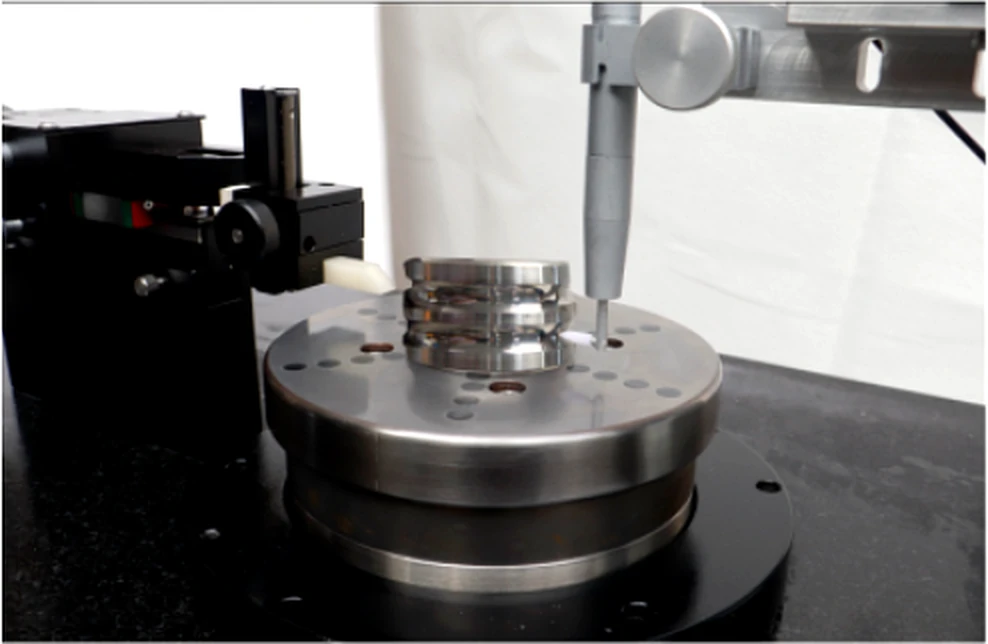
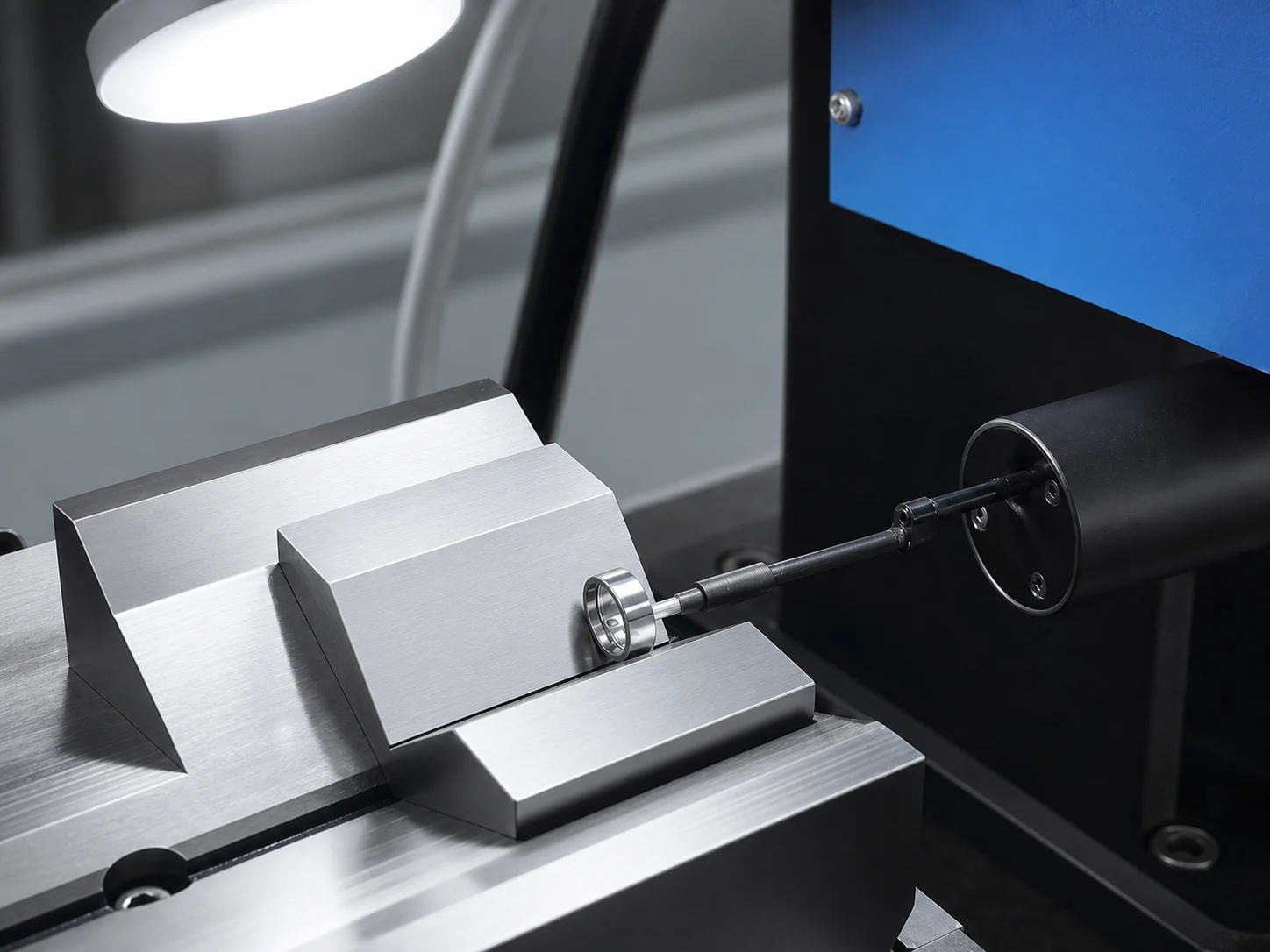
Evidence from our workshop
What to send for a quotation
- Current arrangement (double row designation or single row pair with arrangement code).
- Available axial space and shaft/housing dimensions.
- Loads: radial, axial in each direction, moment.
- Required axial clearance or preload, precision grade, seals.
- Quantity and application.
Frequently Asked Questions
Can one 5200 bearing replace two 7200 bearings?
Often it can in terms of bore and outside diameter, but width, preload, moment stiffness and axial location all change. Check the shaft and housing design and the load case before substituting.
Which is stiffer, a double row bearing or a back-to-back pair?
A back-to-back pair with a spacer usually has a larger effective spread and therefore higher moment stiffness. The double row bearing gives good stiffness within a much shorter width.
Can I adjust the preload of a double row angular contact bearing?
Not in the way a paired set can be adjusted. Its axial clearance is set during manufacture; the mounting fits change it, so fits must be selected accordingly.
Which arrangement tolerates misalignment better?
A face-to-face pair accepts slightly more misalignment than a back-to-back pair or a double row bearing. None of these arrangements is intended for significant misalignment.
What precision can NLHB supply for double row angular contact bearings?
We produce double row angular contact bearings up to P6, open or sealed, with axial clearance agreed per order.
Related guides
Published 2026-09-25. Images show our own workshop and representative products. Final dimensions, grades, inspection limits and supply conditions are confirmed against the requested model, drawing and order.