Auto water pump bearings support the impeller shaft inside an engine cooling pump. They keep the rotating assembly aligned at speed, carry the combined radial and axial loads from belt tension and coolant flow, and work together with the pump seal to keep coolant out of the bearing cavity.
WB-type water pump bearing dimension chart (PDF)
Six-page chart of WB- and WPB-type water pump bearings by principal dimensions in millimetres, with reference brands reference columns where an equivalent is listed.
Download the chart (PDF, 2.8 MB)What is an auto water pump bearing?
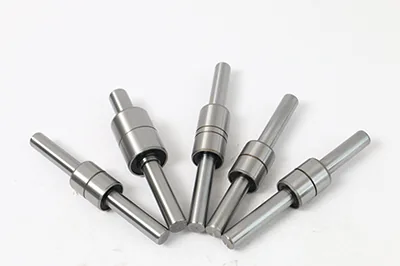
An auto water pump bearing is a rolling bearing installed in the water pump housing of an internal-combustion engine cooling system. Common constructions are double-row ball bearings, ball-and-roller combinations, and unitized shaft-bearing assemblies. In a unitized design the shaft runs directly through the bearing and forms the inner raceway, which removes the separate inner ring and increases stiffness in a compact envelope.
The bearing supports the impeller and the drive pulley so the shaft can rotate smoothly. It carries the radial load of the impeller and belt drive, and the axial load produced along the shaft by belt tension and coolant pressure.
Key design features
- Unitized shaft-bearing construction. The shaft forms the inner raceway, reducing part count and increasing stiffness for a given outside diameter.
- Combined load capacity. Designed to take radial load (impeller weight, belt pull) and axial load at the same time.
- Compact envelope. A narrow width relative to outside diameter fits the limited space between pump housing and seal.
- Sealing on both sides. A mechanical face seal on the impeller side keeps coolant away from the bearing; a lip seal or shield on the pulley side excludes engine-bay contamination.
- Grease selected for temperature. Bearings are typically greased for life with a grease chosen for the operating temperature of the cooling circuit.
What the dimension chart contains
Water pump bearings are built from the same core elements as other rolling bearings: an outer ring, an inner ring or integrated shaft, rolling elements, and a cage that keeps the rolling elements evenly spaced. What distinguishes one water pump bearing from another is mainly its dimensional envelope.
Our chart lists each WB- and WPB-type bearing by its principal dimensions in millimetres — shaft diameter, outside diameter, overall length and the shaft-end dimensions — together with the bearing number and, where available, a reference brands reference number.
The chart does not list load ratings or limiting speeds. These depend on internal design and are confirmed per model on request. Always check the values against the chart and your pump drawing before ordering; do not interpolate between sizes.
Selection guide
- Match the dimensional envelope first. Shaft diameter, housing bore (outside diameter) and length must match the pump casting and the positions of pulley and impeller.
- Check the load case. Heavy accessory drives and high belt tension raise both radial and axial load. Provide belt tension and pulley offset so the bearing can be reviewed against the application.
- Check the speed. The maximum shaft speed follows from engine speed and pulley ratio; include any overdrive.
- Confirm the seal arrangement. The coolant-side seal is critical. A worn or incompatible seal lets coolant reach the bearing and causes corrosion from the inside.
- Confirm the reference number. Cross-check the OEM or aftermarket number against a known equivalent before substituting.
- Specify the grease. For hot or heavy-duty cooling circuits, state the operating temperature so a suitable grease can be specified.
Typical applications
- Passenger car and light-truck engine coolant pumps, gasoline and diesel.
- Commercial vehicle and heavy-duty diesel engine water pumps.
- Agricultural and construction machinery cooling pumps.
- Marine engine raw-water and freshwater cooling pumps.
- Stationary engine cooling pumps for generators and compressors.
Cross-reference and interchange
Water pump bearing numbers usually encode the shaft diameter, outside diameter and overall length, but naming conventions differ between manufacturers. The same envelope can carry quite different part numbers from different suppliers.
For the sizes in our chart, the reference brands columns give a direct reference where one is listed. For other sizes, an equivalent is identified by matching:
- shaft diameter, outside diameter and overall length;
- shaft-end dimensions on the pulley and impeller sides;
- bearing construction (ball-ball or ball-roller);
- seal arrangement and grease requirement.
When all four agree, a substitute can normally be selected. Where a part number is in doubt, send us the OEM reference or a sample and we will confirm the match instead of guessing.
Installation and maintenance
- Press on the correct ring. Apply force only to the ring being fitted — usually the outer ring into the housing. Never drive through the rolling elements.
- Use a press or arbor. Even force avoids brinelling the raceways.
- Set shaft protrusion to the pump specification. Correct impeller-to-housing and pulley-to-shaft positions keep the impeller clear and the belt running true.
- Keep the seal faces clean. Coolant, dirt or sealing compound on the seat faces compromises the mechanical seal.
- Avoid extended dry running. Running dry overheats the seal and the bearing.
- Inspect at service intervals. Coolant traces at the weep hole, pulley play, bearing noise or belt-tracking drift indicate that the bearing or seal needs attention.
- Replace unitized assemblies as a set. Bearing, shaft and seal are serviced together; reusing a worn shaft shortens the life of a new bearing.
Information for a quotation
- Bearing number or OEM / aftermarket reference, if replacing an existing part.
- Shaft diameter, outside diameter, overall length and shaft-end dimensions — or a drawing or sample.
- Ball-ball or ball-roller construction, if known.
- Seal arrangement and operating temperature of the cooling circuit.
- Belt tension, pulley diameter and maximum engine speed.
- Annual quantity and required delivery schedule.
Frequently asked questions
What types of bearings are used in automotive water pumps?
The most common are double-row ball bearings, ball-and-roller combinations (one ball row with one roller row for higher radial capacity), and unitized shaft-bearing assemblies in which the shaft forms the inner raceway.
What determines the service life of a water pump bearing?
Service life depends on load, speed, temperature and sealing. Most premature failures come from coolant entering through a worn seal, excessive belt tension or incorrect installation rather than from the bearing itself.
Can I replace only the bearing instead of the whole water pump?
On serviceable pump designs the bearing can be pressed out and replaced. On many unitized pumps the bearing, shaft, seal and impeller are replaced together, so confirm the pump construction before disassembly.
How do I find the correct interchange for my water pump bearing?
Measure the shaft diameter, outside diameter and overall length from the old bearing or pump drawing, note the construction and seal style, then check our chart and its reference brands columns. If no match is listed, send us the OEM number and we will confirm the equivalent.
Related resources
Chart values are nominal catalogue dimensions. Final dimensions, tolerances, ratings and supply conditions are confirmed against the requested model, drawing and order.