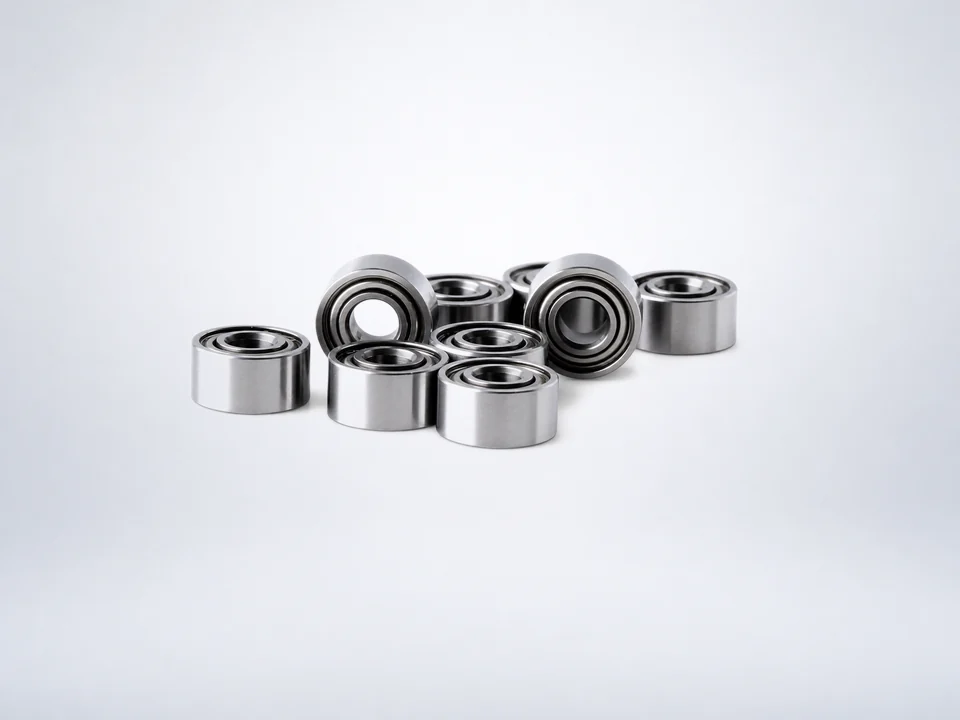
A robot vacuum cleaner runs several small bearings in very different conditions: brush shafts that collect hair and dust, drive wheels that carry the weight of the unit, and a fan motor that runs at high speed next to the user. Each position needs its own balance of noise, sealing and friction. This guide describes the positions, the miniature and thin-section sizes commonly specified for them, and what an OEM should write into the bearing specification.
Four positions, four sets of priorities
Brush positions are limited by contamination, the drive wheels by load and shock from thresholds, and the fan motor by speed, heat and noise. A single bearing type for all positions usually over-specifies one and under-specifies another.
Bearing positions in a robot vacuum
| Position | Operating condition | Main risk | Typical priorities |
|---|---|---|---|
| Side brush | Low speed, small radial load, open to the floor | Hair wrapping at the shaft, dust ingress | Seal or shield, shaft-end protection, low starting torque |
| Main brush roll (ends) | Moderate speed, brush contact load, near the suction path | Fibres and fine dust entering from the brush end caps | Contact seals or labyrinth in the end cap, grease retention |
| Drive wheels | Low speed, radial load from unit weight, shocks at thresholds and edges | Denting from impacts, moisture from wet floors | Load capacity, shields or seals, corrosion resistance where needed |
| Fan / suction motor | High speed, heat from the motor | Noise, grease degradation, temperature rise | Precision grade, Z/V noise grade, high-speed grease, suitable clearance |
The table describes typical conditions. The actual layout, loads and speeds are set by each OEM's design, and the bearing is selected against that design, not against a generic list.
Commonly specified sizes
Small appliances use miniature and thin-section deep groove ball bearings because the housings are compact and loads are light. The sizes below are commonly specified in small-appliance designs and are given as dimensional examples only; they do not describe any brand's product.
| Designation | d × D × B (mm) | Series | Where this size class is often considered |
|---|---|---|---|
| 683ZZ | 3 × 7 × 3 | 68 miniature | Small brush shafts and gear-train idlers |
| 693ZZ | 3 × 8 × 4 | 69 miniature | Brush shafts, small motor shafts |
| MR128ZZ | 8 × 12 × 3.5 | MR thin-section | Brush roll ends and wheel hubs with limited radial space |
| 6800ZZ | 10 × 19 × 5 | 68 thin-section | Drive wheel hubs and larger brush roll supports |
Boundary dimensions of these designations follow the standard metric series. For how miniature designations are built and how to choose between MR, 68 and 69 series, see our miniature bearing selection guide.
Noise: specify it as a grade, not a wish
- For the fan motor, write a vibration grade on the order — for example 693ZZ Z3V3 or a higher grade agreed after sampling. Z grades cover vibration acceleration, V grades cover vibration velocity in three bands; see Z3V3 vibration grades.
- Brush and wheel bearings run slowly, but a damaged or contaminated bearing still produces an audible rumble. A basic noise requirement for these positions keeps the complete unit consistent.
- Grease type and fill quantity change measured vibration. Fix both in the specification once the sample passes.
- Agree how vibration is tested: speed, axial load, and whether bearings are tested with shields fitted.
ZZ or 2RS against dust and hair
| ZZ (metal shields) | 2RS (rubber contact seals) | |
|---|---|---|
| How it works | Non-contact steel shield with a small gap to the inner ring | Rubber lip in contact with the inner ring |
| Protection against fine dust and fibres | Moderate; relies on the housing to keep contamination away | Better exclusion of dust and fibres |
| Friction and starting torque | Low | Higher, because the lip rubs on the inner ring |
| Suitable positions | Fan motor; protected positions inside the housing | Brush ends and wheels exposed to the floor, where friction is acceptable |
Hair does not stop at the bearing face: it wraps around the shaft, pulls grease out and pushes fibre into the shield gap. The most effective protection combines a sealed or shielded bearing with an end cap, shaft collar or labyrinth that keeps hair away from the bearing face. Contact-seal friction is discussed in sealed bearing speed limits, and the general comparison in 608ZZ vs 608-2RS.
Consistency in volume production
- Freeze the full designation after sample approval: size, seal, clearance, precision grade, noise grade, grease and fill.
- Keep the ring and ball material the same between batches; for positions exposed to wet floors, agree whether stainless steel is required.
- Define the incoming inspection: dimensions, rotation feel, vibration sampling, and appearance.
- Agree how any change of grease, cage or shield design is notified before it reaches production.
Small bearings from our own line
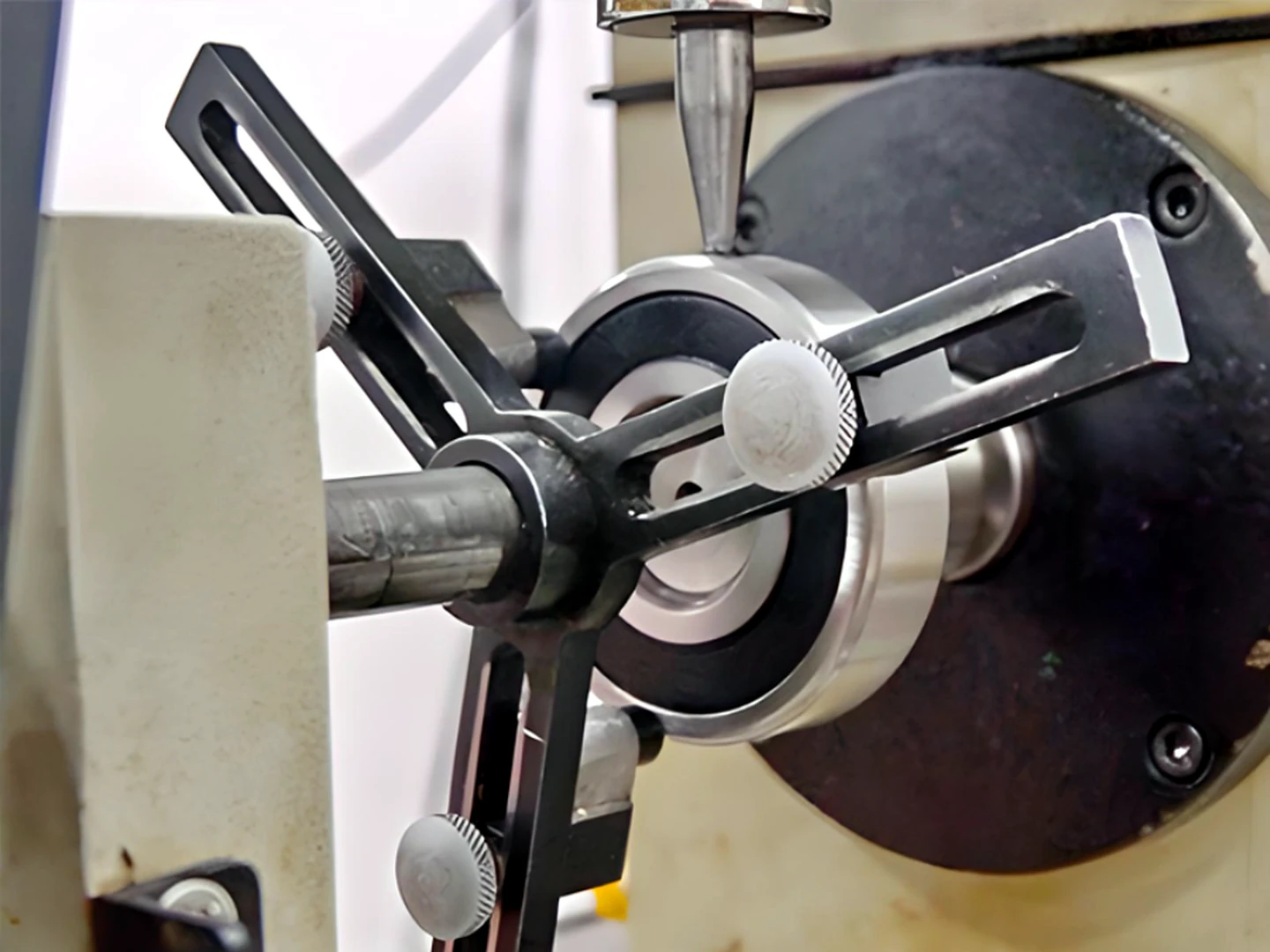
Our miniature bearings are produced in-house, from turning and raceway grinding to super-finishing and assembly, with vibration sorting before packing to the grade agreed on the order. ZZ versions use steel shields; steel or nylon cages and stainless steel rings are available on request. NLHB manufactures miniature and deep groove ball bearings up to P4 precision, and double row angular contact bearings and track rollers up to P6.
Evidence from our workshop

What to send for a quotation
- Position in the unit and the current designation or drawing.
- Speed, load and operating temperature for each position.
- Seal type (ZZ, 2RS or open), cage and ring material.
- Clearance, precision grade and Z/V noise grade.
- Grease type and fill, annual quantity and sampling plan.
Frequently Asked Questions
What bearings are used in a robot vacuum cleaner?
Small deep groove ball bearings in the side brush, main brush roll, drive wheels and fan motor. Miniature and thin-section sizes such as 683, 693, MR128 and 6800 are commonly specified; the actual sizes depend on each design.
Should robot vacuum brush bearings be ZZ or 2RS?
Brush positions are exposed to hair and fine dust, so contact seals (2RS) or a well-designed end cap are often preferred. ZZ shields have lower friction and suit protected positions.
Why does the brush roll of a robot vacuum get noisy?
The usual causes are hair wrapped around the shaft, dust entering the bearing and grease being pulled out. A worn or dented bearing then produces rumble.
What noise grade should the fan motor bearing have?
Specify a Z/V vibration grade such as Z3V3 or higher, agreed after testing samples in the motor, together with grease and clearance.
Can NLHB supply robot vacuum bearings to a drawing?
Yes. Send the size, seal, clearance and noise requirements for each position and we confirm the specification before quoting.
Related guides
Published 2026-09-25. Images show our own workshop and representative products. Final dimensions, grades, inspection limits and supply conditions are confirmed against the requested model, drawing and order.