On electric motor and appliance bearing drawings, technical notes often specify two separate requirements side by side: vibration acceleration ≤ Z3 and vibration velocity ≤ V3. Buyers frequently ask why two vibration codes are needed for the same bearing — and what a BVT inspection report actually measures.
The Core Difference in One Sentence
Z-group grades (Z1–Z4) measure vibration acceleration in decibels (dB), whereas V-group grades (V1–V4) measure root-mean-square vibration velocity in micrometres per second (µm/s) across three frequency bands. Both evaluate running quietness, but each catches a different class of defect:
| System | Measured Quantity | Unit | Standard Framework | Typical Shop Term |
|---|---|---|---|---|
| Z Group (Z1–Z4) | Vibration acceleration | dB | JB/T 7047 (deep groove ball bearings) | Noise grade, dB acceleration group |
| V Group (V1–V4) | Vibration velocity (3 bands) | µm/s | JB/T 10187 & ISO 15242 framework | Velocity grade, BVT low-vibration group |
- Z-grades are sensitive to impulse defects: tiny nicks, contamination particles, burrs or handling indentations on a raceway or ball produce sharp high-frequency acceleration spikes that immediately push the dB reading up.
- V-grades are sensitive to continuous form and waviness errors: out-of-roundness, grinding chatter and raceway waviness produce smooth periodic motion that shows up clearly in velocity bands even when peak acceleration looks acceptable.
That is why quiet motor and export specifications often call out both (for example Z3V3): Z screens out impact and cleanliness defects, while V controls raceway geometry and waviness.
How V1–V4 Grades Are Ordered
Like the Z system, higher numbers mean quieter bearings — V4 is stricter than V3, V2 and V1:
| Grade | Vibration Level | Typical Applications |
|---|---|---|
| V1 | Standard velocity control | General machinery, conveyors, standard gear drives |
| V2 | Low vibration | Standard industrial induction motors, fans, blowers |
| V3 | Extra-low vibration | Quiet household appliance motors, HVAC fans, servo and pump drives |
| V4 | Ultra-low vibration | Acoustic-critical equipment, precision spindles and high-end drives |
Limits scale with bore diameter (larger bearings allow higher velocity limits) and are checked simultaneously in three frequency bands — Low (L), Medium (M) and High (H):
- Low band (roughly 50–300 Hz): reflects ring roundness and low-order raceway form error.
- Medium band (roughly 300–1,800 Hz): reflects raceway waviness from grinding and super-finishing.
- High band (roughly 1,800–10,000 Hz): reflects surface roughness, ball surface finish, cage rub and cleanliness.
A bearing passes V3 only when all three frequency bands fall within the V3 table limits for its bore size.
What Is BVT Testing?
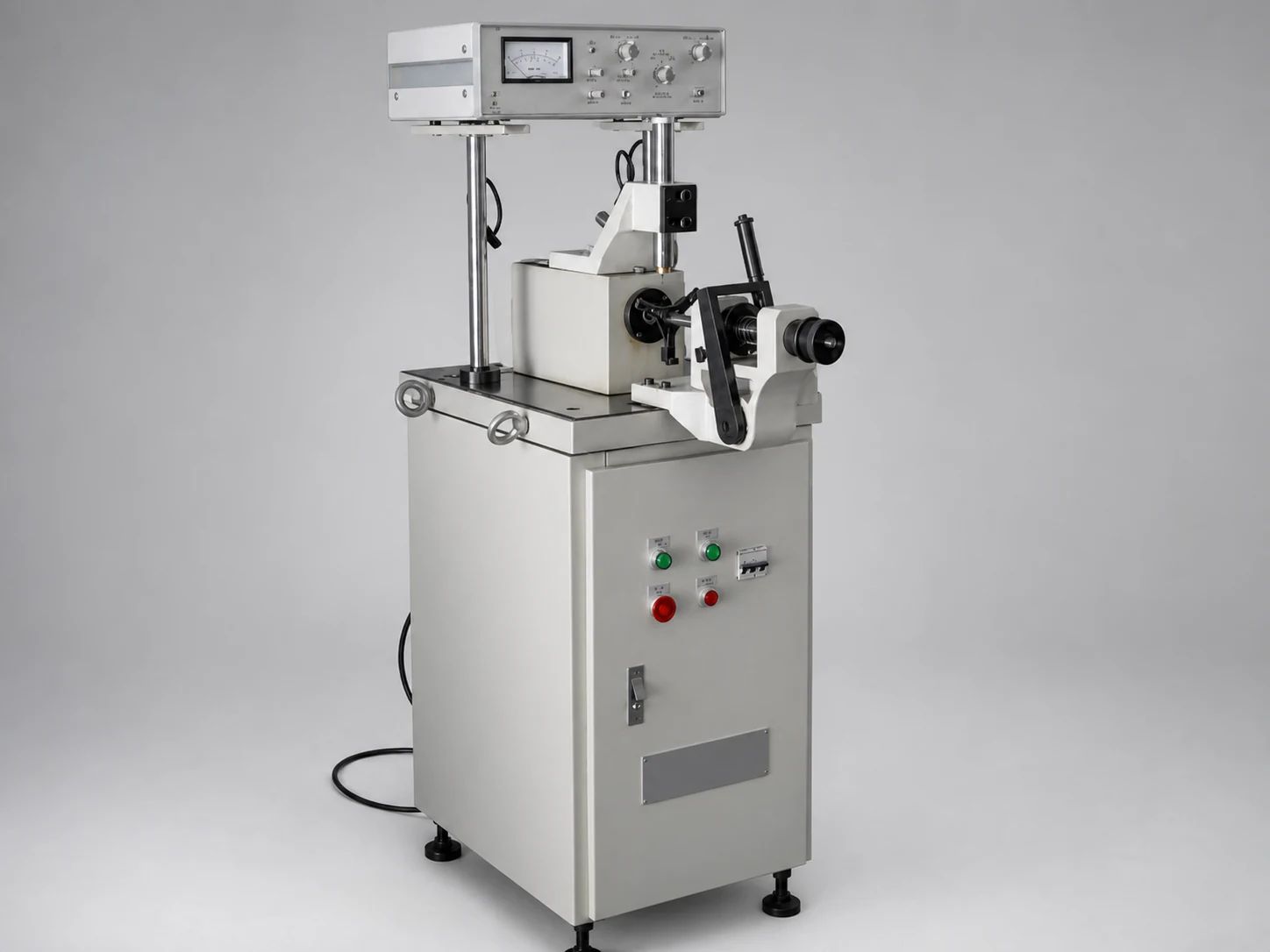
BVT stands for Bearing Vibration Tester (such as the S910 / BVT-series production testers used in our Cixi final inspection room). During a BVT check:
- Spindle drive: the inner ring is rotated at a standardized speed (commonly 1,800 rpm for small and medium deep groove ball bearings).
- Controlled axial load: a calibrated axial thrust load seats the balls against the raceways so radial play does not rattle the reading.
- Velocity pickup: a contact transducer rests radially against the stationary outer ring outside diameter.
- Band-pass filtering: the analyzer separates the signal into Low, Medium and High bands (or acceleration dB).
- Sorting & grading: every bearing — or sampled batch — is compared against the V1–V4 / Z1–Z4 limit table before packing.
Where to Find the Z1–Z4 dB Limit Table
For bore-by-bore decibel limits under JB/T 7047, see Bearing Noise Grades Z1–Z4: dB Limit Tables by Bore or look up values directly in our Noise & Vibration Tool.
How to Specify Vibration Grades on Purchase Orders
- Name the measurement system explicitly: state Z-group (dB acceleration) or V-group (µm/s three-band velocity), rather than writing "low noise" without a metric.
- Pair the grade with clearance and grease: quiet motor bearings usually combine Z3/V3 with C3 radial clearance and low-noise motor grease; heavy contact seals (2RS) rub the inner ring and are measured before seal press-in or specified separately from open/ZZ limits.
- Request batch BVT records: ask for the actual L / M / H band readings or dB distribution sheet tied to the lot number (see Motor Bearing Purchase Specification Template).
- Check housing and shaft fits too: an out-of-round motor housing or excessive press fit transfers form error into the outer ring and makes even a V3 bearing sound loud after mounting.