Two bearings of the same size, precision class and clearance can differ clearly in noise. The difference usually lies in the raceway surface: how round it is, how much waviness is left from grinding, and how smooth the super-finished surface is. These three characteristics are set mainly by raceway grinding and super-finishing, not by assembly. This guide explains how each one generates vibration, how Z and V vibration grades reflect them, and what a bearing factory must control and measure to supply quiet bearings consistently.
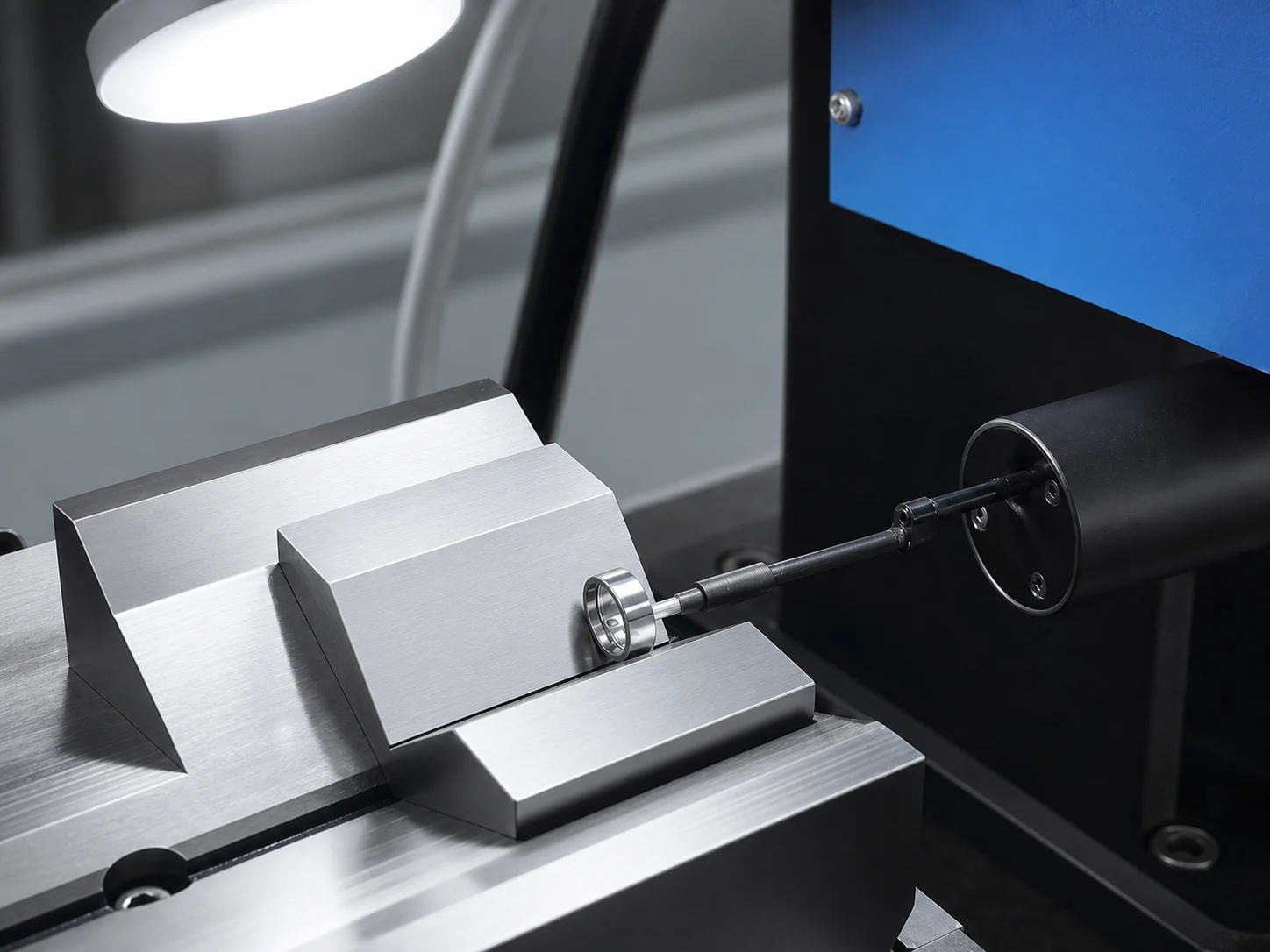
Three scales of surface deviation
Form error is the deviation from a true circle over the whole circumference. Waviness is a shorter, repeated undulation around the raceway. Roughness is the fine texture left by the finishing process. Each scale excites vibration in a different frequency range.
Form, waviness and roughness compared
| Characteristic | What it is | Mainly generated by | Noise effect | Most related vibration grade |
|---|---|---|---|---|
| Roundness (form error) | Deviation from a circle, often as a small number of lobes | Turning and heat-treatment distortion not fully removed; clamping and support in grinding | Running inaccuracy, low-frequency vibration, uneven load | V grade, low band; running accuracy |
| Waviness | Many regular undulations around the circumference | Grinding machine vibration, wheel imbalance and dressing, support and feed conditions | Rumble and hum; tonal components rising with speed | V grade, low and medium bands |
| Roughness | Fine texture across and along the raceway | Grinding marks and the super-finishing result | Hiss and high-frequency noise; lubricant film behaviour | Z grade (acceleration); V grade, high band |
| Raceway profile (cross-section) | Groove radius, groove position and shape across the raceway | Grinding wheel form and dressing, groove position setting | Contact conditions, sensitivity to axial load, running position of balls | Both, indirectly |
The boundaries between form, waviness and roughness are defined by wavelength and are set by the measuring method and filter used. What matters for noise is that each scale excites a different part of the frequency range, so a bearing can be good at one scale and poor at another.
Why waviness produces tones
When a ball rolls over an undulating raceway, it is lifted and lowered at each wave. The result is a vibration whose frequency depends on the number of waves around the circumference and on the rotational speed. A raceway with a regular waviness therefore produces a distinct tone that rises with speed, heard as a hum or rumble. Irregular waviness produces a broader noise. Ball waviness has a similar effect. Because the frequency scales with speed, vibration tests are carried out at a defined speed and load so that results are comparable.
Why roughness produces hiss
Roughness has much shorter wavelengths than waviness, so the vibration it produces lies at high frequencies. It is heard as the steady hiss of a running bearing. Roughness also influences how well the lubricant film separates balls and raceway. A finer, more uniform super-finished surface gives a lower high-frequency level. Vibration acceleration weights high frequencies strongly, which is why Z grades respond mainly to raceway and ball surface finish.
Why grinding and super-finishing decide quietness
- Grinding sets form and waviness. Roundness and waviness left by raceway grinding are only partly reduced by super-finishing. If the ground raceway is lobed or wavy, the finished bearing will be noisier regardless of the super-finish.
- Super-finishing sets roughness and short waviness. It removes grinding marks, improves the surface texture and reduces short-wavelength undulations. It cannot correct large form errors.
- Stock and distortion come from earlier steps. Turning accuracy and distortion from heat treatment determine how much material grinding must remove and how evenly. Uneven stock makes form control harder.
- Machine condition is a process variable. Spindle condition, wheel balance, dressing, workpiece support and coolant cleanliness all show up as waviness or surface defects on the raceway.
- Assembly can spoil a good raceway. Particles, handling damage and unsuitable grease raise vibration even when the raceways were quiet. Cleanliness in assembly is part of noise control.
How Z and V grades reflect raceway quality
| Grade | Measured quantity | Most sensitive to | What a poor result usually indicates |
|---|---|---|---|
| Z1–Z4 (JB/T 7047) | Vibration acceleration | High-frequency components | Rough raceway or ball surface, short waviness, surface damage, particles |
| V1–V4 (JB/T 10187), low band | Vibration velocity | Low-frequency components | Form error and long waviness of raceways or balls |
| V1–V4, medium band | Vibration velocity | Medium-frequency components | Waviness from grinding, local defects |
| V1–V4, high band | Vibration velocity | High-frequency components | Roughness, short waviness, particles, local damage |
Because the two scales weight frequencies differently, they catch different raceway problems. A bearing can pass a Z grade with a good surface finish and still fail a V band because of grinding waviness. That is why low-noise specifications often state both, for example Z3V3. The grade definitions and dB table are in Z3V3 vibration grades and Z1–Z4 noise levels. Limit values depend on bearing size and the standard edition; they are agreed per order.
What the factory controls and measures
| Characteristic | How it is controlled | How it is checked in our factory |
|---|---|---|
| Raceway roundness | Grinding set-up, workpiece support, machine condition | Roundness tester (calibrated), sampling per batch and per set-up |
| Raceway profile | Wheel form, dressing, groove position setting | Raceway profile inspection |
| Surface roughness | Super-finishing parameters and stone condition | Roughness measured in-house |
| Finished bearing vibration | All of the above plus cleanliness and grease | Vibration testers (S910) for Z and V grades agreed per order |
Inspection limits for roundness, profile and roughness are set by bearing size, precision class and the noise grade ordered. They are confirmed against the drawing and order rather than published as a general table.
Specifying low-noise bearings
- State the precision class and the vibration grades together, for example 6202-2RS P6 Z3V3. Precision class alone does not guarantee low noise.
- State the acceptance standard and test conditions: tester, speed, axial load, open or sealed test.
- Specify the grease if it matters: grease type and fill affect measured vibration.
- Ask which raceway characteristics the supplier measures in-house and how often.
- For critical applications, request vibration data of the delivered batch; see motor bearing purchase specification template.
Raceways ground and super-finished in our own factory
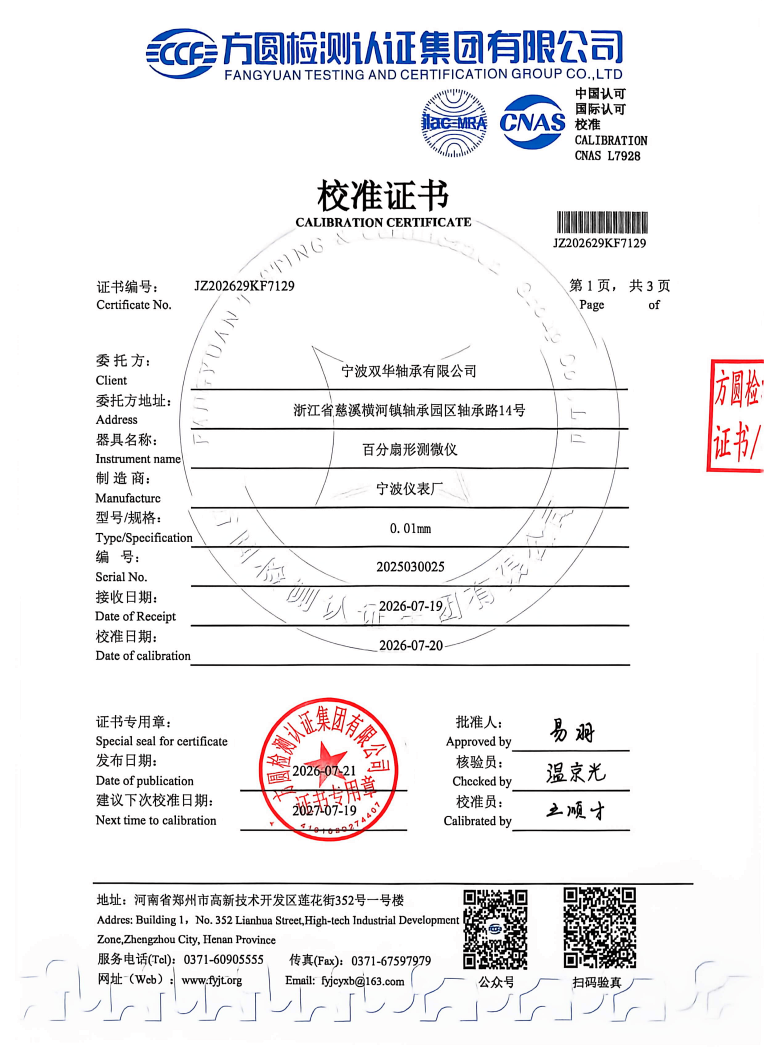
Raceway grinding, super-finishing and assembly are carried out in our Cixi factory. Roundness, raceway profile and surface roughness are measured on our own instruments, and finished bearings are sorted on vibration testers to the grades agreed on each order. NLHB manufactures miniature and deep groove ball bearings up to P4 precision, and double row angular contact bearings and track rollers up to P6.
Evidence from our workshop

What to send for a quotation
- Designation with precision class, clearance and vibration grade.
- Acceptance standard and vibration test conditions.
- Grease type and fill.
- Application: motor type, speed and noise target.
- Required inspection records for roundness, roughness or vibration.
Frequently Asked Questions
Why do two bearings of the same precision class sound different?
Precision class controls dimensions and runout. Noise depends mainly on raceway waviness and surface roughness, which are set by grinding and super-finishing and are specified separately through vibration grades.
What is the difference between roundness and waviness?
Roundness describes the overall deviation from a circle, often a few lobes. Waviness describes many shorter, repeated undulations around the raceway. Waviness is the more direct source of tonal noise.
Does super-finishing correct out-of-round raceways?
Only partly. Super-finishing improves roughness and short waviness but cannot correct large form errors. Roundness must be achieved at the grinding stage.
Which vibration grade reflects surface roughness?
Z grades, which measure vibration acceleration, respond mainly to high-frequency vibration from raceway and ball surface finish. V grades in the low and medium bands respond more to waviness.
Does NLHB measure raceway roundness and roughness in-house?
Yes. Raceway roundness, raceway profile and surface roughness are measured on our own instruments, and finished bearings are vibration-tested before packing. Limits are agreed per model and order.
Related guides
Published 2026-09-25. Images show our own workshop and representative products. Final dimensions, grades, inspection limits and supply conditions are confirmed against the requested model, drawing and order.