Short answer. Metric 6700 and 6800 thin-section bearings create a large open bore for laser paths, slip-rings, fiber bundles, and encoders inside slim housings. Because radial wall thickness is only 3.5–6.0 mm at a 25 mm bore, thin rings mirror housing out-of-roundness immediately, crush easily under heavy press fits, and bind quickly when aluminum housings contract in cold soak.
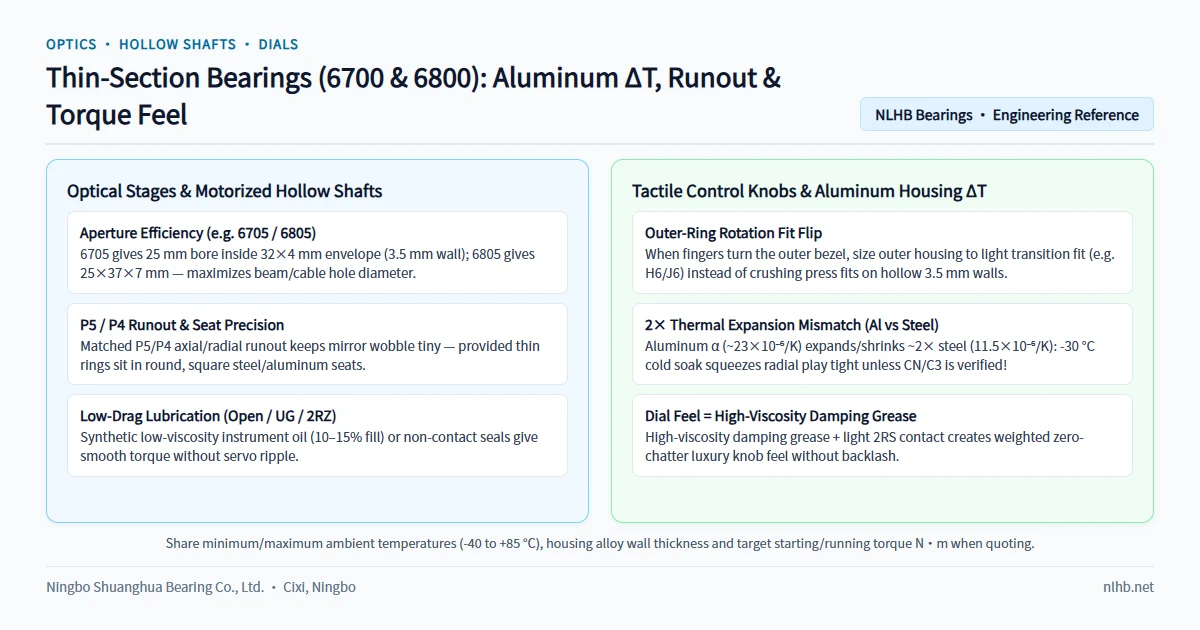
Optical rotary stages, hollow-aperture mounts, and tactile instrument knobs hinge on four coupled decisions: runout grade, rotating-ring fit reversal, differential thermal expansion (ΔT), and torque tuning.
Thin-section geometry at a 25 mm bore
ISO thin-section series trade radial section height H_section = (D − d) / 2 and load rating for maximum hollow aperture:
| Model | d × D × B (mm) |
Radial section (D − d)/2 (mm) |
Dynamic Cr (N) |
Static C0r (N) |
Typical optical / instrument role |
|---|---|---|---|---|---|
6705 (6700 series) |
25 × 32 × 4 |
3.5 |
1,100 |
840 |
Ultra-slim rotary dials, lens rings, compact encoder mounts |
6805 (6800 series) |
25 × 37 × 7 |
6.0 |
3,300 |
2,260 |
Hollow-shaft rotary stages, slip-ring pass-throughs, tactile knobs |
6905 (6900 series) |
25 × 42 × 9 |
8.5 |
5,330 |
3,380 |
Compact precision spindles needing higher stiffness and seal room |
With just 3.5–6.0 mm of total radial section shared across outer ring, balls, and inner ring, even minor bore distortion passes directly into ball contact stress and uneven drag.
Decision 1: Precision runout (P5 / P4) and housing cylindricity
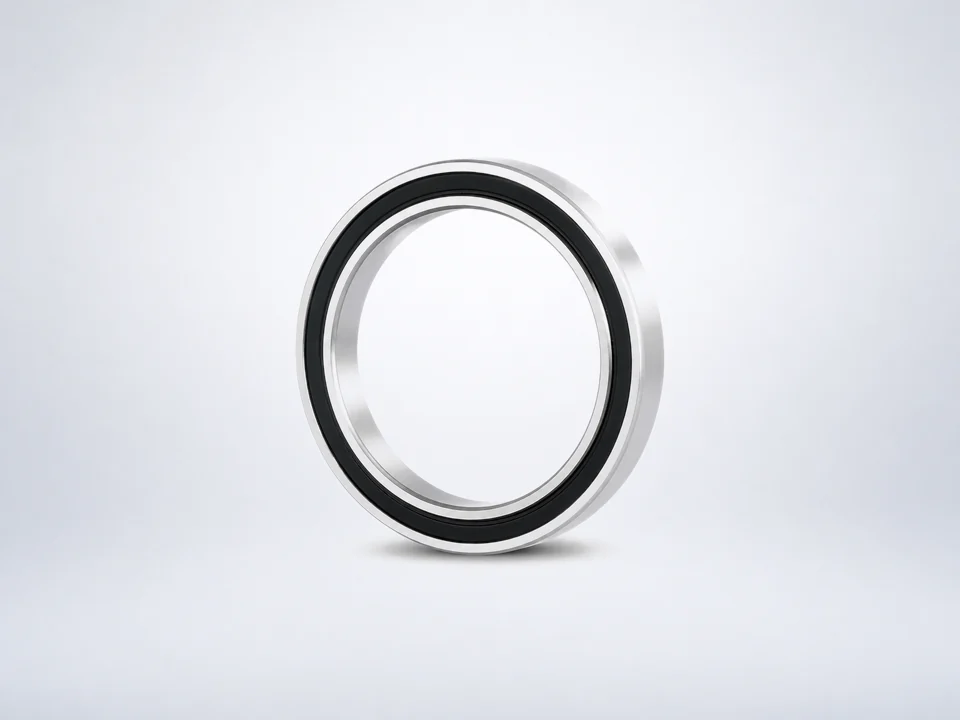
In laser mounts, zoom optics, and encoder stages, wobble and radial eccentricity degrade pointing repeatability directly. Under ISO 492 (GB/T 307.1)—covered in bearing precision grades P0 to P5—precision grades tighten Kia/Kea (radial runout) and Sia/Sea (axial face-to-raceway runout).
NLHB produces thin-section deep groove bearings up to P4 in Cixi. Still, P5/P4 rings conform elastically to whatever taper or ovality sits in the housing bore: pair precision thin-section bearings with ground bores holding cylindricity around ≤ 3–5 µm and square shoulders so beam tilt stays repeatable over 360°.
Decision 2: Outer-ring rotation vs. inner-ring rotation fit reversal
Rotary knobs, lens collars, and outer-sleeve mounts often keep the inner mandrel stationary while the outer ring rotates under finger load. Standard motor "tight shaft / loose bore" habits break here—verify fit direction in our shaft and housing fit tolerance guide and fit and tolerance calculator:
| Rotation & load case | Inner mandrel fit | Outer housing fit | Thin-section failure avoided |
|---|---|---|---|
| Inner ring rotates (motorized optical stage) | Light transition (js5 / h5 on precision small bores) |
Sliding precision (H6 / H7) |
Avoids heavy k6/m6 shaft press fits that crush 6700/6800 play |
| Outer ring rotates (control knob / zoom sleeve) | Slip fit (g6 / h6) on stationary shaft |
Light transition (H6 / J6 / K6) |
Avoids heavy N7 press fits that collapse thin outer rings |
Under light manual or optical loads, pair H6, J6, or K6 with light retaining compound or clamping rather than heavy N7 interference.
Decision 3: Aluminum housing thermal expansion (ΔT)
Optical benches and instrument bezels commonly use aluminum alloys (α_Al ≈ 23 × 10⁻⁶ / K), expanding and shrinking at roughly twice the rate of bearing steel (α_steel ≈ 11.5 × 10⁻⁶ / K). Differential change ΔD = (α_Al − α_steel) × D × ΔT shifts bore diameter by ~1.15 µm per 10 mm of OD per 10 K (~5.2 µm per 10 mm over a 45 K swing):
- Cold soak (
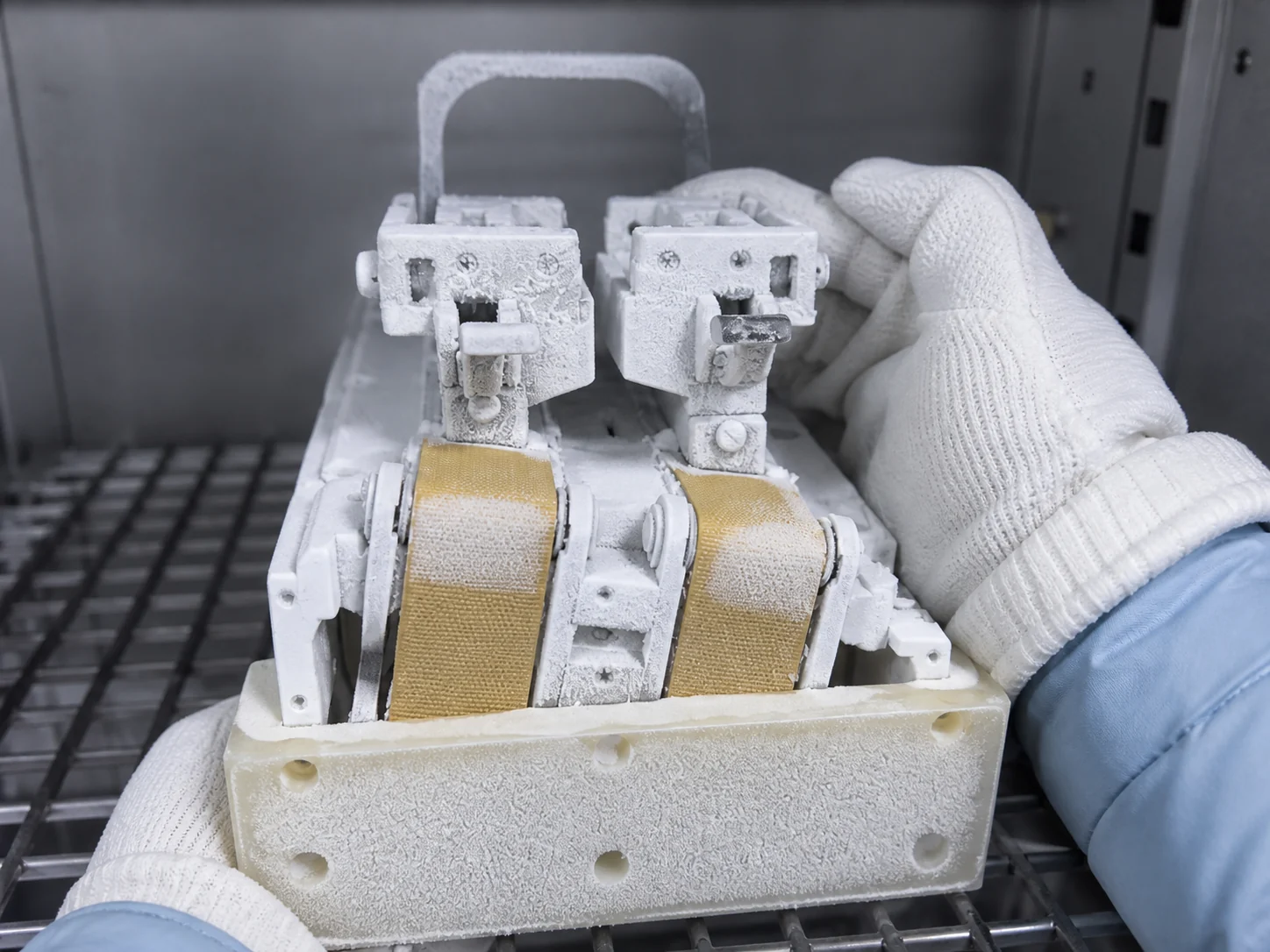
-30 °Cto-40 °C): Cooling a6805(D = 37 mm) in aluminum from+20 °Cto-30 °C(ΔT = 50 K) shrinks the aluminum bore roughly~21 µmmore than the steel ring, crushing tightC2clearance into binding torque spikes. - Warm running (
+60 °Cto+70 °C): Heating the same housing opens bore clearance by~17–21 µm, looseningH7fits unless wave-spring preload, stepped retention, or matchedCN/C3clearance compensates.
Decision 4: Tuning torque feel — motorized stage vs. damped control knob
Identical 6805 dimensions serve opposite torque goals, detailed in our starting and running torque guide:
| Application priority | Closure choice | Lubricant & fill strategy | Clearance / preload | Resulting performance |
|---|---|---|---|---|
| Motorized optical stage / scanner | Open, ZZ shields, or non-contact 2RZ |
Low-viscosity instrument oil (~10–20 cSt at 10–15% fill) |
CN / C2 with light wave-spring preload |
Minimal breakaway drag and low torque ripple |
| Tactile manual control knob | Contact 2RS elastomer seals |
High-viscosity synthetic damping grease (25–45% fill) |
Matched radial play with light preload | Silky, weighted drag with zero rattle |
Never tighten an axial shaft nut hard to manufacture knob drag—overloading thin ball grooves causes brinelling and notchiness.
Frequently asked questions
What is the difference between 6700, 6800, and 6900 thin-section bearings at 25 mm bore?
6705 (25 × 32 × 4 mm) has a 3.5 mm section (Cr = 1,100 N), 6805 (25 × 37 × 7 mm) has a 6.0 mm section (Cr = 3,300 N), and 6905 (25 × 42 × 9 mm) has an 8.5 mm section (Cr = 5,330 N).
Why do P5/P4 thin-section bearings lose runout accuracy in an oval bore?
With walls only 3.5–6.0 mm thick overall, thin rings conform elastically to housing ovality or taper, transferring seat errors straight into raceway wobble and torque ripple.
Should I use an N7 press fit in a rotating control knob housing with a 6805?
No. Heavy N7 fits crush thin outer rings and erase radial play. Use H6, J6, or K6 light housing fits paired with clamping or retaining adhesive where needed.
Why does an optical stage bearing bind at -30 °C in an aluminum housing?
Aluminum contracts roughly twice as fast as steel (Δα ≈ 11.5 × 10⁻⁶ / K). Over a 50 K drop on a 37 mm bore (6805), differential shrinkage reaches ~21 µm, pinching tight C2 bearings unless CN/C3 clearance compensates.
How do I achieve smooth, damped knob feel without backlash rattle?
Pair a 2RS contact-sealed 6700 or 6800 bearing with high-viscosity synthetic damping grease and matched radial play or light spring preload.
What precision grades does NLHB offer for 6700 and 6800 thin-section bearings?
NLHB manufactures 6700, 6800, and 6900 thin-section bearings up to P4 precision with custom grease fills, matched clearances, in-house roundness checks, and cold-soak testing as agreed.
Sources and data boundary
6705, 6805, and 6905 dimensions and ratings come from NLHB's catalog dataset (tools/bearing-data.js). Thermal contraction rates, bore cylindricity guidelines, and lubricant viscosity ranges require confirmation against your alloy datasheet and environmental bench tests.
- ISO 492 / GB/T 307.1, Rolling bearings — Radial bearings — Tolerances.
- ISO 286, Geometrical product specifications (GPS) — ISO code system for tolerances.
- ISO 5753 / GB/T 4604, Rolling bearings — Internal clearance.
- NLHB Thin-Section Bearings Catalog Data (
products/thin-section-bearings.htmlandtools/bearing-data.js).
Related guides
- Thin-section ball bearings (6700, 6800, 6900, 16000)
- Fit and tolerance calculator
- Bearing starting and running torque guide
- Bearing precision grades P0 to P5
- Shaft and housing fit tolerance guide
Send your envelope, housing alloy, temperature span, and target torque or runout limits to review a 6700 or 6800 sample specification: request a quote.