Short answer. A harmonic reducer pairs two mechanically opposite bearings: a PRZ thin-wall flexible ball bearing that elastically deforms on the elliptical wave-generator cam, and an SF or HF crossed-roller output bearing bolted between housing and flange to take every external arm load. NLHB manufactures both PRZ flexible bearings and SF / HF output crossed-roller bearings in-house to approved reducer drawings and inspection agreements—and the iron rule is never to let external joint loads cross into the PRZ bearing.
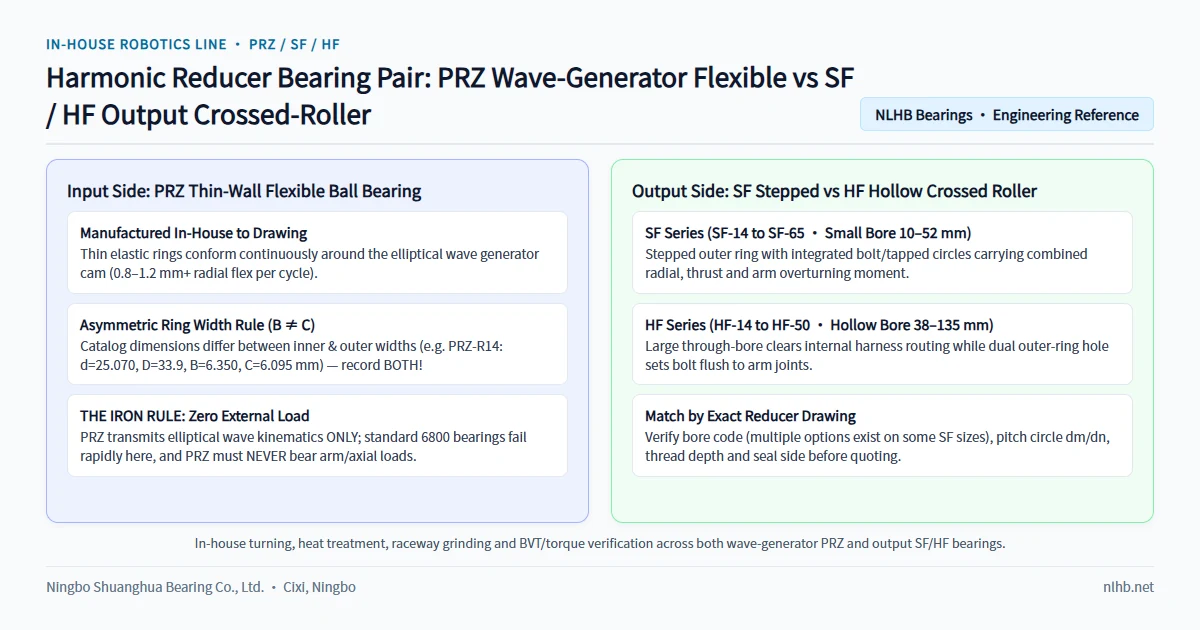
Because both sit inside one compact robot actuator, buyers sometimes confuse thin ball rings with crossed-roller output rings or assume standard 6800 thin bearings can substitute on a cam. Mixing roles fractures thin rings or induces tooth ratcheting. Check full dimensions on our PRZ flexible bearings and SF / HF harmonic reducer output bearings pages before locking a drawing.
Two opposite jobs inside one harmonic reducer
A harmonic drive contains a circular spline, flexspline, and elliptical wave generator. Inside that envelope, each bearing obeys opposite structural rules.
| Parameter | Wave generator (PRZ flexible bearing) |
Output stage (SF / HF crossed-roller) |
|---|---|---|
| Elements & contact | Single-row balls, thin flexible rings | 90° alternating cylindrical rollers (line contact) |
| Service ring state | Continuous 2-lobe elliptical flexing | Rigidly bolted to housing & flange; stays round |
| Mechanical job | Transmits cam ellipse wave to flexspline teeth | Carries external radial, bidirectional axial & moment loads |
| Mounting interface | Cam press-fit (d), flexspline slip fit (D) |
Integrated Φ through-holes & M tapped hole circles |
| Misapplication result | Cracks under external moment or shear | Rigid rings cannot flex; jams wave generator |
THE IRON RULE: PRZ flexible bearings transmit wave deformation ONLY and MUST NEVER carry external radial, axial, or overturning loads from the robot link. Every external output load must pass straight through the SF or HF crossed-roller bearing into the reducer housing.
PRZ flexible wave-generator bearings: dimensions and asymmetrical widths
Every rotation of the elliptical cam puts the entire PRZ inner ring, ball set, cage, and outer ring through two radial deformation cycles. Standard 6800 thin-section bearings are hardened and caged to remain round inside rigid seats; fitting a 6800 bearing onto a cam causes minor-axis ball pinch, cage binding, and rapid alternating bending fatigue—so standard 6800 bearings cannot substitute for PRZ.
| NLHB Model | d (mm) |
D (mm) |
Inner B (mm) |
Outer C (mm) |
r (mm) |
Catalog max radial deformation (mm) | Catalog reducer speed (rpm) | Catalog reducer torque (N·m) |
|---|---|---|---|---|---|---|---|---|
PRZ-R14 |
25.070 |
33.9 |
6.350 |
6.095 |
0.3 |
0.8 |
3,000 |
6 |
PRZ-R17 |
30.300 |
41.722 |
6.680 |
6.160 |
0.3 |
0.9 |
3,000 |
16 |
PRZ-R20 |
35.560 |
49.073 |
8.130 |
7.240 |
0.3 |
1.0 |
3,000 |
30 |
PRZ-R25 |
45.212 |
61.341 |
6.350 |
9.000 |
0.3 |
1.0 |
3,000 |
50 |
PRZ-R32 |
58.928 |
79.756 |
8.640 |
11.810 |
0.3 |
1.2 |
3,000 |
90 |
PRZ-40 |
71.12 |
98.171 |
10.29 |
14.475 |
0.6 |
— | — | — |
PRZ-50 |
88.9 |
122.707 |
12.7 |
18.085 |
1.0 |
— | — | — |
PRZ-65 |
117.856 |
159.312 |
15.88 |
23.495 |
1.0 |
— | — | — |
Two drawing checks catch most sourcing mistakes:
- Inner ring width B differs from outer ring width C: On PRZ-R14 to PRZ-R20, B is slightly wider than C (6.350 vs 6.095 mm on PRZ-R14). From PRZ-R25 to PRZ-65, C becomes substantially wider than B (9.000 vs 6.350 mm on PRZ-R25; 23.495 vs 15.88 mm on PRZ-65) to spread tooth-mesh support inside the flexspline cup. Always give both B and C when ordering or comparing samples.
- Operating columns reflect paired reducers, not bearing limits: Max radial deformation (0.8–1.2 mm), 3,000 rpm, and 6–90 N·m are catalog reducer conditions. True bearing life depends on cam profile accuracy, cam interference fit, flexspline clearance, and grease fill (standard ring hardness is 60–64 HRC).
SF vs HF output crossed-roller bearings: selecting by bore and hole pattern
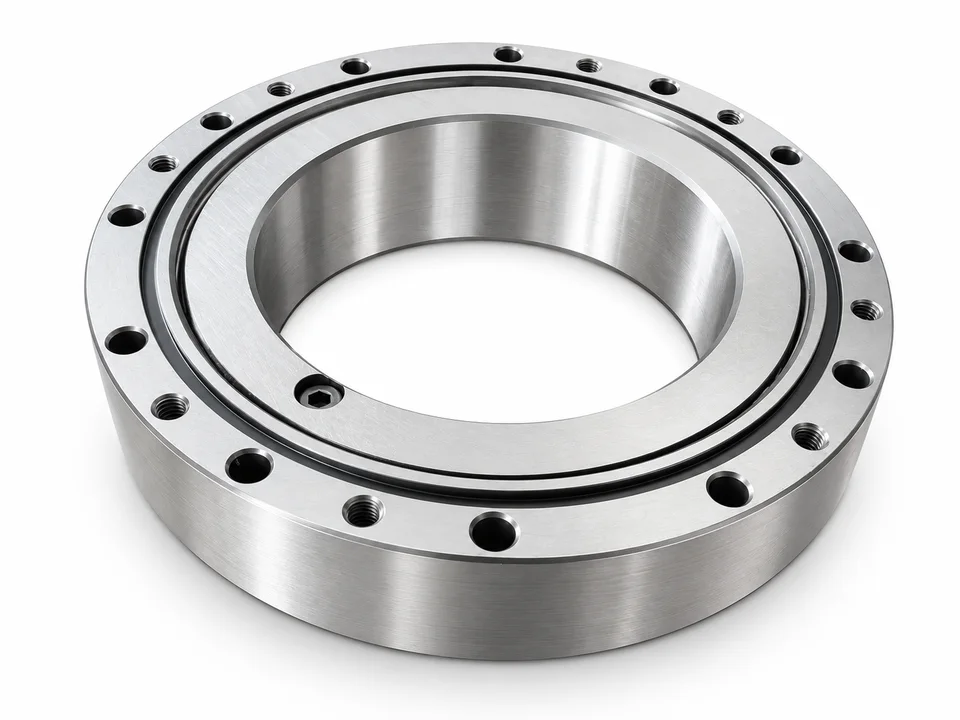
NLHB manufactures two output crossed-roller families in-house: SF (sizes 14–65, 8 sizes) and HF (sizes 14–50, 7 sizes). Orthogonal 90° cylindrical rollers resist radial, bidirectional axial, and arm overturning moments directly.
| Series | Sizes | Bore d (mm) |
OD D (mm) |
Width H (mm) |
Structural features | Typical joint use |
|---|---|---|---|---|---|---|
SF |
SF-14..SF-65 |
10–52 |
55–210 |
16.5–39 |
Stepped outer ring (H2/D1/D2), small bore, dual inner-ring M bolt circles (dn/dL) |
Cup/hat reducers and solid-shaft industrial robot wrists |
HF |
HF-14..HF-50 |
38–135 |
70–214 |
15.2–36 |
Large hollow through-bore, dual outer-ring hole sets (Φ + tapped opposite seal) |
Hollow cobot/humanoid joints routing cables, encoders, or air lines |
Representative NLHB output models show how ratings and integrated bolt circles scale:
- SF-14: d=11 (9) mm, D=55 mm, H/C/B = 16.5 / 16 / 13.5 mm, outer holes 8-Φ3.5 (dm=49 mm), inner 6-M4 & 6-M4 (M3), Cr=7 kN, Cor=9.1 kN.
- SF-25: d=20 mm, D=85 mm, H/C/B = 18.5 / 18 / 16.5 mm, outer 16-Φ3.5, inner 8-M8 & 8-M6, Cr=13.8 kN, Cor=21.6 kN.
- HF-17: d=47 mm, D=80 mm, H/C/B = 17 / 16 / 16.4 mm, outer 12-Φ3.5 + 4-M3 (10) tapped, inner 20-M3 (6) opposite seal, Cr=9.4 kN, Cor=16.1 kN.
- HF-25: d=68 mm, D=110 mm, H/C/B = 20.7 / 18.7 / 19.7 mm, outer 12-Φ4.5 + 4-M3 (6), inner 16-M4 (8) + 4-M3 (6), Cr=28.5 kN, Cor=45.2 kN.
Never order by reducer size alone: SF-14/40/50/65 have two bore options, and HF models vary in seal-side tapped holes. If your joint uses clamped rings instead of bolted flanges, compare RAU crossed roller bearings and our guide on robot joint bearings.
Verification checklist before production release
Send complete assembly requirements so NLHB confirms geometry and inspection agreements upfront:
1. PRZ flexible bearings: Reducer designation and ratio, cam ellipse drawing and fit, flexspline clearance, speed profile, grease, and both B and C widths.
2. SF / HF output bearings: Outline drawing showing H / C / B, step dimensions (D1/D2/d1/d2/d3/H2/B1), bolt circles (dm/dn/dL), through-holes and M3–M8 thread depth, seal side, and clamped rotation torque limit (typically verified after bolting onto a flat fixture).
Frequently asked questions
Does NLHB manufacture both PRZ flexible bearings and SF/HF output bearings in-house?
Yes. NLHB manufactures both PRZ thin-wall flexible wave-generator bearings and SF / HF output crossed-roller bearings in-house to approved reducer drawings and agreed inspection protocols.
Why do PRZ flexible bearings list unequal widths B and C?
B is the inner-ring width on the cam and C is the outer-ring width inside the flexspline. Because cam retention and flexspline load transfer differ across sizes, both B and C must be confirmed on quotes and samples.
Can a standard 6800 thin-section bearing replace a PRZ flexible bearing?
No. 6800 bearings are built to stay circular in rigid seats; elliptical cam flexing induces rapid bending fatigue, minor-axis ball pinch, and cage failure.
Can a PRZ bearing absorb small external axial or overturning loads?
No. PRZ bearings exist solely to transmit cam wave deformation; all external arm radial, thrust, and moment loads must go directly through the SF or HF output bearing.
How do I pick between SF and HF output bearings?
Use SF for solid-shaft or cup/hat reducers with stepped outer rings and 10–52 mm bores; use HF (38–135 mm bore) when motor power, encoder, or air lines must pass through a hollow joint shaft.
Sources and data boundary
All PRZ, SF, and HF model dimensions, bolt patterns, load ratings (Cr, Cor), and catalog operating columns come directly from NLHB product tables. Non-catalog steel hardness and clamped-torque check notes carry inline verification tags for confirmation on your reducer drawing.
- NLHB Bearings. Flexible Bearings for Harmonic Reducers (
PRZSize Chart). https://nlhb.net/products/flexible-bearings.html - NLHB Bearings. Harmonic Reducer Output Bearings (
SF&HFSize Chart). https://nlhb.net/products/harmonic-reducer-bearings.html - NLHB Bearings.
RAUThin-Section Crossed Roller Bearings. https://nlhb.net/products/crossed-roller-bearings.html - ISO 76 & ISO 281. Rolling bearings — static and dynamic load ratings and rating life.
Related guides
- PRZ flexible bearings for harmonic reducers
- SF and HF harmonic reducer output bearings
- RAU thin-section crossed roller bearings
- Robot joint bearings: RAU crossed-roller vs 3800 vs paired 7900
Ningbo Shuanghua Bearing (NLHB) manufactures PRZ flexible wave-generator bearings and SF / HF output crossed-roller bearings in-house in Cixi, China. Send your reducer drawing, cam profile, bolt pattern, and preload or torque target: request a quote.