The rotor of a galvanometer scanner is usually carried by a pair of miniature deep groove ball bearings. They do not rotate continuously; they oscillate through small angles at high frequency. In this duty each ball rolls over only a short patch of raceway, the lubricant film is slow to recover, and the raceway can develop oscillation marks. The marks, together with raceway waviness, make friction torque change with angle. The result is scan-line jitter that the servo loop cannot fully remove. This article summarises published test data, estimates the oscillation geometry of an MR63ZZ (3×6×2.5 mm), and lists what to control when specifying a bearing pair for a closed-loop galvo.
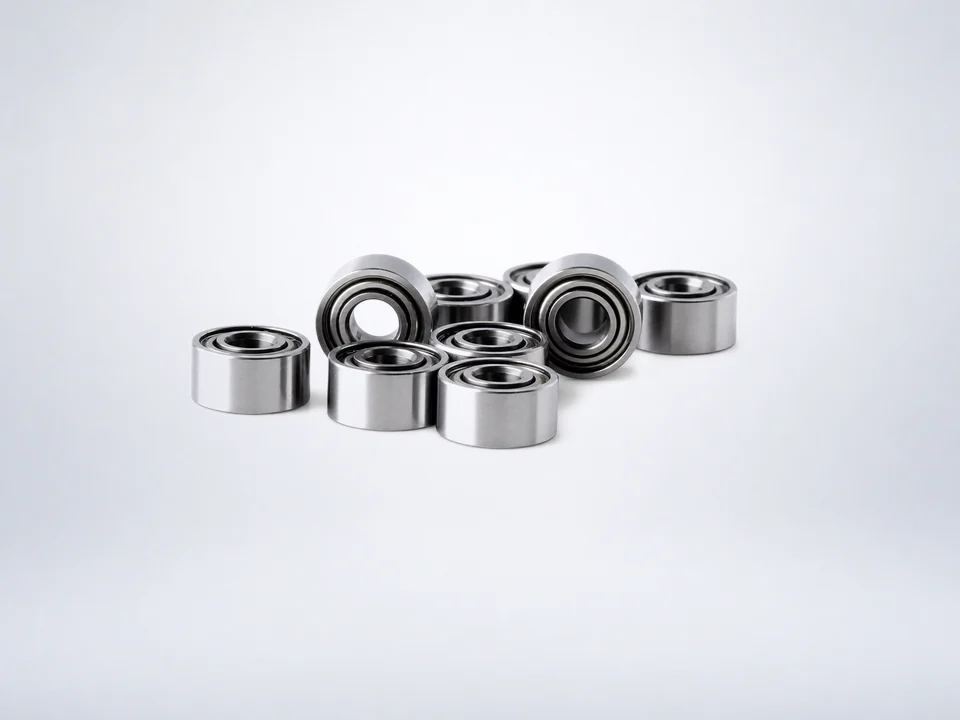
Small angles, high frequency, no full turn
A galvo bearing never sweeps its whole raceway. The same few patches carry every reversal. Torque uniformity over time matters more than the precision class on the label.
Abstract
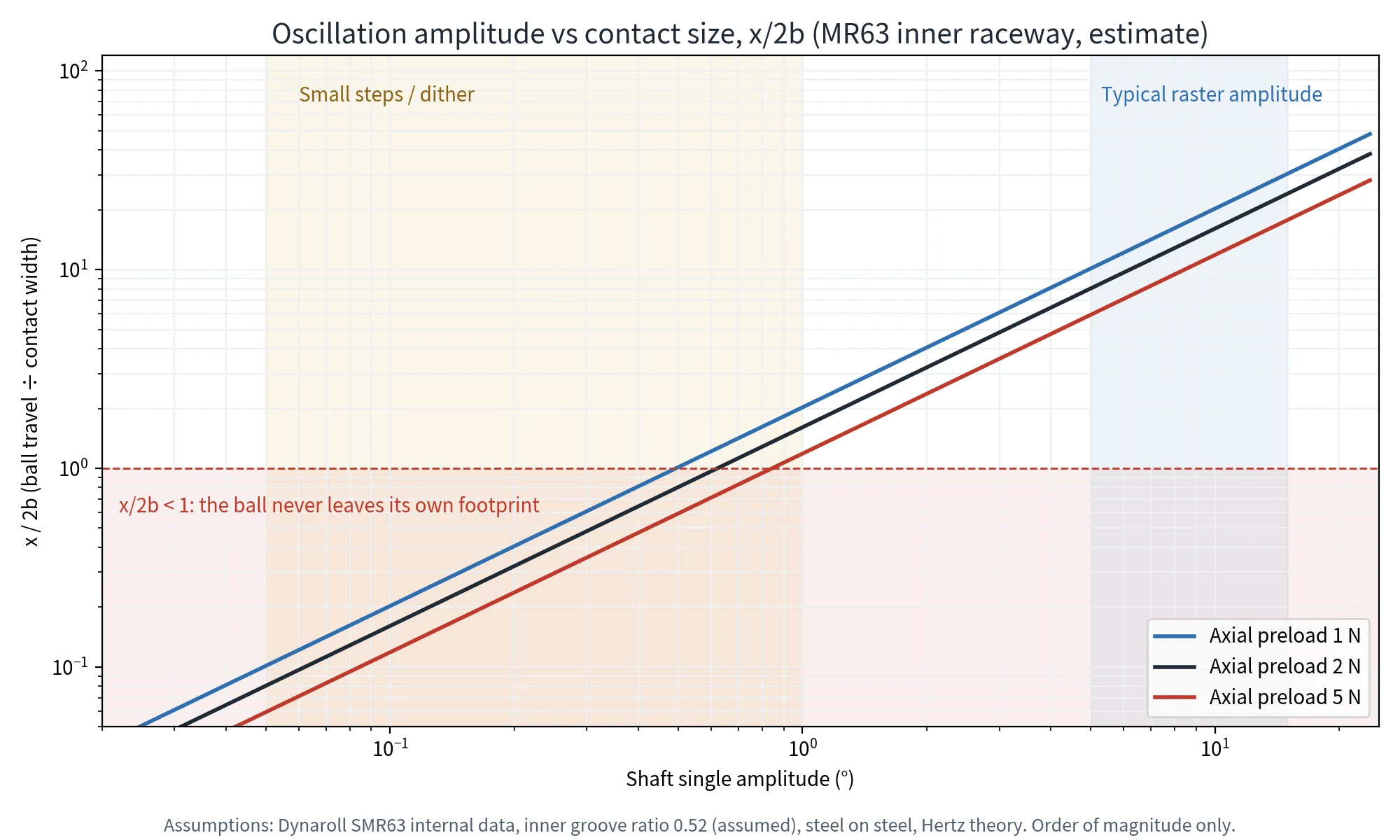
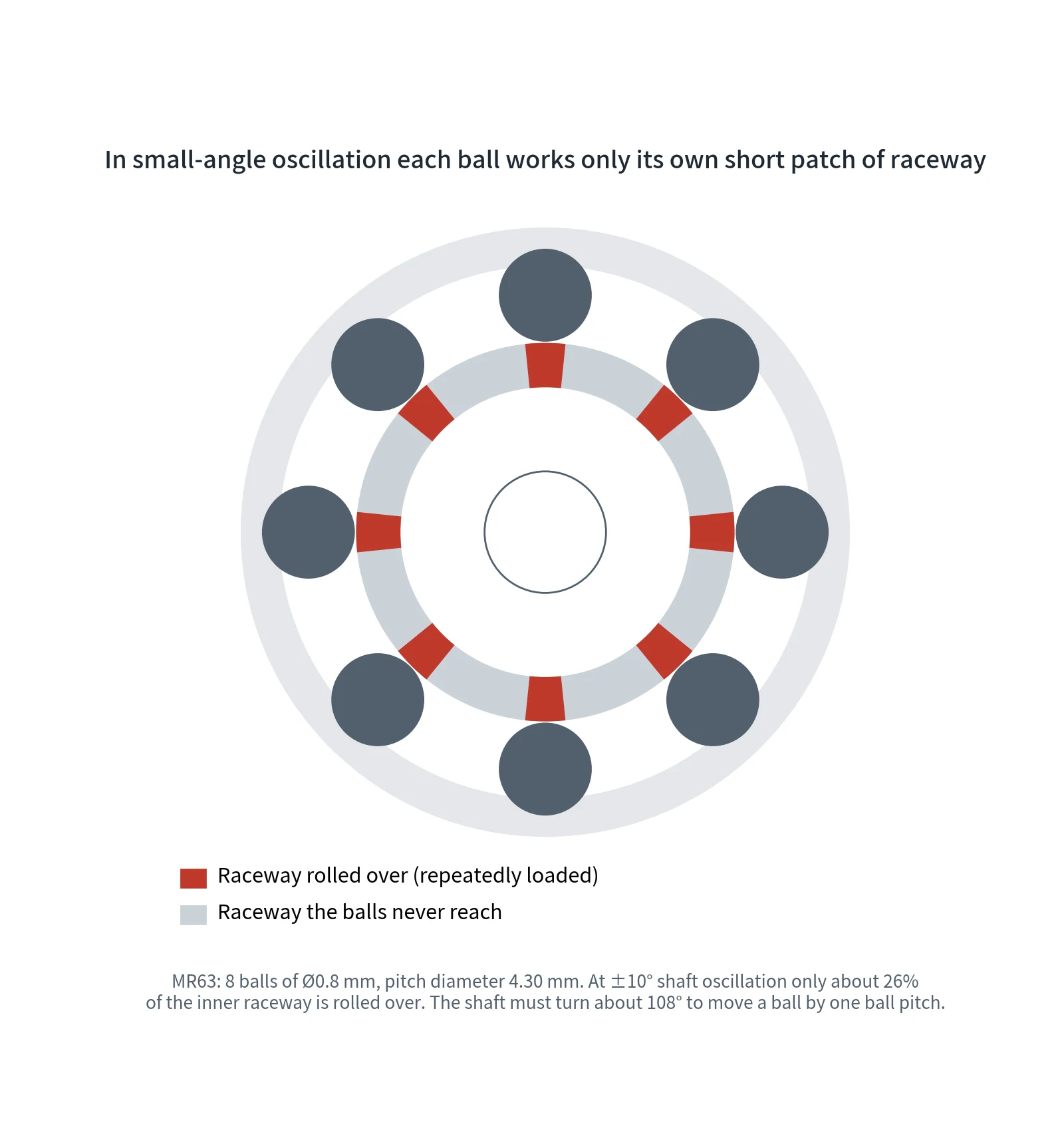
With 1–5 N axial preload, our Hertz estimate for an MR63 shows that a shaft amplitude below about 0.5°–0.8° does not move a ball out of its own contact footprint. At ±10° only about 26% of the inner raceway is rolled over . Published experiments show that wear depth and torque rise are closely linked, that lubrication is decisive, and that higher oscillation frequency causes more damage. Selection therefore has to treat raceway quality, balls, clearance and preload, cage, grease and pairing as one system, verified by low-speed torque traces and in-scanner tests.
1. Why galvo bearings are a special case
Galvo scanners steer the beam in laser marking, welding, additive manufacturing, ophthalmic OCT and confocal microscopy. A magnet rotor carries a mirror through small, fast moves, and a position detector closes the loop. One published 5 mm-mirror galvo from ISS lists 8 μrad maximum repeatability and 15 μrad/°C maximum zero drift . At this level any uneven bearing friction is a disturbance the controller must fight.
Two support concepts exist. SCANLAB and others use axially preloaded precision ball bearings for a backlash-free, stiff, low-friction rotor. Thorlabs also offers cross-flexure galvos and describes them as smoother than ball-bearing pivots. The flexure option shows that bearing torque disturbance in oscillation is a known problem that needs deliberate engineering.
2. Duty and failure mechanism
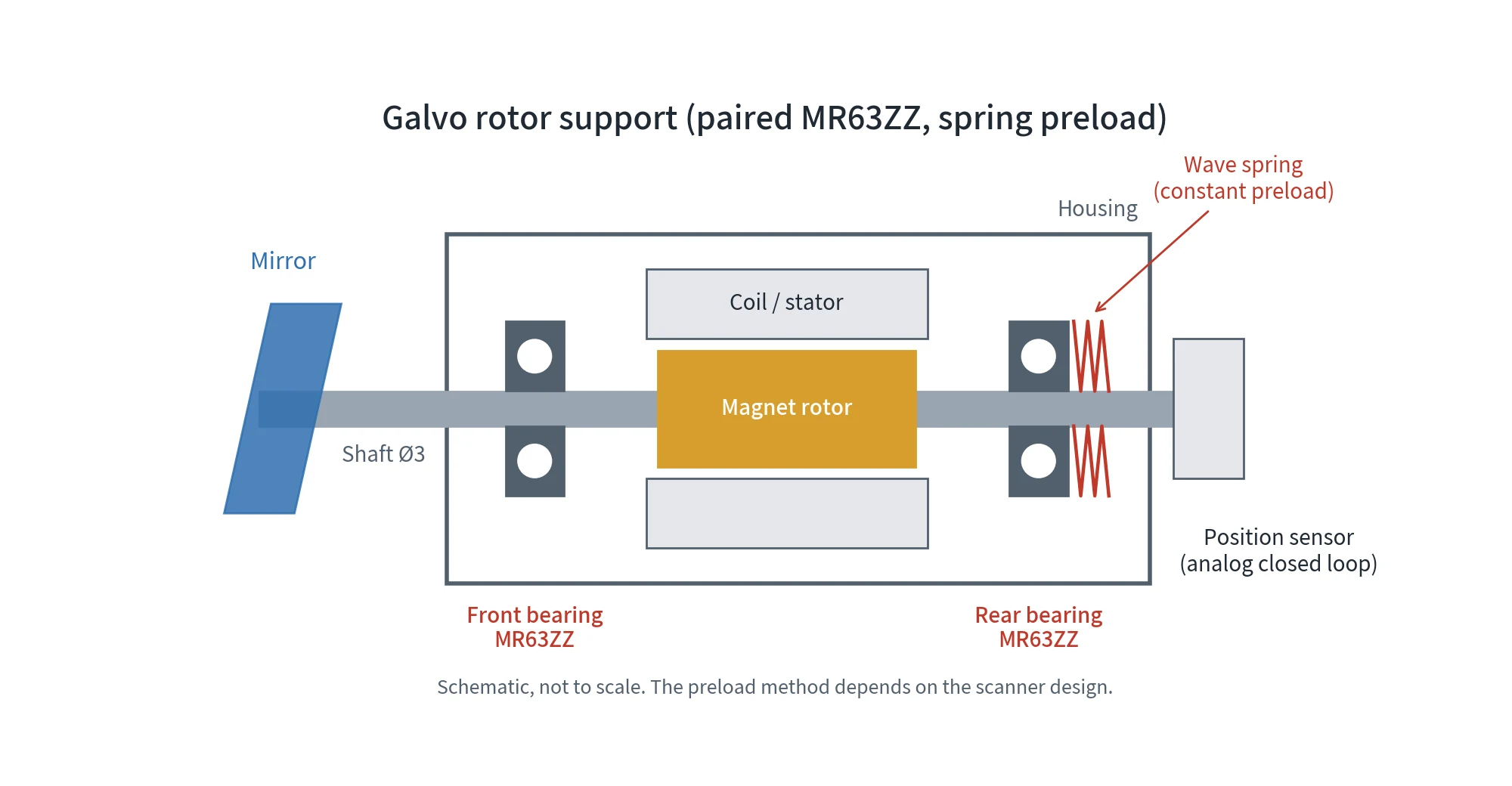
A miniature-bearing maker's preload guide describes two methods:
| Method | How | Advantage | Drawback |
|---|---|---|---|
| Fixed-position preload | Parts clamped in a fixed axial position | Simple, high stiffness | Thermal expansion and wear change the preload |
| Constant-pressure preload | Coil spring or wave washer applies the force | Preload stays stable over temperature | More parts, lower stiffness |
The coil heats the rotor and housing during operation, so constant-pressure preload keeps torque more stable.
How the balls move
- The ball centres turn by only (1−γ)/2 of the shaft angle, where γ = D·cosα / dp.
- The ball's travel x on the inner raceway is proportional to the shaft amplitude.
- If x is smaller than the contact width 2b, the ball never leaves the area it has already pressed.
The literature uses x/2b to separate damage regimes. At very small x/2b, standstill marks dominate. At larger x/2b, still short of one ball pitch, false brinelling and fretting wear dominate.
From oscillation marks to torque ripple
- Short strokes push grease out of the contact. It does not flow back quickly.
- Local metal contact starts fretting. Oxidised debris becomes an abrasive and speeds up wear.
- Shallow marks form on the raceway at ball spacing.
- Each time a ball crosses the edge of a mark, the torque steps.
- The steps sit at fixed angles. Following error grows there and the scan lines show regular jitter.
Even on a perfect raceway the torque is not constant in small oscillations. Using the Dahl friction model, Todd and Johnson showed that ball rolling and spin do not reach steady state, so torque follows a hysteresis loop whose size depends on amplitude. The servo can partly compensate this loop. Torque steps from oscillation marks grow over time, and the compensation falls behind.
3. Published test data
Only data with a clear published source are listed. Bearing sizes, loads and conditions differ widely; read the trends, not the absolute values.
| ID | Source | Test object | Key result |
|---|---|---|---|
| D1 | Bayer et al., Lubricants 2023 | Oscillating grease-lubricated bearings (81212, 7208, scaled blade bearings) | Maximum wear depth and torque rise nearly linearly related (citing Becker). Higher frequency gives more damage. Critical frequency for damage onset about 0.2–0.4 Hz (81212) and 0.8–1 Hz (7208) at the reported amplitudes. Amplitude effect not monotonic. |
| D2 | Friction, 2023 | Controlled oscillating rolling contact | Dry: false brinelling evolves into fretting corrosion; surface oxygen 2.50 → 21.22 wt%; residual stress 120 → 300 MPa. With grease, only surface deformation and roughness-level damage. |
| D3 | NMB (MinebeaMitsumi), galvo application note | Bearings in a 3D-printer galvo | Using hard disk drive pivot experience, a PFPE base oil eliminated oscillation marks on the raceways. |
| D4 | ESMATS 2026 | 6.35 mm OD hybrid miniature bearings | Dry running: pronounced torque fluctuation from cage instability. Oil lubrication: stable torque, minimal drift, reduced ripple. |
| D5 | NHBB, starting-torque table | Small inch instrument bearings, 75 g thrust load | Maximum starting torque 1,800 mg·mm with tight radial play (0.0001″–0.0003″), 1,500 normal, 1,400 loose (0.0005″–0.0008″). Less play, more starting torque. |
| D6 | MinebeaMitsumi, preload guide | Miniature and small ball bearings | Over 10,000 h noise life: average contact stress ≤ 800 MPa (preload ≈ 0.5–1% Cr). 5,000–10,000 h: ≈ 1,000 MPa (1–1.5% Cr). Under 5,000 h: ≈ 1,500 MPa (1.5–2% Cr). |
| D7 | SMB Bearings, cage guide | Miniature bearing cages | A PA66 crown cage slides better than steel and gives fewer running-torque fluctuations; it loses elasticity below about −30 °C. |
| D8 | Oscillating-bearing reviews and grease test methods | Greases for oscillating bearings | Consensus: low-viscosity base oil with low thickener content, so the grease behaves more like oil. |
Consistent trends
Wear and torque rise go together (D1). Lubrication decides the outcome (D2–D4, D8). Higher frequency is worse (D1) — galvo frequencies are far above the critical values found for larger bearings. Clearance and preload set the starting torque (D5, D6).
4. MR63ZZ oscillation geometry (estimate)
Internal data follow published SMR63 values [13]: 8 balls of Ø0.8 mm, 4.30 mm pitch diameter, 24.1° initial contact angle at MC5 clearance . The inner groove curvature ratio is assumed to be 0.52. The inner-race contact is calculated for steel on steel with Hertz theory and the Hamrock–Brewe approximations. This is a theoretical estimate, not a measurement.
| Axial preload | Load per ball | a | b (rolling) | Avg. contact stress | Max. contact stress | Amplitude where x = 2b |
|---|---|---|---|---|---|---|
| 1 N | 0.31 N | 42 μm | 4.5 μm | ≈ 520 MPa | ≈ 780 MPa | ≈ 0.49° |
| 2 N | 0.61 N | 52 μm | 5.7 μm | ≈ 660 MPa | ≈ 990 MPa | ≈ 0.62° |
| 5 N | 1.53 N | 71 μm | 7.7 μm | ≈ 890 MPa | ≈ 1,340 MPa | ≈ 0.84° |
Estimate by NLHB Engineering. Order of magnitude only.
What the numbers mean
- Small steps and dither fall in the x/2b < 1 region. During fine positioning, dither or idle, a ball can sit in the same contact area for long periods — the conditions for standstill marks.
- Normal raster amplitudes are far from one ball pitch. The ball pitch is 45°, so the shaft must turn about 108° to move a ball by one position. At ±10° the other 74% of the inner raceway never meets a ball, and the worked patches receive grease only slowly from their edges.
- More preload means wider contact and higher stress. D6 recommends average contact stress below about 800 MPa for long noise life. Here 1–2 N gives about 520–660 MPa and 5 N approaches 900 MPa. The preload window is narrow: calculate it, do not set it by feel.
5. Selection and process control
| Item | What to control | Basis |
|---|---|---|
| Material | Martensitic stainless rings and balls, so rust from storage or assembly does not become a torque point | Instrument-bearing practice |
| Precision | Raceway roundness and waviness, not only bore and OD tolerance | Section 2 |
| Balls | High ball grade, matched lot; evaluate ceramic balls where oscillation marks are critical | D2, D4 |
| Clearance and preload | Small clearance class plus axial preload; prefer constant-pressure preload; check contact stress | D5, D6, Section 4 |
| Cage | Steel crown cage as baseline; compare torque traces with a nylon crown cage | D4, D7 |
| Grease | Low-viscosity, low-thickener, anti-fretting grease; PFPE has a proven galvo case; small, controlled fill quantity and position | D1, D3, D8 |
| Pairing | Both bearings of one galvo from the same lot, matched for clearance and torque, packed as a pair | Section 2 |
| Cleanliness | Ultra-clean washing and clean assembly; grease vapour and particles can contaminate the mirror | Application practice |
| Shields | Check rotation of every bearing after ZZ shields are fitted; a bent shield causes intermittent torque spikes | Application practice |
Bearing makers also note that torque rises with grease quantity and at lower temperature, and that it fluctuates depending on whether grease on the cage bridges to the raceways. Grease quantity and position matter as much as grease type.
6. Verification plan
| Level | Test | Method | Acceptance |
|---|---|---|---|
| Incoming | Radial clearance, vibration, appearance | Clearance gauge; vibration tester; magnifier | Agreed clearance and vibration classes |
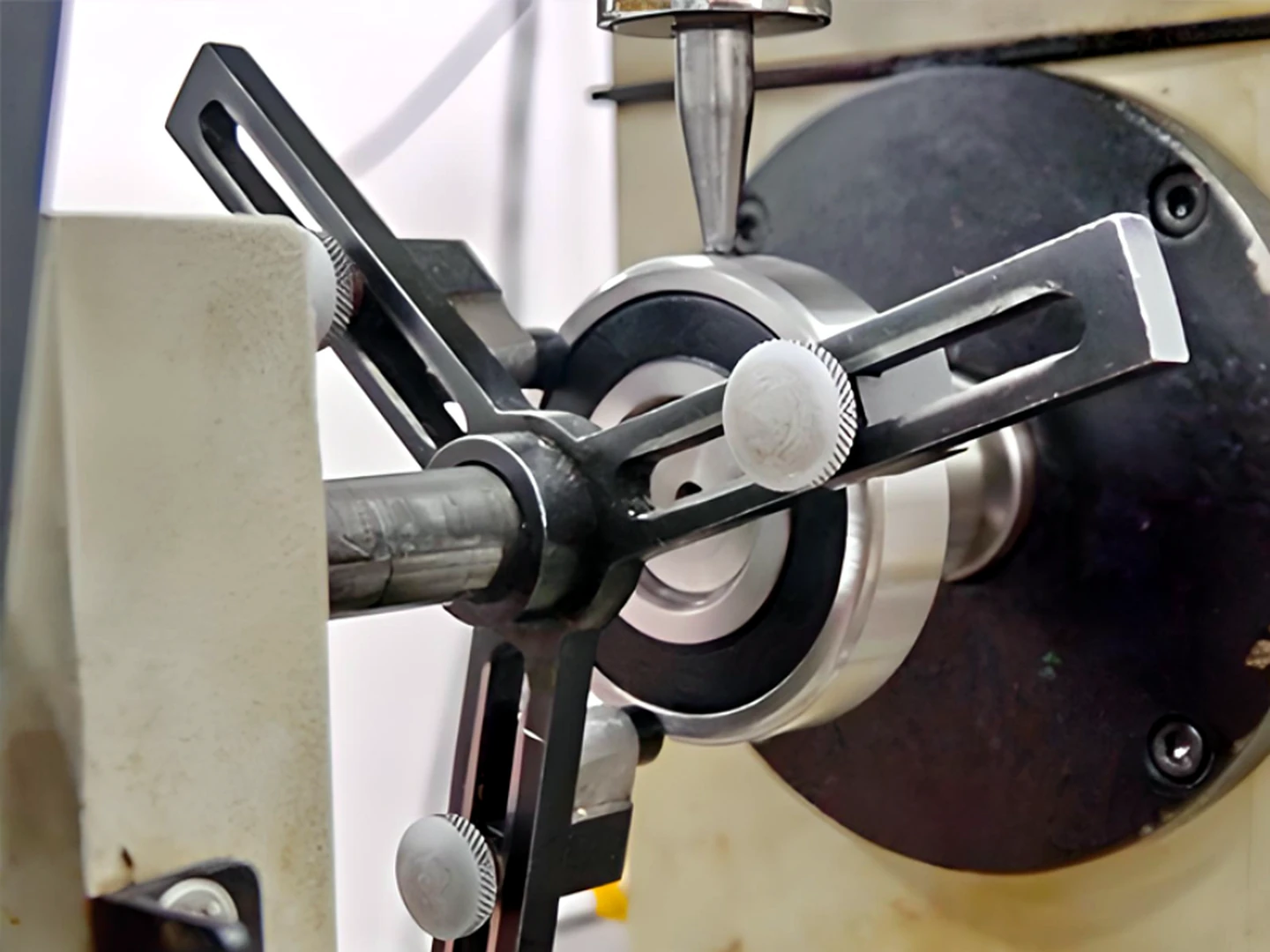
| Torque | Starting torque; low-speed running-torque trace | Low-speed micro-torque test at about 2 rpm, which reveals brinelling, contamination and lobing | Customer limits for level and ripple |
| In scanner | Torque or following error in oscillation; raceway inspection after an endurance run | Scanner test bench; microscope for oscillation marks | Scan-line quality; size and depth of marks |
For the grease itself, ask the grease supplier for standard fretting test results such as ASTM D4170 (Fafnir fretting wear test) .

7. Conclusions
- For galvo bearings the key property is uniform, stable friction torque, not only the precision class.
- Small galvo steps fall in the x/2b < 1 region, and normal raster amplitudes roll over only about a quarter of the MR63 inner raceway. The oscillation-mark risk is built into the duty.
- Published tests agree: oscillation wear and torque rise are linked, lubrication is decisive, and higher frequency causes more damage.
- Control raceway quality, ball matching, clearance and preload, cage, grease and pairing together, and verify with low-speed torque traces and in-scanner tests.
Specifying bearings for a galvo?
Send the oscillation angle and frequency, preload method and value, torque requirement, grease preference, operating temperature and annual quantity. We confirm precision, clearance, grease and pairing, and agree the inspection method before quoting.
Request a QuoteFAQ
Why do galvo scanner bearings cause scan-line jitter?
A galvo oscillates through small angles, so each ball rolls over only a short patch of raceway. Grease is pushed out and returns slowly, and oscillation marks form at ball spacing. When a ball crosses a mark the friction torque steps at a fixed angle, the following error grows there and the scan lines jitter.
What bearing size do small galvo scanners use?
Small-aperture galvos often use a pair of miniature deep groove ball bearings such as MR63ZZ (3×6×2.5 mm) on a 3 mm shaft. The scanner design sets the actual size, fits and preload.
Which grease is used for oscillating galvo bearings?
Published work favours low-viscosity base oils with low thickener content for oscillating bearings. A miniature-bearing maker has reported that a PFPE base oil eliminated oscillation marks in a galvo application. The grease type, fill quantity and fill position should be agreed with the scanner maker and verified by test.
How should galvo bearings be preloaded?
An axial preload removes play. Constant-pressure preload with a wave spring keeps torque more stable over temperature than fixed-position preload. For a bearing as small as MR63, calculate the preload against contact stress rather than setting it by feel.
Can NLHB supply paired MR63ZZ bearings for galvos?
Yes. Send the oscillation angle and frequency, preload method, torque requirement and grease preference. We confirm the precision, clearance, grease and pairing, and agree the inspection method before quoting.
References
- NMB (MinebeaMitsumi). Ball bearing solution for 3D printing galvanometer (application note). PDF
- ISS. Galvo-controlled scanning mirrors, specifications. Link
- SCANLAB. Galvanometer scanners. Link
- Thorlabs. Cross-flexure single-axis galvo systems. Link
- MinebeaMitsumi. Preload (miniature and small ball bearings). Link
- Bayer G. et al. Experimental investigations on wear in oscillating grease-lubricated rolling element bearings of different size and type. Lubricants 2023, 11(3), 120. Link
- Oscillating rolling element bearings: a review of tribotesting and analysis approaches. Tribology International, 2023. DOI
- Origin and evolution of false brinelling and fretting corrosion under rolling conditions. Friction, 2023. Link
- Todd M.J., Johnson K.L. Models for steady and nonsteady Coulomb torque in ball bearings. Link
- Development of a micro-torque measurement system for miniature bearings. ESMATS 2026. PDF
- NHBB. Starting and running torque. Link
- SMB Bearings. A guide to bearing retainers. Link
- Dynaroll. SMR63 specification. Link
- MinebeaMitsumi. Torque (miniature and small ball bearings). Link
- Dynaroll. MicroTorque ball bearing torque testing. Link
- Wikipedia. False brinelling (ASTM D4170 test). Link
Related guides
Published 2026-10-30. Test data are quoted from the cited publications; the MR63 geometry is an NLHB estimate, not a measurement. Final dimensions, grades, grease, preload and inspection limits are confirmed against the customer's drawing and order.