3D printers, camera gimbals and small motors use a handful of miniature bearing families: MR thin-section bearings, three-digit 6xx bearings such as the 60, 62, 68 and 69 series, and four-digit thin-section 68xx and 67xx bearings. Once you know how each family encodes size, a worn or unmarked bearing can be identified from three measurements. This guide explains the naming logic and the measuring procedure; for exact dimensions, use our size lookup page.
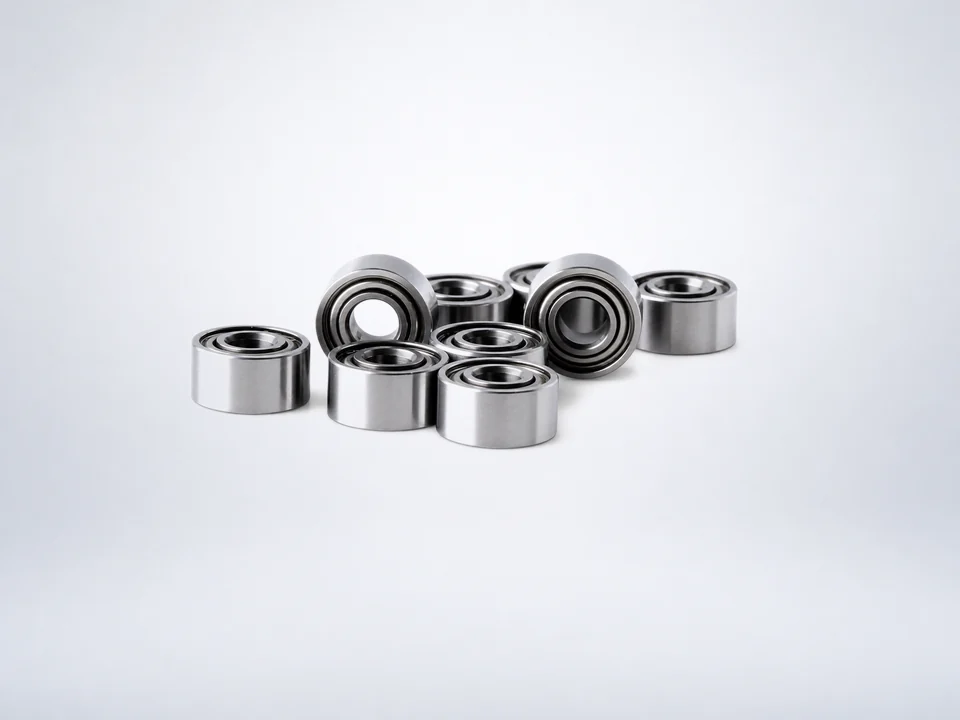
Three measurements identify most bearings
Bore (d), outside diameter (D) and width (B) define the boundary dimensions. The family, the suffix and whether it has a flange tell you the rest.
How the three families encode size
| Family | How to read it | Example | Where it is often found |
|---|---|---|---|
| MR (metric miniature) | MR + bore + OD in mm; width is not in the name | MR85: 5 mm bore, 8 mm OD | Extruder gears, small idlers, gimbal and micro-motor shafts |
| 6xx (60, 62, 63, 68, 69 series) | First digits = series (cross-section); last digit = bore in mm | 608: 8 mm bore, 60 series; 693: 3 mm bore, 69 series | Belt idlers, spool holders, small motors, fans |
| 68xx / 69xx / 67xx (thin-section) | Last two digits = bore code (00 = 10, 01 = 12, 02 = 15, 03 = 17, 04+ = code × 5) | 6802: 15 mm bore; 6805: 25 mm bore | Gimbal axes, rotary stages, hollow-shaft designs |
| Flanged versions (F, MF prefix) | Same logic plus a flange on the outer ring | F-, MF- versions of the families above | Idler pulleys and housings without a shoulder |
Within the same bore, the series number sets the cross-section. For example, a 68-series bearing is thinner and lighter than a 69-series bearing of the same bore, which in turn is thinner than a 60-series one. Width is not written in the MR designation, and some MR sizes exist in more than one width: MR85 is 2.0 mm wide open and 2.5 mm wide with ZZ shields. Always confirm width separately.
Where they are used
3D printers
Belt idler pulleys, extruder drive gears, lead-screw supports, spool holders and linear-motion carriages. Sizes differ between printer models and between original and upgrade parts.
Camera gimbals
Thin-section bearings on the pan, tilt and roll axes, where low friction, low axial and radial play and a large bore for cables matter.
Small motors
Brushless and DC micro motors use miniature bearings on the rotor shaft; noise grade, clearance and grease affect sound and temperature rise.
How to identify a bearing size
- Clean the bearing and read any marking on the ring or shield. The marking may include the designation and suffix.
- Measure the bore (d) with calipers or a pin gauge, at more than one position.
- Measure the outside diameter (D). For flanged bearings, also measure flange diameter and flange width.
- Measure the overall width (B), including shields or seals.
- Note the closure: open, ZZ metal shields, RS/2RS rubber seals.
- Compare the three dimensions against the bearing size chart and number lookup. If the values do not match a metric size, check inch series.
Common identification mistakes
- Measuring a worn bearing, or a bearing still on the shaft, and reading the wear or the shaft as the bore.
- Confusing metric and inch sizes. Some inch miniature bearings are close to metric sizes; measure to two decimals and compare both.
- Ignoring width: two bearings with the same bore and OD may differ in width, especially between open and shielded versions.
- Replacing only by size. Clearance, precision, noise grade, material and grease also change how a small motor or gimbal behaves.
Miniature bearings made in our own factory
All our miniature bearings are produced in house, with chrome or stainless steel rings, steel or silicon nitride ceramic balls, ZZ shields or rubber seals, and steel or nylon cages to customer requirement. NLHB manufactures miniature and deep groove ball bearings up to P4 precision, and double row angular contact bearings and track rollers up to P6.
Evidence from our workshop


What to send for a quotation
- Designation, or measured bore, OD and width.
- Closure: open, ZZ or 2RS; flanged or not.
- Material: chrome steel, stainless steel, ceramic balls.
- Precision, clearance and noise requirement, if any.
- Application: printer, gimbal or motor model; quantity.
Frequently Asked Questions
How do I read an MR bearing number?
MR is followed by the bore and the outside diameter in millimetres. MR85 is 5 mm bore and 8 mm OD. Width is not in the name and must be measured or looked up.
What does the last digit of 608 or 693 mean?
For three-digit miniature bearings with bores under 10 mm, the last digit is the bore in millimetres: 608 has an 8 mm bore and 693 has a 3 mm bore.
How do I read a 68xx bearing number?
The last two digits are a bore code: 00 = 10 mm, 01 = 12 mm, 02 = 15 mm, 03 = 17 mm, and from 04 upward the code multiplied by 5 gives the bore.
How do I find the size of an unmarked bearing?
Measure bore, outside diameter and width, note the closure and any flange, then compare with a size chart. Check inch sizes if the values do not match metric.
Can I replace a 3D printer bearing with any bearing of the same size?
Size fit is the first step. Clearance, closure, precision and grease also affect noise and play, especially in gimbals and small motors.
Related guides
Published 2026-09-25. Images show our own workshop and representative products. Final dimensions, grades, inspection limits and supply conditions are confirmed against the requested model, drawing and order.