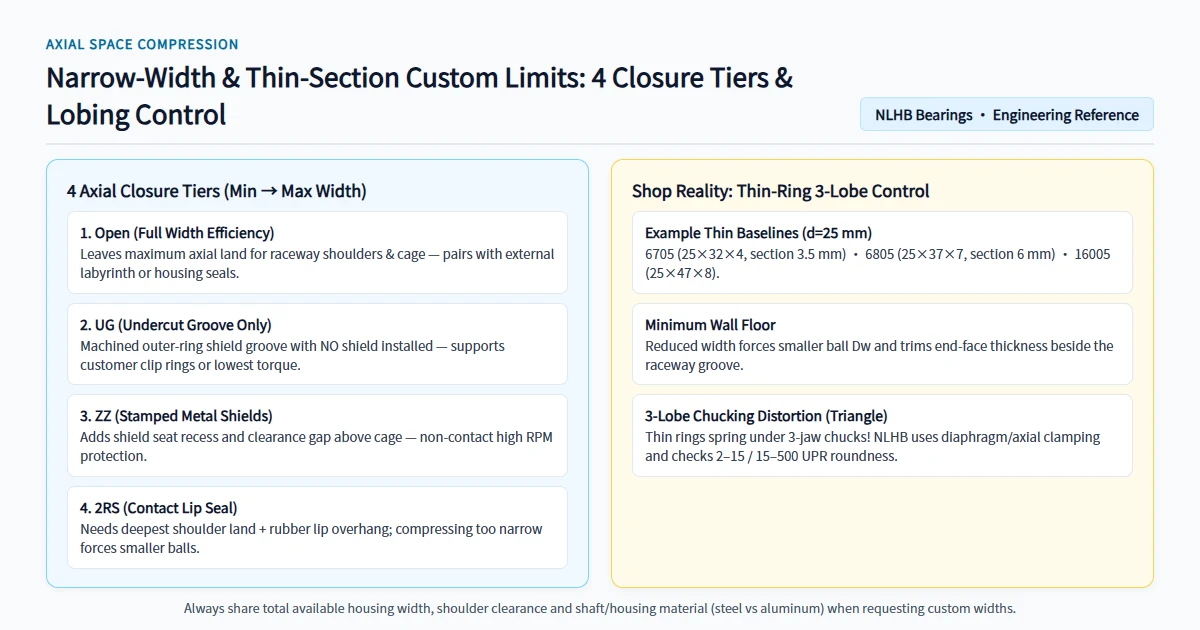
Short answer. When standard 6700 (4 mm wide at 25 mm bore), 6800 (7 mm), or 16000 (8 mm) bearings exceed tight axial space in robotic joints, encoders, or compact actuators, compressing width to 2.5–3.2 mm shrinks ball diameter Dw, raises Hertzian contact stress, thins groove-to-face lands, and dictates a closure step-down (Open → UG → ZZ → 2RS). On the shop floor, thin-ring roundness depends on replacing 3-jaw chucks with diaphragm or axial clamping and filtering 2–15 UPR vs 15–500 UPR harmonics.
When a housing bore matches 25 × 32 mm radially yet offers only 3.2 mm axially instead of 4.0 mm, engineers face a choice: shave width off the bearing or re-machine expensive mating housings. Knowing the geometric floors inside a thin-section ring prevents drawing an ungrindable part or specifying seals that rub the cage.
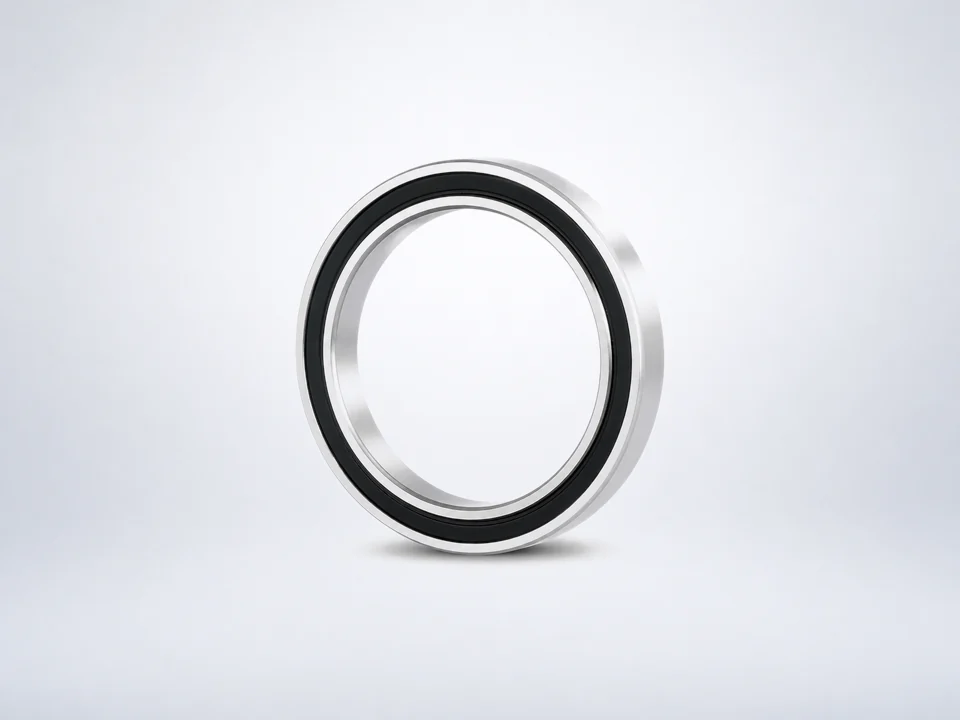
Standard thin-section baseline at 25 mm bore
Before specifying a custom narrow width, compare the four standard ISO series on our thin-section bearings catalog at a common 25 mm bore (section height = (D - d) / 2):
| Model | Series | d × D × B (mm) |
Section Height (mm) | Dynamic Rating C (N) |
Static Rating C0 (N) |
Standard Role |
|---|---|---|---|---|---|---|
6705 |
6700 |
25 × 32 × 4 |
3.5 |
1,100 |
840 |
Ultra-slim section & narrowest 4 mm width |
6805 |
6800 |
25 × 37 × 7 |
6.0 |
3,300 |
2,260 |
Baseline thin-section (Open, ZZ, 2RS, NR) |
6905 |
6900 |
25 × 42 × 9 |
8.5 |
5,330 |
3,380 |
Moderate-load compact section |
16005 |
16000 |
25 × 47 × 8 |
11.0 |
7,000 |
4,600 |
Ultra-narrow cousin of 6005 (25 × 47 × 12 mm) |
Compare 6805 (3,300 N) down to 6705 (1,100 N): cutting section height from 6.0 mm to 3.5 mm and width from 7 mm to 4 mm drops dynamic rating by two-thirds. Meanwhile 16005 keeps the 47 mm OD of 6005 while shaving 4 mm off width for applications with tight axial clearance and ample radial space. For bores below 10 mm, check our miniature bearings catalog (681–689, 691–699, and MR) before tooling custom sizes.
What breaks when compressing width from 4–7 mm down to 2.5–3.2 mm
In custom projects keeping a 25 × 32 mm radial footprint (6705 bore/OD) while compressing width B from 4.0 mm down to 3.2 mm (or reducing 4–7 mm designs into 2.5–3.2 mm), four physical bottlenecks occur simultaneously:
- Smaller ball diameter (
Dw) and higher Hertzian stress. Narrower rings shrink the raceway arc height and force smaller balls (for example, stepping down toward1.588 mmor1.2 mm), sharply reducingCandC0because capacity scales roughly withDw^1.8. - Thinner groove-to-face land. Hardened steel remaining between the raceway groove edge and ring end face must withstand heat-treat quench stress, double-disc face grinding, and light axial thrust without chipping. Once total width drops below
3.0 mm, even0.2–0.3 mmcorner chamfers consume a large fraction of the remaining outer land. - Tighter cage window clearance. Standard ribbon steel cages require axial room around the ball pocket for crimping tabs or rivets; below
3.2 mmwidth, snap-in crown cages dominate, yet still need spine thickness. - Smaller grease reservoir. Less internal volume raises torque sensitivity to grease fill and base-oil viscosity; review our starting and running torque guide when defining torque limits.
Four closure width tiers: Open, UG, ZZ, and 2RS
On ultra-narrow thin-section bearings, every closure tier claims axial space inside B:
| Closure Tier | Internal Feature | Axial Penalty vs Open | Running Drag | Best Fit |
|---|---|---|---|---|
Open |
No shield grooves or lips | 0 mm (minimum possible B) |
Lowest | Enclosed gearboxes, optical encoders, dry cavities |
UG |
Shield undercut groove machined, left open | Minimal (~0.3–0.6 mm groove recess) |
Same as Open |
Ultra-low-drag builds or customer retaining hardware |
ZZ |
Stamped metal shields in UG groove |
Medium (groove + shield-to-cage gap) | Low | Light dust protection where lip friction is unacceptable |
2RS |
Molded rubber contact seals | Largest (widest groove-to-cage & lip margin) | Highest | Dusty/wet duty—often forces wider B or external housing seals |
On narrow builds (B ≤ 3.5 mm), fitting 2RS seals inside the bearing forces undersized balls or causes seal-lip rub against the cage pocket. Specifying Open or UG bearings behind a lip or labyrinth seal built into the housing cover protects the bearing while keeping friction torque low.
Shop-floor thin-ring manufacturing: three-lobe distortion and roundness harmonics
Thin rings (3.5 mm radial wall on 6705, 6.0 mm on 6805) behave like flexible spring hoops during turning, heat treatment, and grinding.

At NLHB's Cixi factory, three shop-floor controls keep thin rings round:
- Three-lobe clamping distortion (
三角圆). Radial 3-jaw chucks pinch thin rings inward at three points; the grinder cuts a round bore under chuck load, and the ring springs into a three-lobed triangle once unclamped. Controlling geometry requires axial face clamping (magnetic chucks or face-clamping mandrels) and precision diaphragm chucks. - Harmonic filtering per ISO 12181. Two-point micrometers miss odd-lobe triangles (
constant-diameter Reuleaux shapes). Rotary roundness testing per ISO 12181 isolates low-band harmonics (2–15 UPR) from chucking or heat-treat warpage and mid-band waviness (15–500 UPR) from wheel chatter. - Housing roundness transfer. A thin ring mirrors its housing bore; check seat roundness and aluminum thermal expansion with our fit and tolerance calculator.
Custom thin-section quote checklist
Send these six items to our custom bearing solutions desk via request a quote:
- Envelope limits: Bore
d, maximum ODD, and hard ceiling for widthB. - Closure tier: Whether
Open/UGwith an external cover seal works, or ifZZ/2RSmust fit insideB. - Loads & speed: Radial load, thrust, oscillation angle (if any),
rpm, and torque ceiling. - Mating materials & fits: Steel vs aluminum housing, fit tolerances, and housing roundness.
- Precision & testing: Tolerance grade (
P0–P4for deep groove),UPRroundness targets, and noise limits. - Drawing or 3D envelope: CAD sketch showing adjacent shoulders or snap rings.
Frequently asked questions
How narrow can a custom thin-section ball bearing be built?
Depending on bore and radial section, open or UG custom designs can compress into the 2.5–3.2 mm range where loads allow smaller balls and crown cages. ZZ shields and 2RS seals require additional width.
What does UG mean on a narrow thin-section bearing?
UG means the outer-ring shield undercut groove (防尘盖卡槽) is machined, yet the bearing ships open without shields for minimal friction or customer retaining hardware.
Why does a micrometer show uniform OD while a thin-wall bearing binds in its housing?
Two-point micrometers miss three-lobe (3 UPR) clamping distortion because a three-lobe triangle reads constant diameter across angles. Only rotary roundness inspection reveals the lobing.
Can I put 2RS seals inside a 3 mm wide custom bearing?
Usually no without forcing undersized balls or risking lip-to-cage interference. Below 3.5 mm, housing-mounted seals paired with Open or UG bearings are safer.
How much capacity drops when downsizing from 6805 to 6705?
Dynamic rating falls 67%—from 3,300 N (6805) to 1,100 N (6705)—because section height shrinks from 6 mm to 3.5 mm.
Why does housing material matter more for thin-section bearings? Aluminum housings expand faster than steel bearings at temperature and print machining ovality straight onto the thin outer ring, shrinking clearance.
Sources and standards
- ISO 15 / GB/T 276 — Rolling bearings: Radial bearings, boundary dimensions, general plan.
- ISO 492 / GB/T 307.1 — Rolling bearings: Radial bearings, tolerances.
- ISO 12181-1 & ISO 12181-2 — Geometrical product specifications (GPS): Roundness and harmonic filtering.
- ISO 281 / GB/T 6391 — Rolling bearings: Dynamic load ratings and rating life.
- NLHB Thin-Section Catalog — Thin-Section Bearings 6700, 6800, 6900, 16000.