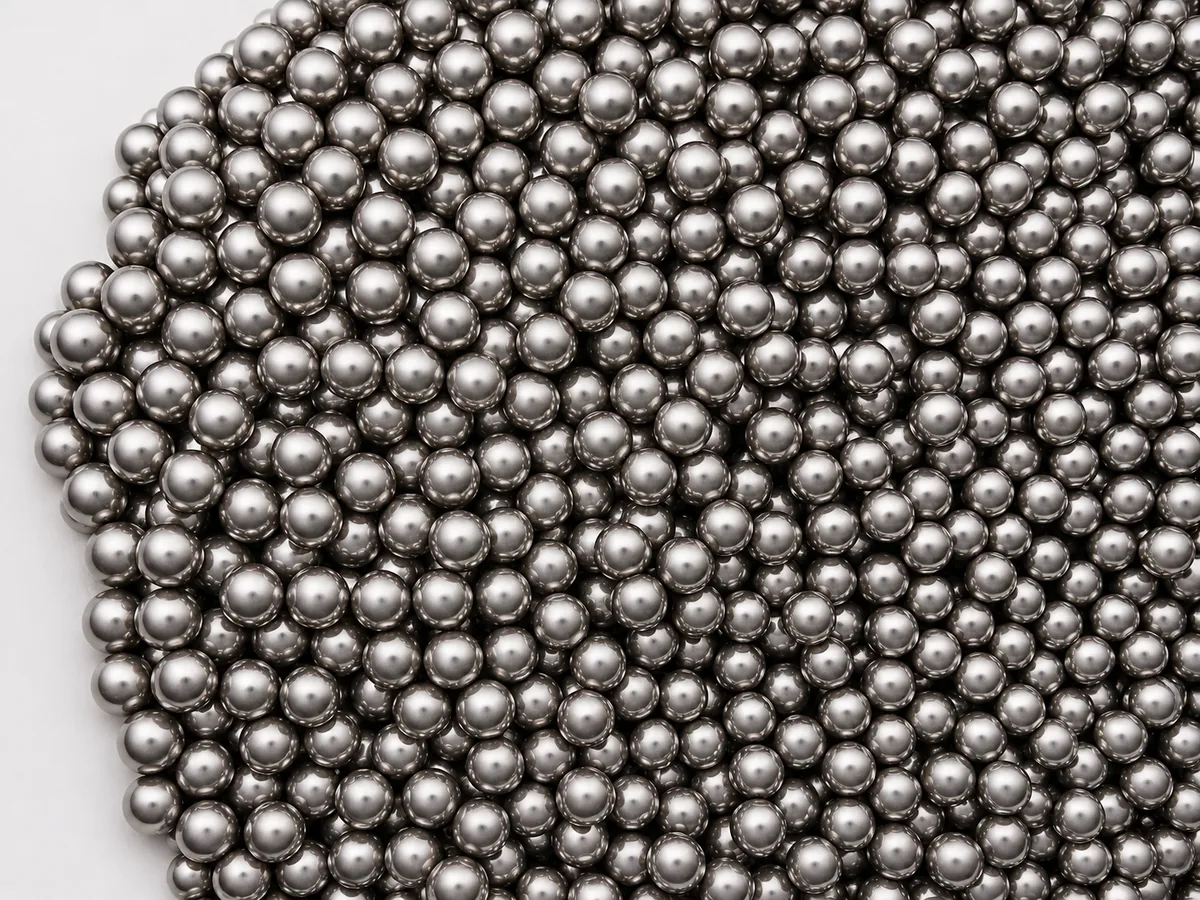
Chrome steel balls are the rolling elements of ball bearings, made from high-carbon chromium bearing steel. "Chrome" refers to the chromium in the steel, not to a chrome plating.
The Chinese grade GCr15 corresponds to AISI 52100, DIN 100Cr6 and JIS SUJ2. Ball precision is graded under ISO 3290-1:2014 or the Chinese GB/T 308.1-2013.
NLHB assembles bearings, so balls are a part we use every day. When we buy balls we look at three things: grade, gauge and surface quality. Each is explained below.
The lower the number after G, the more precise the ball. The grade sets four tolerances: ball diameter variation, deviation from spherical form, surface roughness, and lot diameter variation.
| Grade | Ball diameter variation µm | Spherical form deviation µm | Roughness Ra µm | Lot diameter variation µm |
|---|---|---|---|---|
| G5 | 0.13 | 0.13 | 0.014 | 0.25 |
| G10 | 0.25 | 0.25 | 0.020 | 0.50 |
| G16 | 0.40 | 0.40 | 0.025 | 0.80 |
| G20 | 0.50 | 0.50 | 0.032 | 1.00 |
The G10 row matches the specified values on the test report below.
G10 does not mean a diameter tolerance of ±10 µm. G10 and G16 balls can have exactly the same diameter; the difference is how round they are, how smooth they are, and how uniform the lot is. We normally supply G10 balls and can supply G5 balls to customer requirements. Less demanding applications can use G16 or G20.
This is the test report for one batch of GCr15 balls. Report date April 2026; size 7.9375 mm (5/16 in); material GCr15 / 100Cr6; grade G10Z4.
| Test item | Specified | Measured |
|---|---|---|
| Lot diameter variation VDwL | 0.50 µm | 0.11–0.12 µm |
| Ball diameter variation VDws and spherical form ΔSph | 0.25 µm | 0.066–0.074 µm |
| Surface roughness Ra | 0.020 µm | 0.004–0.005 µm |
| Surface roughness Ry | 0.16 µm | 0.04 µm |
| Microstructure: martensite | Graded | Grade 2 |
| Microstructure: troostite | Graded | None |
| Hardness | HRC 61–66 | HRC 64.2–65.2 |
| Hardness uniformity | — | 1 |
| Single-ball vibration | — | 25–26 dB per ball, 25.5 dB lot average |
| Crushing load | 32,830 N | ≥ 82,710 N |
| Acid etch inspection | Pass | Pass |
How to read it:
Every ball batch ships with a test report like this. The values apply to this batch only.
Balls of the same grade and nominal diameter still differ slightly in actual mean diameter. Ball makers sort them into size groups called gauges. Under ISO 3290-1, the preferred gauges for G10 balls run from −9 µm to +9 µm in 1 µm steps. The "±9" gauge field on the report above is this range, and this lot is marked ±8 µm.
Gauge sets the internal clearance of the assembled bearing. When the raceways are already ground, the assembler picks the gauge that brings the clearance into the target range. So when ordering balls, also state:
| Item | What to confirm |
|---|---|
| Material | GCr15 / 52100 with certificate; heat treatment to GB/T 34891 or JB/T 1255 |
| Hardness | Commonly HRC 61–66 (the specified value on the report above), or as agreed |
| Size | Nominal diameter (metric or inch), grade, gauge |
| Surface | No corrosion, scuffing or soft spots |
| Packing | Rust-preventive oil, bagged by gauge, label content |
For low-noise bearings, ball waviness and surface defects also matter; grade alone does not guarantee the bearing's noise level.
Most are GCr15 / 52100 high-carbon chromium bearing steel. 440C stainless steel is used where corrosion resistance is needed, and ceramic balls in more demanding applications.
The diameter can be the same. G10 allows at most 0.25 µm spherical form deviation and Ra 0.020 µm; G16 allows more on both. G10 is the usual choice for low-noise motor bearings.
The Z number is the ball vibration group. The Chinese industry standard JB/T 8923-2010 defines groups Z1, Z2 and Z3, where a higher number means lower vibration. Group codes beyond the standard follow the agreement between ball maker and user. It relates directly to bearing noise. Grade covers geometry, Z covers vibration, and gauge covers size; specify all three separately.
A common requirement is HRC 61–66. One batch of 7.9375 mm G10 balls measured HRC 64.2–65.2.
No. Chrome steel means chromium-alloyed bearing steel such as GCr15 / 52100; the whole ball is made of it.
No. G grades apply to balls only. Bearing classes such as P0, P6 and P5 (ABEC 1, 3, 5) apply to the dimensions and running accuracy of the complete bearing.