Short answer. On radial ball bearings, suffix N designates a machined outer-ring snap-ring groove only, while NR designates the groove plus its mating circular snap ring per ISO 464 (GB/T 305-2019). That locating collar lets designers machine straight-through cylindrical housings without internal retaining grooves or stepped shoulders—provided the housing bore corner chamfer stays tight and axial thrust stays within locating limits.
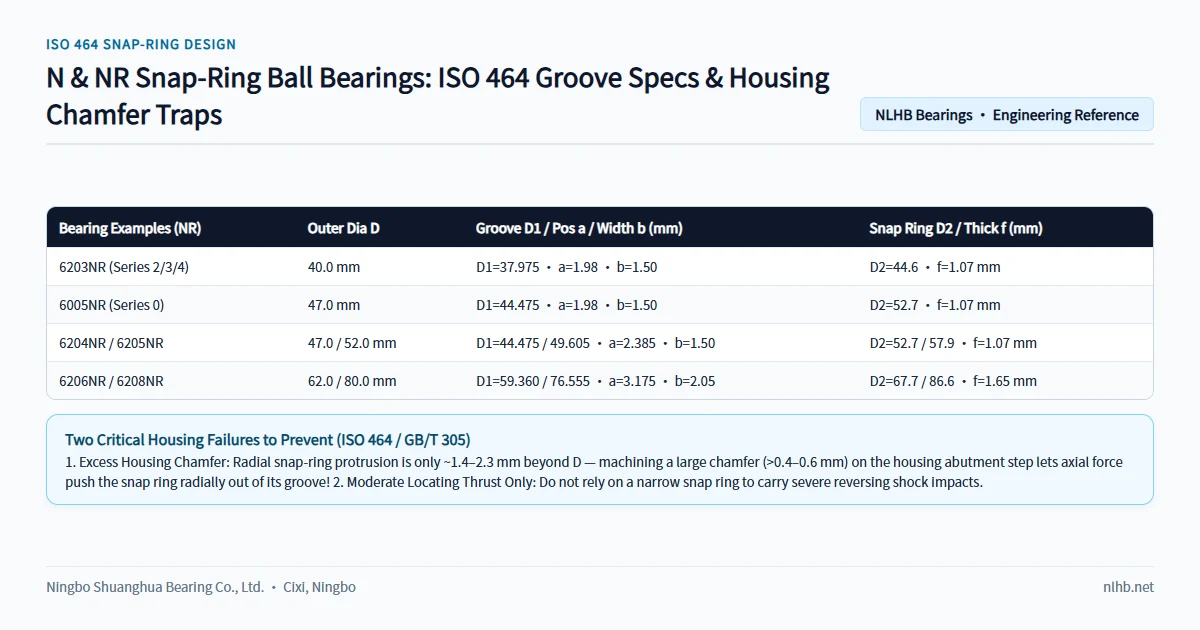
Compact gearboxes, conveyor rollers, electric motors, and agricultural bearings assemblies rely on NR bearings to align two housings in one line-boring pass. Yet two recurring field errors—an oversized housing edge chamfer and treating the snap ring as a heavy thrust shoulder—cause most snap-ring failures.
N vs. NR: why designers use outer-ring snap rings
Specifying the right suffix prevents missing retaining hardware at assembly:
Nsuffix (groove only): The outer ring has the turned groove (D1, widthb, setbacka, root radiusr0), with no snap ring supplied. Used when customers fit custom retaining plates or keys.NRsuffix (groove + fitted snap ring): Ships with its spring-steel snap ring perISO 464(GB/T 305-2019). Seated in a through-bored housing against an end cover, it acts as an external axial locating shoulder.- Closure combinations:
NandNRpair with shields or seals (6205-2RS-NR,6205-ZZ-N). On single-closure bearings (RSorZ), always state whether the groove sits on the closed or open face. See the bearing suffix guide for full code rules.
Verified ISO 464 / GB/T 305 groove & snap-ring dimensions
ISO 464 defines each groove and ring pair by D1 (groove bottom diameter), a (distance from reference face to groove edge), b (groove width), r0 (max groove corner radius), f (snap-ring axial thickness), and D2 (mounted snap-ring OD). Note that e in ISO 464 denotes snap-ring radial section width, whereas the minimum axial counterbore recess depth required to clear the mounted ring face is a + f plus tolerances.
| Bearing models (example) | Dia series | D (mm) |
D1 (mm) |
a (mm) |
b (mm) |
r0 max (mm) |
f (mm) |
a + f min recess (mm) |
D2 (mm) |
|---|---|---|---|---|---|---|---|---|---|
6904NR (19 series) |
19 | 37.0 | 35.55 | 1.625 | 1.075 | 0.25 | 0.80 | 2.425 | 39.8 |
6004NR (0 series) |
0 | 42.0 | 39.625 | 1.98 | 1.5 | 0.4 | 1.07 | 3.05 | 46.3 |
6005NR (0 series) |
0 | 47.0 | 44.475 | 1.98 | 1.5 | 0.4 | 1.07 | 3.05 | 52.7 |
6006NR (0 series) |
0 | 55.0 | 52.475 | 1.98 | 1.5 | 0.4 | 1.07 | 3.05 | 60.7 |
6007NR (0 series) |
0 | 62.0 | 59.36 | 1.98 | 2.05 | 0.6 | 1.65 | 3.63 | 67.7 |
6008NR (0 series) |
0 | 68.0 | 64.565 | 2.39 | 2.05 | 0.6 | 1.65 | 4.04 | 74.6 |
6010NR (0 series) |
0 | 80.0 | 76.555 | 2.39 | 2.05 | 0.6 | 1.65 | 4.04 | 86.6 |
For medium-light and medium series—detailed in our 6000, 6200 and 6300 size chart, 6200 series, and 6300 series—diameter series 2, 3, and 4 share common groove values at equal OD D:
| Bearing models (example) | Dia series | D (mm) |
D1 (mm) |
a (mm) |
b (mm) |
r0 max (mm) |
f (mm) |
a + f min recess (mm) |
D2 (mm) |
|---|---|---|---|---|---|---|---|---|---|
6203NR |
2/3/4 | 40.0 | 37.975 | 1.98 | 1.5 | 0.4 | 1.07 | 3.05 | 44.6 |
6204NR |
2/3/4 | 47.0 | 44.475 | 2.385 | 1.5 | 0.4 | 1.07 | 3.455 | 52.7 |
6205NR / 6304NR |
2/3/4 | 52.0 | 49.605 | 2.385 | 1.5 | 0.4 | 1.07 | 3.455 | 57.9 |
6206NR / 6305NR |
2/3/4 | 62.0 | 59.36 | 3.175 | 2.05 | 0.6 | 1.65 | 4.825 | 67.7 |
6207NR / 6306NR |
2/3/4 | 72.0 | 68.555 | 3.175 | 2.05 | 0.6 | 1.65 | 4.825 | 78.6 |
6208NR / 6307NR |
2/3/4 | 80.0 | 76.555 | 3.175 | 2.05 | 0.6 | 1.65 | 4.825 | 86.6 |
Even when outside diameters match, dimensions differ across series: in the 6000 series, 6005NR (D = 47 mm) uses a = 1.98 mm, while 6204NR (D = 47 mm) uses a = 2.385 mm. Never mix 60xxNR and 62xxNR axial locating pockets.
Failure mode 1: oversized housing bore chamfer
Radial projection beyond D, equal to (D2 − D) / 2, is small: only 1.40 mm on 6904NR (D = 37 mm), 2.15 mm on 6004NR (D = 42 mm), 2.30 mm on 6203NR (D = 40 mm), and 2.85–3.30 mm across D = 47–80 mm. With snap-ring axial thickness f at just 0.80–1.65 mm, a large 1.5–2.0 mm × 45° housing deburring chamfer eats away the flat seating land. Under axial load, the thin ring dishes into the bevel, climbs out of the D1 groove, and shears.
Keep the housing bore abutment corner chamfer tight—typically r max ≈ 0.4–0.6 mm per ISO 464 housing abutment guidelines—and check housing radial fit with the fit and tolerance calculator so loose bores do not sacrifice ring engagement.
Failure mode 2: excessive axial load and gap placement
With groove depth (D − D1) / 2 around 0.73–1.72 mm, an NR ring gives reliable locating restraint against moderate positioning thrust or belt pull, not heavy reversing shock loads:
- Avoid heavy reversing shock: Cyclic hammering across groove clearance (
b − f,0.275–0.43 mm) causes fretting and groove wall fatigue. - Keep the ring gap away from peak radial load: Do not align the split opening directly under the main radial load vector where edge stress concentrates.
- Size cover counterbores properly: Make the end-cap bore larger than expanded
D2and axial pocket depth≥ a + f.
Quote checklist for N and NR bearings
Before requesting quotes, confirm: (1) N vs. NR, (2) shipping pre-mounted vs. loose, (3) groove side relative to any single seal/shield, (4) cover counterbore diameter (> expanded D2) and depth (≥ a + f), and (5) axial load, speed, and housing tolerance.
Frequently asked questions
What is the difference between bearing suffix N and NR?
N means the outer ring has a snap-ring groove only. NR means the outer ring includes both the groove and its circular snap ring per ISO 464 (GB/T 305-2019).
Why did an NR snap ring pop out or dish under axial load?
Usually because the housing bore corner chamfer was too large. Because the ring projects only 1.4–3.3 mm radially past D across 37–80 mm sizes (f = 0.80–1.65 mm), a wide bevel removes its flat seat and lets it dish out of the groove.
Can I swap a 6005NR and 6204NR because both have D = 47 mm?
No. 6005NR has a 25 mm bore and groove setback a = 1.98 mm, whereas 6204NR has a 20 mm bore, 14 mm width, and a = 2.385 mm.
How deep must the housing end-cap counterbore be for an NR bearing?
The axial pocket clearing the mounted snap ring must be at least a + f plus tolerances, with a bore diameter clearing expanded D2.
Are NR snap rings suitable for heavy reversing axial shock?
No. NR bearings handle moderate axial locating loads. Heavy reversing impact requires a solid stepped housing shoulder or bolted retaining flange.
Can NLHB supply custom groove positions or pre-mounted snap rings?
Yes. NLHB manufactures standard ISO 464 N and NR bearings and custom groove widths/positions to drawing, shipped pre-mounted or with rings packed loose.
Sources and data boundary
Dimensions above come from our verified ISO 464 / GB/T 305-2019 dataset. Verify individual groove tolerances, expanded ring diameters, and housing chamfer limits against the standard before freezing housing CAD.
- ISO 464, Rolling bearings — Radial bearings with locating snap ring.
- GB/T 305-2019, Rolling bearings — Radial bearings with locating snap ring.
- ISO 15, Rolling bearings — Radial bearings — Boundary dimensions.
Related guides
- 6000, 6200 and 6300 deep groove ball bearing size chart
- 6000 series size chart
- 6200 series size chart
- 6300 series size chart
- Agricultural bearings range
- Bearing suffix guide
- Fit and tolerance calculator
Send your bearing number, housing chamfer, counterbore depth, and axial load details to confirm N or NR specification before ordering samples: request a quote.