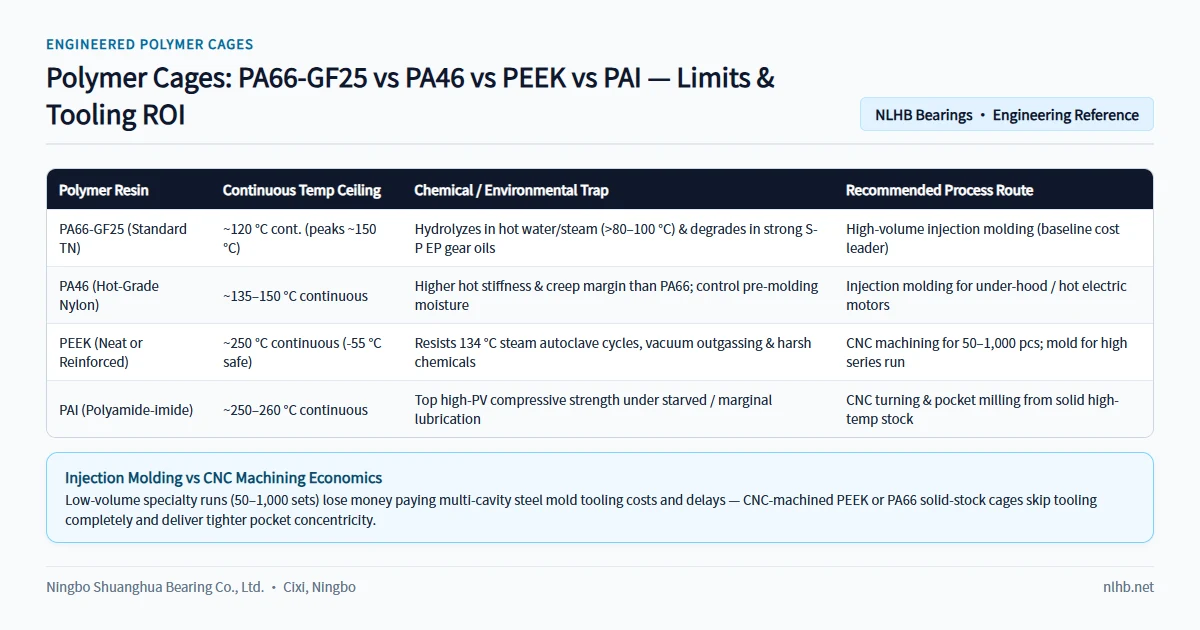
Short answer. Choose PA66-GF25 for cost-effective electric motors and appliances up to about 120 °C, step up to PA46 when continuous motor heat or creep pushes past 120 °C toward 135–150 °C, and switch to PEEK or PAI for 250 °C-class service, 134 °C steam sterilization, vacuum outgassing, or boundary-lubricated high speeds. For 50–1,000 piece pilot runs or specialized pitch diameters, CNC machining polymer bar or tube avoids $3k–$8k multi-cavity injection mold tooling until annual volume scales above 10,000+ pieces.
Choosing between polymer and metal is only the first filter—covered in our pressed steel vs nylon vs machined cage guide. Once an application calls for an engineering plastic retainer, picking the wrong polymer family or overlooking chemical and moisture boundaries causes pocket cracking long before steel raceways fatigue.
PA66-GF25 vs PA46 vs PEEK vs PAI Comparison
As detailed on our polymer bearing cages hub, NLHB supplies cages across four engineering polymers. Never confuse resin melting point or heat-deflection temperature (HDT) with a cage's continuous operating ceiling: unfilled, 30% glass-filled, and 30% carbon-filled PEEK share a 343 °C melting point while exhibiting HDT ratings around 152 °C, 328 °C, and 336 °C respectively—yet real cage limits depend on oil chemistry, centrifugal stress, and duration.
| Polymer Material | Typical Color & Code | Continuous Operating Ceiling | Sub-Zero & Steam/Moisture Behavior | Chemical & Lubricant Traps | Primary Manufacturing & Duty |
|---|---|---|---|---|---|
PA66-GF25 (25% glass-fiber reinforced polyamide 66) |
Black or natural (TN / TNH) |
~120 °C continuous (~150 °C brief peaks) |
Embrittles in extreme sub-zero unless stabilized; hydrolyzes & embrittles in continuous hot water/steam >80–100 °C |
Degrades rapidly in automotive/industrial gear oils with high sulfur/phosphorus EP additives above 100 °C |
High-volume injection molding; motors, fans, appliances |
PA46 (polyamide 46) |
Brown or black | ~135–150 °C continuous (higher hot-stiffness & creep margin than PA66) |
Slightly higher equilibrium moisture uptake than PA66 dry baseline — requires pre-conditioning/drying control |
Better grease-aging retention in hot auxiliary motors; still check aggressive EP gear oils | Injection molding; automotive under-hood auxiliaries, hot motors |
PEEK (neat, GF, or CF) |
Beige/natural or black | ~250 °C continuous |
Resists 134 °C steam autoclave sterilization cycles; retains toughness down to cryogenic -55 °C |
Broad chemical resistance; ultra-low outgassing in vacuum | Molded at volume or CNC-machined for medical, semiconductor, vacuum, chemical pumps |
PAI (polyamide-imide) |
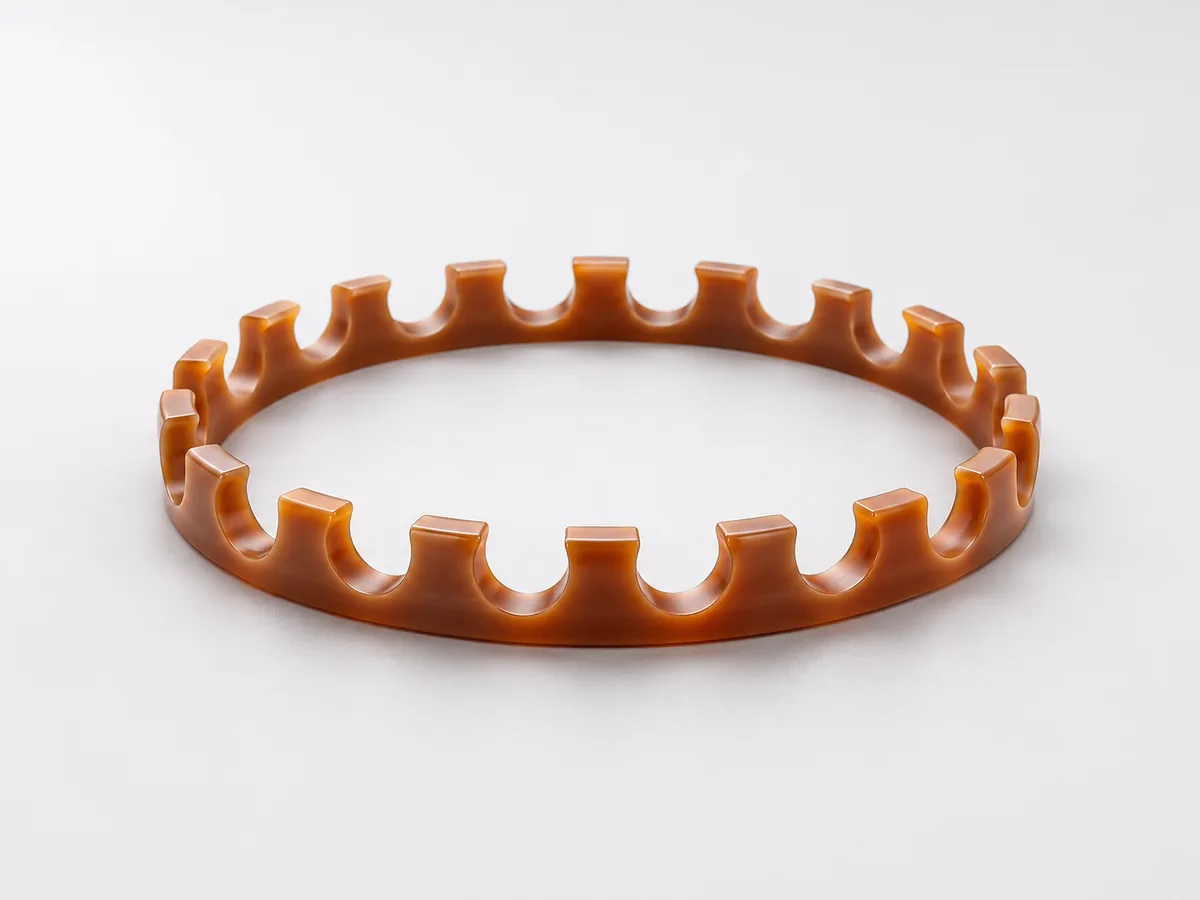
Amber | ~250–260 °C continuous |
High dimensional stability at elevated heat; verify moisture pre-bake before precision machining | Top compressive strength & PV wear resistance at elevated speed and marginal/boundary lubrication |
Precision CNC machining; aerospace actuators, high-speed spindles, dry/starved instruments |
Critical Chemical, Moisture & Temperature Traps
Three failure patterns repeatedly trip up buyers substituting polymer cages without checking fluid and thermal boundaries:
- Hot water, steam, and caustic washdown. Standard
PA66-GF25absorbs water and undergoes irreversible molecular chain hydrolysis when exposed continuously to hot water or steam above80–100 °C, causing crown fingers to snap during operation. Medical autoclaves (134 °Csteam) and hot chemical washdown lines requirePEEKor stainless cages rather than standard polyamide. - High sulfur/phosphorus EP gear oils. Automotive transmission fluids and industrial extreme-pressure (
EP) gear oils containing active sulfur/phosphorus additives chemically attackPA66polymer chains above roughly100 °C. Always check oil additive chemistry alongside operating temperature; for wider thermal specification steps, review our high-temperature bearing specification guide. - Moisture conditioning in
PA46andPA66. Bone-dry freshly molded polyamide cages are stiff and brittle; controlled moisture conditioning restores pocket flexibility for snap-in ball assembly while setting final pitch diameter stability. Uncontrolled drying or wet storage shifts pocket clearance.
Crown Snap-In vs Solid Window Cage Geometry
Pocket geometry interacts directly with bearing type, ball insertion, and speed dynamics:
- Crown snap-in cages (
冠形保持架): Open on one axial side so steel or ceramic balls snap directly past elastic pocket prongs during assembly. Ideal for deep groove and select single-row angular contact bearings; lowers assembly labor and suits multi-cavity injection molding. - Solid window (full-type) cages (
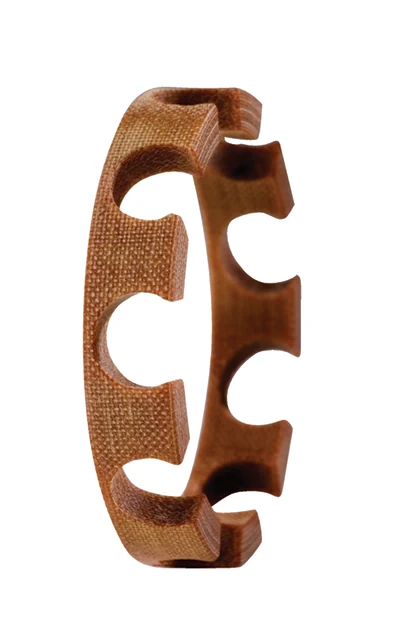
实体窗式): Closed rings on both axial flanks with machined or two-piece window pockets. Offers higher radial/circumferential stiffness against centrifugal bursting, superior ball-pocket or ring-land guidance (inner-ring or outer-ring guided), and tighter dynamic balance at highdNspeeds.
Injection Molding vs CNC Machining: The Economic Break-Even
Should you cut a new injection mold or CNC-machine cages from solid polymer rod or tube? The answer rests on annual volume, resin melt viscosity, and pitch-diameter flexibility:
| Decision Factor | Multi-Cavity Injection Molding | CNC Turning & Milling (Rod / Tube Stock) |
|---|---|---|
| Economic volume zone | High annual volume (10,000+ pcs) where amortized tooling drops unit piece cost |
Precision pilot or low-volume runs (50–1,000 pcs) before committing to hard tooling |
| Upfront tooling & schedule | Requires dedicated precision mold tooling (~$3,000–$8,000 range depending on cavities and high-temp runner design) plus mold trial cycles |
Zero mold tooling fee and zero mold wait; direct CAD-to-CAM machining from PEEK, PAI, or PA66 stock |
| Design & pitch flexibility | Locked to mold pitch diameter, ball count, and pocket geometry (note NLHB already holds 1,800+ existing deep groove cage moulds covering 2.6–110+ mm pitch diameters) |
Handles odd ball counts, custom non-standard pitch diameters, and rapid engineering revisions |
| Resin processability | Best for PA66-GF25, PA46, and moldable PEEK; hard or impractical for ultra-viscous/thermoset-like PAI |
Essential for PAI and specialty PEEK grades too viscous or specialized to mold economically in small batches |
Before paying for new mold steel on a deep groove ball bearing cage, check whether an existing mould matches your ball diameter, ball count, and pitch circle through our bearing components catalog and polymer cages size chart.
Frequently asked questions
What is the continuous temperature limit of a PA66-GF25 bearing cage?
Most PA66-GF25 cages carry a continuous operating ceiling around 120 °C with brief peaks near 150 °C in compatible greases. However, continuous hot water, steam above 80–100 °C, or sulfur/phosphorus EP gear oils above 100 °C lower that usable limit sharply.
When should I upgrade from PA66 to PA46?
Upgrade to PA46 when motor or under-hood auxiliary operating temperatures hover around 120–150 °C, where PA66 softens and loses pocket stiffness against ball centrifugal forces, and when PA46 grease compatibility is confirmed.
Why choose PEEK instead of PA46 for bearing cages?
PEEK withstands continuous ~250 °C heat, repeated 134 °C steam autoclave sterilization cycles, aggressive chemical media, ultra-low vacuum outgassing, and remains tough down to cryogenic -55 °C.
How is PAI different from PEEK in high-speed cages?
PAI reaches roughly 250–260 °C continuous thermal resistance and offers higher compressive strength and PV wear resistance under marginal or boundary lubrication at elevated speeds, typically supplied as precision CNC-machined cages.
At what volume does CNC machining polymer cages beat injection molding?
For 50–1,000 piece pilot batches, non-standard pitch diameters, or viscous resins like PAI, CNC machining from rod or tube eliminates $3k–$8k tooling costs and mold cycles. Multi-cavity injection molding pays back once annual demand reaches 10,000+ parts.
Does melting point or HDT tell me the safe operating temperature of a polymer cage?
No. A polymer's 343 °C melting point or short-term HDT test value is much higher than the continuous mechanical operating limit of a thin-walled bearing cage exposed to lubricant chemistry and centrifugal load.
Sources and Data Boundary
- NLHB Polymer Bearing Cages Catalog & Size Chart (
1,800+existing deep groove cage moulds,PA66-GF25,PA46,PEEK,PAI) — polymer-cages. - ISO 75 / ASTM D648 — Plastics: Determination of temperature of deflection under load (
HDTvs continuous cage service boundary). - Polymer resin manufacturer thermal-aging, steam-hydrolysis (
134 °Cautoclave), and extreme-pressure lubricant compatibility data boundaries.
Need standard moulded polyamide cages from existing tooling or CNC-machined PEEK / PAI retainers to drawing? Send your ball diameter, ball count, pitch circle, temperature, and lubricant details to request a quote.