Short answer. An extended inner ring ball bearing integrates the axial spacer directly into the inner ring (B1 > B, or B > C in pulley notation), letting bolts or retaining rings clamp squarely without loose washers. This stops washer cocking that pinches 2RS seals, shortens tolerance stack-up, and removes dropped parts.
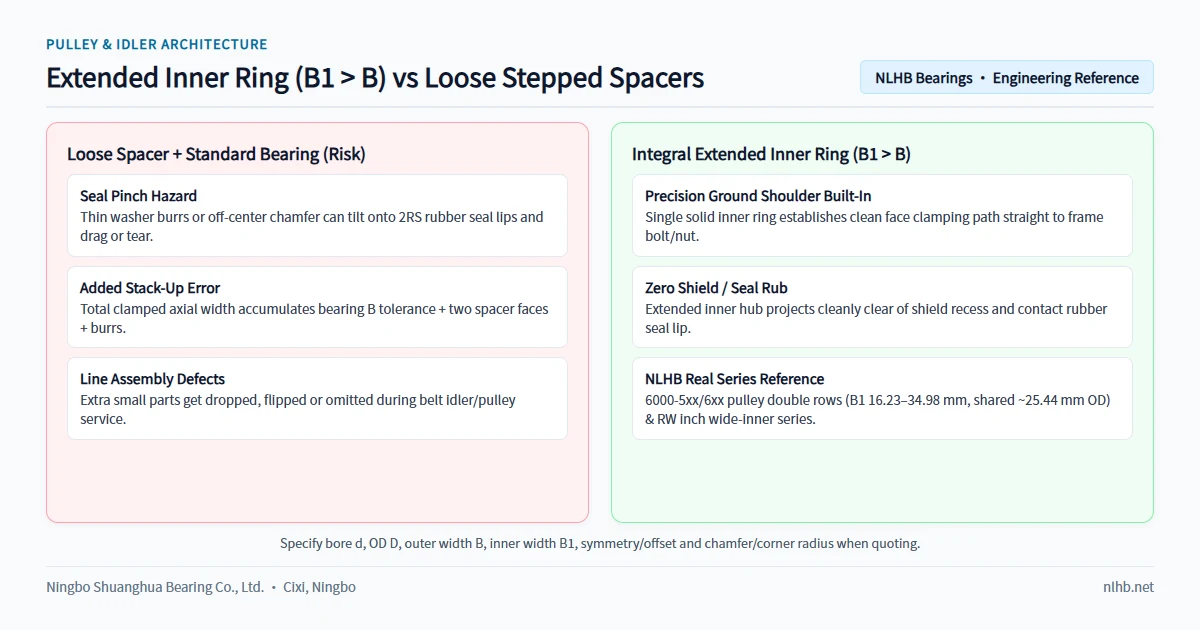
In mower deck idlers, tensioners, conveyor rollers, and miniature shafts, flat washers keep rotating pulleys clear of brackets. One extended inner ring turns that three-piece joint into a single drop-in component.
Why integral inner-ring extensions outperform loose spacers
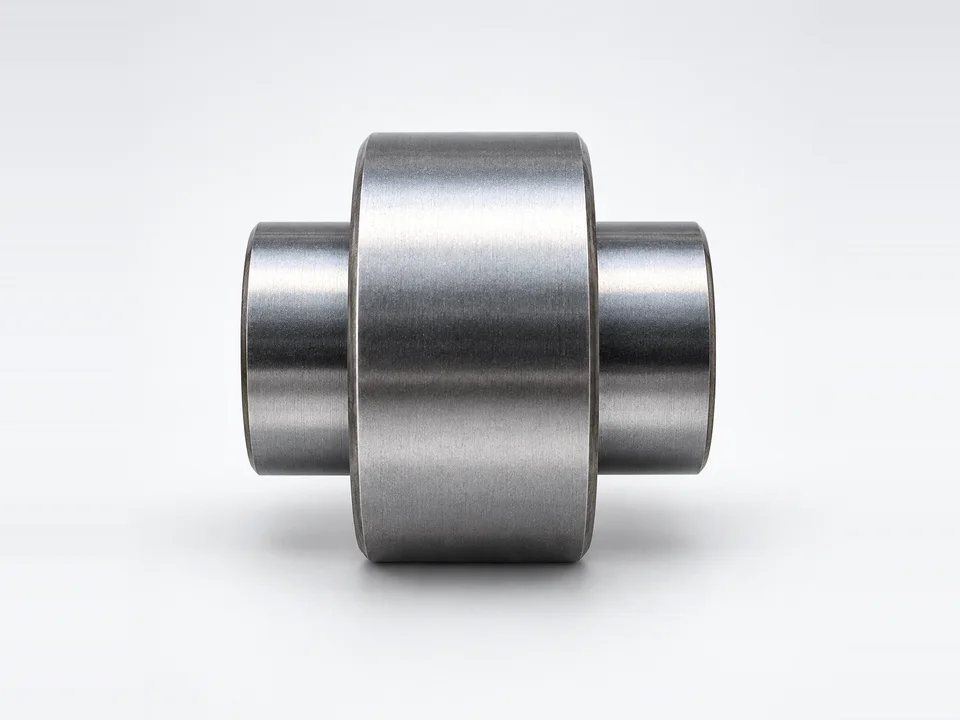
Bolt preload in an idler pulley should pass straight through hardened inner-ring faces into the mounting bracket. Loose spacer washers create four field failures:
- Washer cocking pinches seals. Stamped washers carry burrs, dish under torque, or sit off-center on a bolt shank. When an edge bridges across the inner chamfer onto a
2RSlip orZZshield, drag rises and grass or washdown water enters. - Additive tolerance stack-up. Extra stamped washers (
±0.05to±0.15 mm) and mating faces trap paint or burrs, shifting pulley belt tracking. - Missed or reversed parts. Thin shims get dropped or stepped bushings reversed on high-mix lines; one extended inner ring locks the standoff into one part.
- Preload loss and fretting. Soft washers yield under belt vibration, allowing inner-ring creep and bore wear until the pulley wobbles.
Grinding the standoff onto the hardened ring passes preload squarely while protecting seal clearance.
Two standard families: miniature RW inch vs pulley double-row series
NLHB supplies extended inner ring geometry in two catalog families: miniature single-row inch bearings (RW series) and double-row angular contact pulley bearings (6000-5xx / 6000-6xx).
Miniature extended inner ring inch bearings (RW series)
The inch R, 1600 and RW series extend miniature R inch bearings by lengthening the inner ring 0.397 mm (1/64 in) per side (0.794 mm / 1/32 in total, B1 > C) so forks and clevises clear the outer ring without shims.
| Model | Bore d (mm) |
OD D (mm) |
Outer Width C (mm) |
Inner Width B1 (mm) |
Protrusion/Side (mm) | Ball dw (mm) |
|---|---|---|---|---|---|---|
RW2 |
3.175 |
9.525 |
3.967 |
4.762 |
0.398 |
1.587 |
RW3 |
4.762 |
12.700 |
3.967 |
4.762 |
0.398 |
2.380 |
RW4zz |
6.350 |
15.875 |
4.978 |
5.773 |
0.398 |
2.380 |
RW188 |
6.350 |
12.700 |
3.175 |
3.967 |
0.396 |
1.999 |
On shielded RW4zz, the inner ring still protrudes 0.398 mm per side beyond the outer ring (B1 = 5.773 mm vs C = 4.978 mm), allowing side clamping without touching metal shields.
Double-row pulley extended inner ring bearings (6000-5xx / 6000-6xx)
Mower deck idlers and belt drives experience side thrust beyond single-row limits. NLHB's pulley bearing line uses double-row angular contact geometry in 21 catalog sizes sharing a 25.43–25.45 mm (1.001–1.002 in, nominal 25.44 mm) OD, .480–.485 in (~12.19–12.32 mm, nominal 12.26 mm) outer width, and .578–.582 in (14.73 mm) inner shoulder OD, stepping bore and overall inner width per bracket.
(Symbol note: miniature tables use C for outer width and B1 for inner width; pulley drawings use C for outer width and B for overall inner width.)
| Model | Bore Group | Bore d (mm / in) |
Shared OD D |
Outer Width C |
Extended Inner Width B |
|---|---|---|---|---|---|
6000-510A |
5/16 in |
8.08 mm (.3145–.3215 in) |
25.44 mm (1.001–1.002 in) |
12.26 mm (.480–.485 in) |
16.23 mm (.634–.644 in) |
6000-516 |
5/16 in |
8.08 mm (.3145–.3215 in) |
25.44 mm (1.001–1.002 in) |
12.26 mm (.480–.485 in) |
21.29 mm (.833–.843 in) |
6000-616 |
3/8 in |
9.61 mm (.375–.382 in) |
25.44 mm (1.001–1.002 in) |
12.26 mm (.480–.485 in) |
21.29 mm (.833–.843 in) |
6000-616A |
3/8 in |
9.79 mm (.382–.389 in) |
25.44 mm (1.001–1.002 in) |
12.26 mm (.480–.485 in) |
21.29 mm (.833–.843 in) |
6000-629 |
3/8 in |
9.61 mm (.375–.382 in) |
25.44 mm (1.001–1.002 in) |
12.26 mm (.480–.485 in) |
31.83 mm (1.248–1.258 in) |
6000-633 |
3/8 in |
9.61 mm (.375–.382 in) |
25.44 mm (1.001–1.002 in) |
12.26 mm (.480–.485 in) |
34.98 mm (1.372–1.382 in) |
Note 6000-616 (9.61 mm) vs 6000-616A (9.79 mm): both share 21.29 mm inner width, so omitting the suffix letter causes misfit. For spring-arm tensioners, review our tensioner bearing guide.
Symmetric vs asymmetric protrusion and drawing datums
In a custom extended inner ring design, choose between symmetric and asymmetric overhang first:
- Symmetric protrusion (
L1 = L2 = (B1 - C) / 2) makes assembly non-directional and simplifies double-disc grinding and raceway centering. - Asymmetric protrusion (
Hoffset orL1 ≠ L2) places the standoff on the bracket side while keeping the outer face flush (0 mm) or lightly stepped (0.5–1.5 mm) inside recessed pulley hubs.
Follow three drawing rules:
- Dimension from one datum face. Call out overall inner width
B1, outer widthC, and ONE offset (HorL1), marking the opposite overhang as reference. - Control inner shoulder OD. The
6000-6xxshoulder (.578–.582 in,14.73 mm) gives solid clamp area for bolt heads while clearing2RSseal lips. - Match bore fit with clearance. Clearance-fit pulley bolts do not expand the ring; press-fitted custom extended rings on shafts need fit-vs-clearance checks with our fit and tolerance calculator.
Shop-floor grinding datum control on long inner rings
Long inner rings like 6000-629 (31.83 mm, 3.3× bore) and 6000-633 (34.98 mm, 3.6× bore) amplify grinding errors:
- End-face squareness. Non-square faces bend the bolt and steal axial clearance. Double-disc grinding establishes the primary datum face (
基准端面) first for bore and raceway setups. - Deep-bore taper. Grinding a
35 mmdeep9.6 mmbore flexes slender quills; rigid tooling prevents bell-mouthing that loosens bolt seating. - Shoulder and raceway runout (
Kia). Concentricity across bore, raceways, and seal shoulder (ISO 492/GB/T 307.1grades) prevents eccentric seal drag.
NLHB checks end-face parallelism, width B1, bore taper, and seal drag before packing.
Quote checklist for extended inner ring bearings
Send these five items via request a quote:
- Part number or envelope: Bore
d, ODD, outer widthC, and overall inner widthB1with tolerances. - Extension layout: Symmetric or asymmetric overhang (
L1/L2orH), shoulder OD, and snap-ring grooves. - Shaft or bolt fit: Bolt/shaft diameter, clamping torque, and clearance vs interference fit.
- Structure & sealing: Single-row vs double-row angular contact;
ZZ,2RS, or open; speed, belt load, and dust/moisture conditions. - Precision & demand: Tolerance grade (
ABEC-1 / P0or tighter), runout limits, and annual volume.
Frequently asked questions
Can an extended inner ring replace two flat washers on a standard 6200 or R-series bearing? Yes, provided the shoulder OD clears the seals or shields and overall width matches the clevis gap. One ground inner ring eliminates washer cocking, pinched seals, and missed assembly parts.
Why do 6000-5xx and 6000-6xx pulley bearings use a clearance bore like .375–.382 in?
They mount onto standard 3/8 in or 5/16 in pulley bolts using axial end-face clamping rather than a shaft press fit, allowing easy bolt insertion while clamp friction prevents inner-ring rotation.
Is symmetric or asymmetric protrusion easier to manufacture? Symmetric protrusion is simpler to grind and non-directional during assembly. Asymmetric protrusion is straightforward on custom runs as long as one primary datum end face is clearly called out.
What happens if the extended inner ring end faces are out of square with the bore? Torquing the mounting bolt cocks the inner ring inside the outer ring, consuming axial clearance, raising torque, and overloading one side of the raceways.
Do RW miniature bearings keep the same OD as standard R-series inch bearings?
Yes. Every RW size shares the bore d, OD D, and outer width C of its matching R size while extending the inner ring 1/64 in (0.397 mm) on each side.
When does inner-ring length-to-bore ratio become critical in grinding?
Once inner width exceeds 3× to 4× the bore diameter—such as 6000-633 (34.98 mm wide on a 9.61 mm bore)—quill deflection governs bore taper and cylindricity. Share full tolerances early for process review.
Sources and standards
- ISO 15 / GB/T 276 — Rolling bearings: Radial bearings, boundary dimensions, general plan.
- ISO 492 / GB/T 307.1 — Rolling bearings: Radial bearings, geometrical product specifications (GPS) and tolerance values.
- NLHB Custom Pulley Bearing Catalog — Pulley Bearings for Idler and Tensioner Pulleys (21 Sizes).
- NLHB Inch Bearing Catalog — Inch Ball Bearings: R, 1600, RW, RLS and RMS Size Chart.