Short answer. On a four-wheel linear carriage, mount 2 concentric rollers on the fixed datum rail side and 2 eccentric rollers on the opposing adjustment side. Concentric studs lock straightness and primary thrust alignment without shifting the carriage centerline, while eccentric studs (e = 1 mm on most FR / LR models, 2 mm on FR22) absorb rail parallelism tolerances and remove play cleanly—provided you hold the eccentric stationary with a counter-wrench or pin spanner while tightening the locknut or bolt.
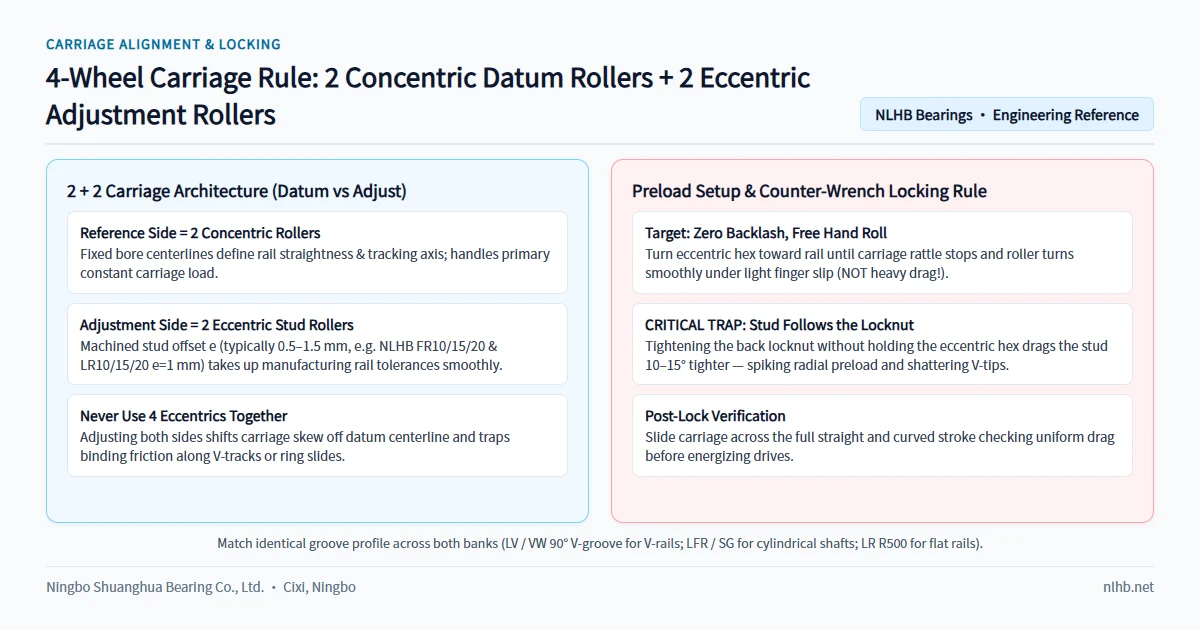
Letting the eccentric rotate even slightly during final fastener tightening is the fastest way to overload a track roller on assembly. Match the roller profile to your rail first—whether FR / LV / VW V-groove, LR crowned flat-rail, LFR / SG U-groove/gothic-arch round rails, or FV30 ring slides—by reviewing our eccentric track rollers and ring slide track rollers.
Why a 4-wheel carriage needs a 2+2 concentric + eccentric layout
Welded frames and long linear beds always carry rail span tolerances. Distributing concentric vs eccentric studs controls whether the carriage runs cleanly or binds.
| 4-wheel layout | Datum straightness | Backlash adjustment | Result on real rails |
|---|---|---|---|
2 concentric + 2 eccentric (2+2) |
Locked by 2 datum concentric wheels | ±2e radial travel absorbs rail-span drift |
Zero play, smooth rolling drag, repeatable tracking |
| 4 concentric wheels | Fixed | None without shims or slotted holes | Binds tight spots mid-stroke or rattles loose |
| 4 eccentric wheels | Lost (centerline shifts) | Excessive adjustment freedom | Carriage skews crabwise; uneven load and lost alignment |
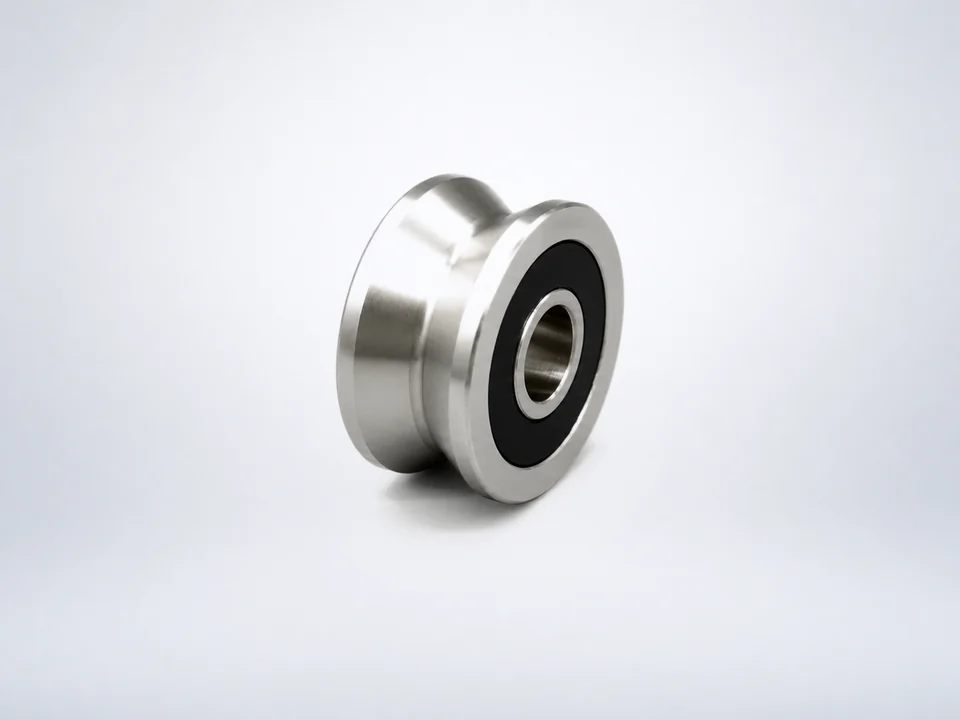
On dual-rail gantries with wide span tolerances, designers often pair same-size FR (90° V-groove) on the datum rail with LR (R500 crowned outer ring) on the floating flat rail: both share identical stud, collar, and adjusting-hole geometry, preventing flank binding when rail span varies.
NLHB eccentric track roller specs across V, flat, and U-groove rails
Always match the outer profile to the rail first using our track roller selection by rail profile guide.
| NLHB Series / Model | Outer profile & rail | D (mm) |
Stud / Bore (mm) | Eccentricity e (mm) |
Reference A, loads & speed |
|---|---|---|---|---|---|
FR10 (concentric: FR10Z) |
90° V-groove (Ø9 gauge) |
42 |
Stud 15 h7, bore 6.4 |
1 |
A=22.62, C0=5,300 N, C=4,900 N (10⁶ m), 12,000 r/min |
LR10 |
Crowned R500 (flat rail) |
47 |
Stud 15 h7, bore 6.4 |
1 |
Shares FR10 stud/holes; C0=5,300 N, 12,000 r/min |
FR15 (concentric: FR15Z) |
90° V-groove (Ø14 gauge) |
53 (0/−0.02) |
Stud 15 ±0.01, bore 8.4 ±0.005 |
1 |
A=29.65±0.01, C0=6,800 N, C=7,200 N, 9,000 r/min |
LR15 |
Crowned R500 (flat rail) |
47 |
Stud 15 ±0.01, bore 8.4 ±0.005 |
1 |
Shares FR15 stud/holes; C0=6,800 N, 9,000 r/min |
FR20 / FR22 |
90° V-groove (Ø20 gauge) |
63 / 70 |
Stud 20 h7, bore 10.5 |
1 / 2 |
FR20 A=36.2, C0=9,500 N, 7,000 r/min |
LV / VW |
90° / 120° V-groove |
10–75 / 14.84–75.39 |
Bore 3–30 / 4–22 |
Via eccentric stud/pin | See LV V-groove & VW guide rollers |
LFR / SG |
Gothic-arch / U-groove (round rail) | Size-dependent | Standard metric bore | Via eccentric stud/pin | Two-point contact on ground round rails |
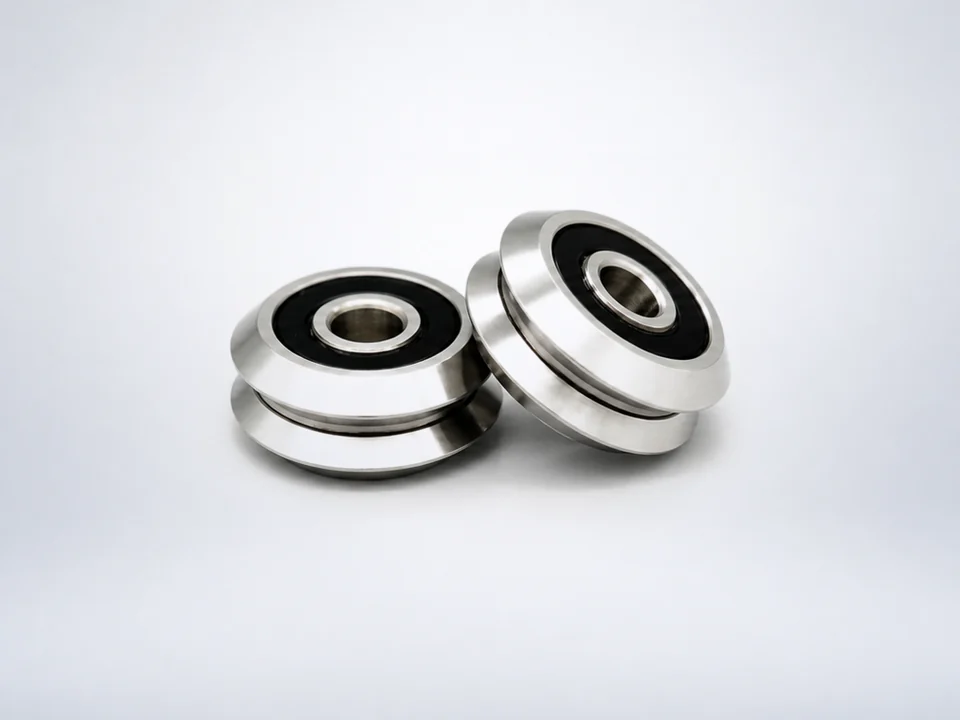
FR / LR rollers use a sealed double-row angular contact ball bearing (+6 / +23 µm normal axial clearance on sizes 10–22, −3 / +5 µm preloaded), a collar standing 1 mm proud of the roller face so the outer ring never rubs the plate, a bolt counterbore, and two collar adjusting holes (2 × Ø2.6 or Ø4.1). Threaded-stud eccentric rollers and FV30 mounts provide hex flats/sockets and a rear locknut.
Preload adjustment steps and the locknut rotation trap
- Clean rails and roller grooves. Trapped grit falsifies preload feel and dents raceways immediately.
- Seat and torque the 2 concentric datum rollers (
-Zsuffix) first. Lock the carriage reference line tight to spec. - Install the 2 eccentric rollers at maximum clearance. Point the eccentric away from the rail, seat the collar flush, and leave the nut or bolt finger-tight.
- Index the eccentric toward the rail for light, smooth rolling drag. Turn via the collar pin-spanner holes (
FR/LR) or eccentric hex/flat until radial play vanishes and hand pushing feels smooth—never force heavy zero-slip preload. Confirm every roller rotates smoothly under light thumb contact as the carriage moves. - Check the full stroke. Tight spots mean rail parallelism error (or carrier geometry drift on ring-slide eccentric preload), not insufficient preload.
- AVOID THE CRITICAL LOCKNUT TRAP: Hold the eccentric hex head/flat stationary with a thin counter-wrench (or lock the pin spanner in the
FR/LRface holes) while tightening the locknut or bolt to final torque. - Re-check rolling drag and play after torquing.
Why 10–15° of unheld rotation ruins the roller: Turning an eccentric stud 10–15° along with the locknut drives the outer ring tenths of a millimeter into rigid steel rails, multiplying radial preload. That overload squeezes grease out at dwell points—rapidly triggering false brinelling, V-tip chipping, high-pitched whine, and early raceway spalling.
| Field symptom | Root cause | Shop fix |
|---|---|---|
| Knocking at stops | Loose locknut or insufficient preload | Re-index eccentric and torque with counter-wrench |
| Speed-rising whine | Stud rotated 10–15° during tightening |
Back off eccentric, re-set light drag while counter-holding |
| V-tip chipping | Over-preload or 90° rail angle tilt |
Verify rail alignment and A gauge contact point |
| Tight spots at fixed zones | Rail span drift across stroke | Re-align floating rail or swap floating side to LR rollers |
Frequently asked questions
Why not install four eccentric rollers so every wheel adjusts? Four eccentrics eliminate the fixed datum, letting the carriage centerline and skew drift every time a roller is adjusted or replaced.
Why does tightening the locknut without a counter-wrench damage eccentric rollers?
Nut friction drags the eccentric 10–15° into the rail, spiking radial preload and causing false brinelling, V-tip chipping, whine, and early raceway spalling.
What does the Z suffix mean on FR15Z?
Z denotes the concentric (fixed-axis) version matching the stud, collar, and V-profile of the FR15 (e = 1 mm) eccentric roller for the carriage datum side.
Can FR V-groove and LR crowned rollers run together on one carriage?
Yes. Same-size FR and LR models (10, 15, 20, 25, 35) share stud and collar dimensions, letting LR (R500) float across parallel flat rails without binding.
How heavy should eccentric preload feel? Just enough to eliminate radial play while maintaining smooth, uniform hand-push drag and guaranteeing every loaded roller rotates freely without skidding.
Sources and data boundary
All FR10–FR35, LR10–LR35, LV, VW, and FV30 dimensions, e offsets, collar standoffs, axial clearances, and load ratings are verified from NLHB product pages. The 10–15° tightening slip warning carries an inline verification tag for torque-mark checking on your carriage.
- NLHB Bearings. Eccentric Stud Track Rollers (
FR&LRSeries). https://nlhb.net/products/eccentric-track-rollers.html - NLHB Bearings.
LVV-Groove Track Rollers Size Chart. https://nlhb.net/products/lv-v-groove-track-rollers.html - NLHB Bearings.
VWV-Groove Guide Rollers Size Chart. https://nlhb.net/products/vw-v-groove-guide-rollers.html - NLHB Bearings. Ring Slide Track Rollers (
FV30Type). https://nlhb.net/products/ring-slide-track-rollers.html
Related guides
- Eccentric stud track rollers (FR & LR)
- LV V-groove track rollers
- VW V-groove guide rollers
- Ring slide track rollers (FV30 type)
- Ring slide track rollers: eccentric studs and preload
- How to match a track roller to your rail profile
Ningbo Shuanghua Bearing (NLHB) turns, heat-treats, grinds, and assembles concentric and eccentric FR / LR / LV / VW / SG / LFR track rollers in Cixi, China. Send your rail profile, carriage layout, load, speed, and plate thickness: request a quote.