Ring slides and circular production lines move carriers around a closed track with frequent stops at stations. The carriers are guided by track rollers running on the inner and outer edges of the ring. Positioning repeatability, noise and wear depend on the roller profile, on how the rollers are preloaded against the ring, and on how accurately the rollers run. NLHB manufactures custom rollers for ring slides used in battery and medical production lines, with running accuracy up to P6.
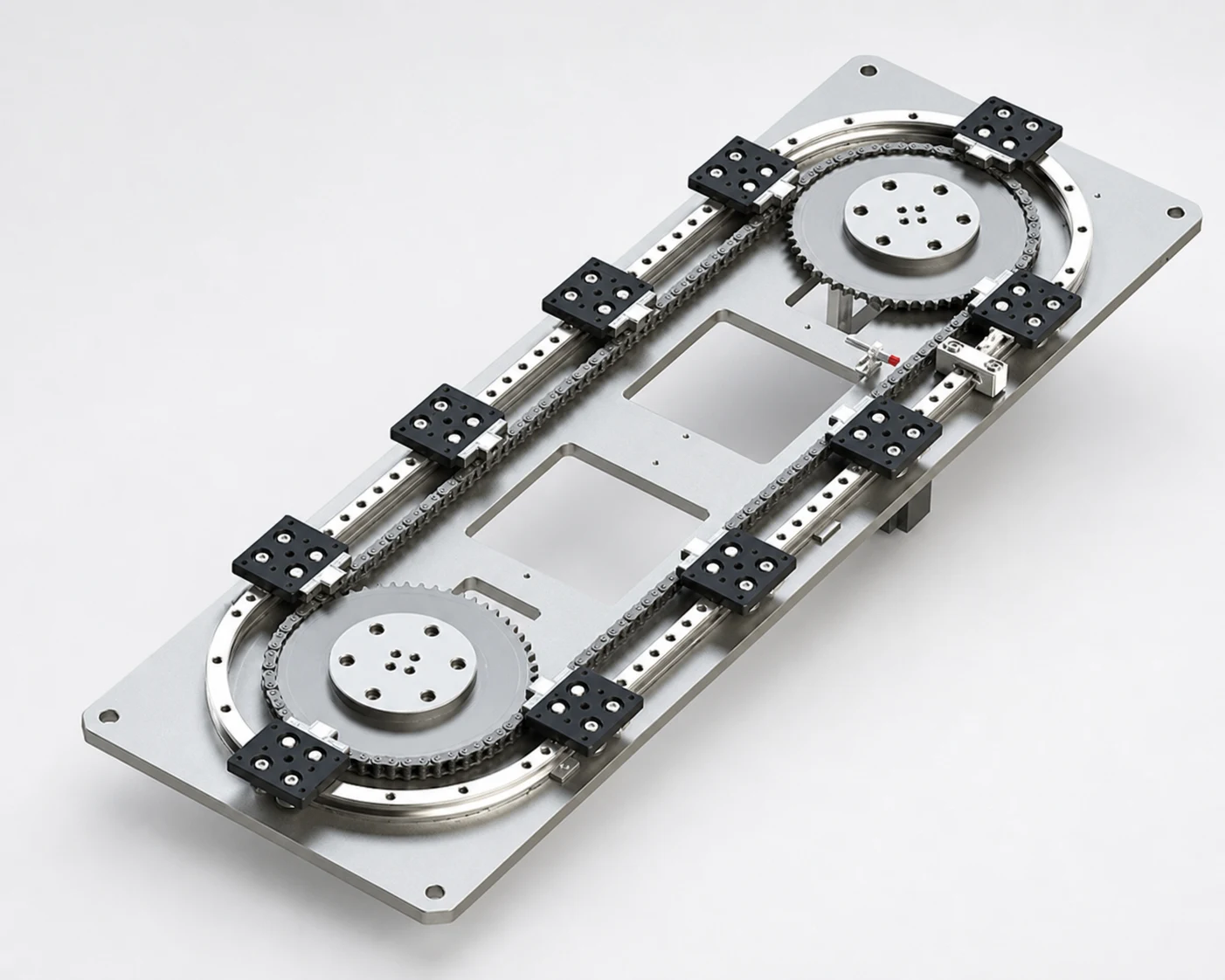
The carrier is located by its rollers
On a ring slide the carrier has no other guidance. Any radial runout of the roller, profile error or uneven preload appears directly as carrier position error at the stations and as noise at speed.
How a ring slide carrier is guided
A typical carrier has rollers on both sides of the ring: one set on the outer edge and one on the inner edge. The rollers on one side are mounted on concentric studs and define the carrier's reference position. The rollers on the other side are mounted on eccentric studs; turning the eccentric moves the roller towards the ring and removes play.
| Item | Concentric stud | Eccentric stud |
|---|---|---|
| Function | Fixed reference; defines carrier position | Adjustable; removes play and sets preload |
| Typical position | Reference side of the carrier | Opposite side, facing the concentric rollers |
| Adjustment | None | Rotation of the eccentric moves the roller axis; eccentricity per drawing |
| Locking | Nut to specified torque | Hold the eccentric while tightening the nut so the setting does not move |
On a straight guide both sides roll on parallel tracks. On a ring, the inner and outer rollers follow different radii and the carrier rotates as it moves. The carrier geometry — roller spacing and positions — must be designed for the ring radius, otherwise preload changes as the carrier moves between straight and curved sections of a combined track.
Setting preload with eccentric studs
- Clean the ring edges and the roller profiles. Particles trapped during setting cause false readings and later noise.
- Mount the concentric rollers and tighten them to the specified torque.
- Mount the eccentric rollers finger-tight with the eccentric set away from the ring.
- Turn each eccentric until the roller just contacts the ring and the carrier has no detectable play.
- Move the carrier around the full ring. Preload should feel even; tight or loose points indicate ring edge runout or a carrier geometry problem, not a roller setting problem.
- Hold the eccentric and tighten the lock nut to the specified torque. Recheck play and rolling resistance after tightening.
- Check that each roller turns under the carrier load; a roller that can be held still by hand while the carrier moves is not loaded.
Preload values and tightening torque depend on the roller size and stud design and are given on the drawing or the slide maker's instructions.
Too much or too little preload
| Condition | Symptoms | Consequence |
|---|---|---|
| Too little | Carrier play, rocking at stations, clicking noise when direction or speed changes | Poor repeatability, impact wear on ring edges and rollers |
| Correct | No play, even rolling resistance around the ring, all rollers turning | Stable positioning, low noise, even wear |
| Too much | High rolling resistance, heat, whining noise, rapid profile wear | Reduced bearing life, flaking on the ring edge, drive overload |
Profile accuracy and running accuracy
Two accuracies matter. The bearing inside the roller determines radial runout of the outer ring; the ground profile determines where contact occurs on the ring edge. We produce track rollers up to P6 running accuracy, and the profile form and position relative to the bore are agreed per drawing and checked on our profile inspection equipment. For the grade system, see P4, P5 and P6 explained.
- Match the roller profile to the ring edge angle or form. Contact on the flank edge instead of the profile centre causes high contact stress and noise.
- Specify runout of the profile relative to the bore, not only the bearing grade.
- Use rollers from the same production batch on one carrier so that profile height is consistent.
Running noise: causes and checks
| Noise | Likely cause | Check |
|---|---|---|
| Rhythmic click once per carrier revolution | Ring joint, damaged spot on the ring edge | Inspect the ring edge at the noise position |
| Click once per roller revolution | Dent or particle on the roller profile | Inspect the roller profile; replace if damaged |
| Continuous whine increasing with speed | Excessive preload or dry contact | Reduce preload; check lubrication of the ring edge per the slide maker |
| Rumble or rough running | Contaminated or damaged internal bearing | Rotate the roller by hand off the ring; replace if rough |
| Knock at stations | Insufficient preload, loose stud | Recheck play and nut torque |
Maintenance
- Keep the ring edges clean; battery and medical lines often require cleaning schedules that also protect the rollers.
- Lubricate the ring edge only if and as the slide maker specifies. Sealed rollers are normally greased for life; confirm for your design.
- Recheck carrier play at defined intervals and after any collision or carrier removal.
- Replace rollers on a carrier as a set, and reset preload after replacement.
Custom ring-slide rollers from our factory
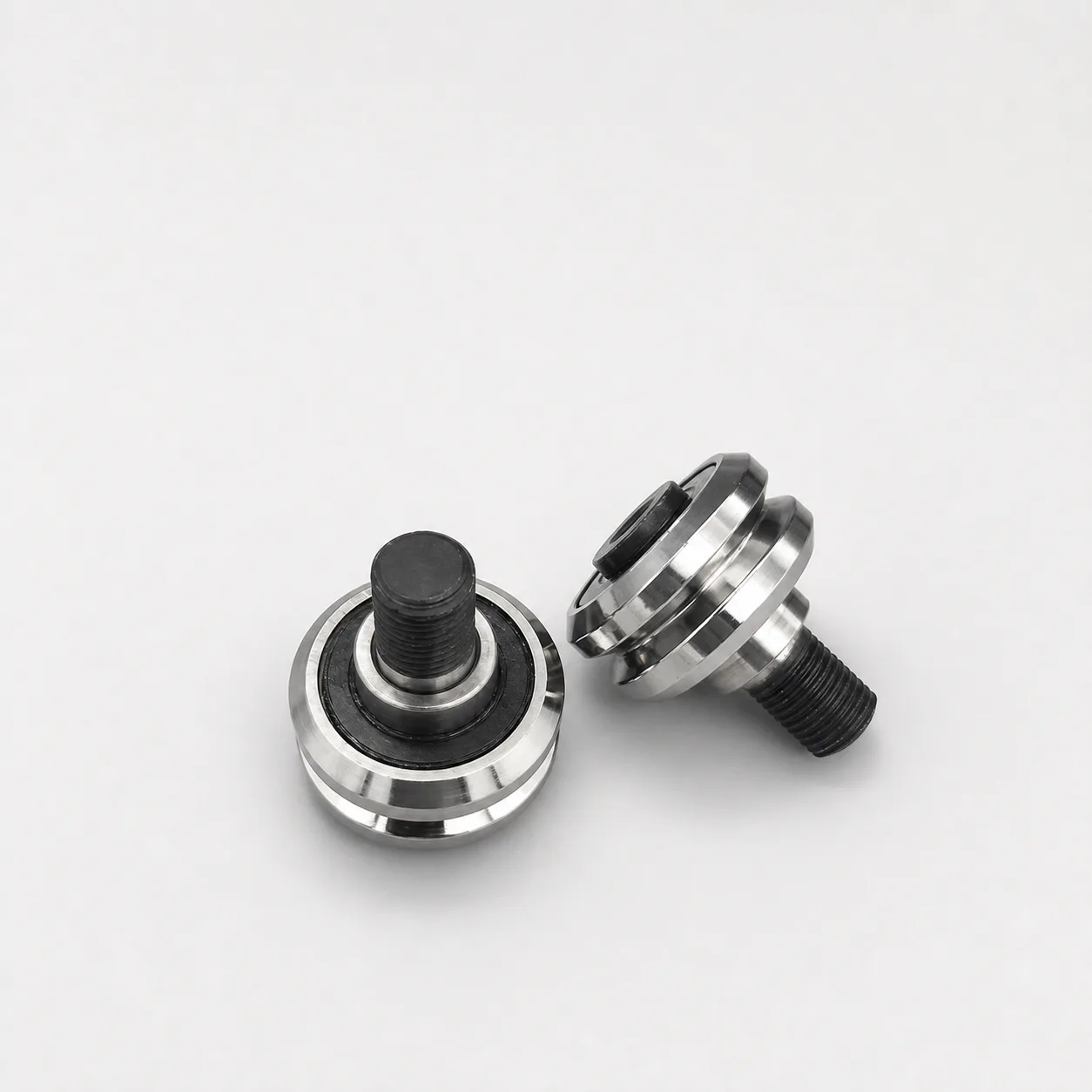
We have supplied custom track rollers for ring-slide assemblies used in battery and medical production lines. Profiles are turned and ground in our Cixi factory and checked on our own inspection equipment. NLHB manufactures miniature and deep groove ball bearings up to P4 precision, and double row angular contact bearings and track rollers up to P6.
Evidence from our workshop
What to send for a quotation
- Ring edge profile (V angle or radius), ring radius and whether the track has straight sections.
- Roller drawing or sample, including stud type (concentric or eccentric) and eccentricity.
- Carrier load, speed, stop frequency and positioning requirement.
- Required running accuracy (up to P6) and profile tolerance.
- Environment (cleanroom, dry room, washdown), seal requirement and quantity.
Frequently Asked Questions
Why use eccentric studs on a ring slide?
Eccentric studs let you move the roller towards the ring to remove play and set preload. Concentric rollers on the other side keep the carrier's reference position.
How much preload should ring slide rollers have?
Enough to remove all play with even rolling resistance around the ring and every roller turning. Exact values and nut torque follow the drawing or the slide maker's instructions.
Why is my ring slide noisy?
Common causes are excessive preload, a damaged or contaminated roller profile, a damaged ring edge or joint, a rough internal bearing, or loose studs. The noise period helps locate the cause.
What precision can NLHB ring slide rollers reach?
Up to P6 running accuracy. Profile form and position are agreed per drawing and checked on our inspection equipment.
Can you make ring slide rollers from a sample?
Yes. We measure the profile, bore and stud, confirm a drawing with you and then produce.
Related guides
Published 2026-09-25. Images show our own workshop and representative products. Final dimensions, grades, inspection limits and supply conditions are confirmed against the requested model, drawing and order.