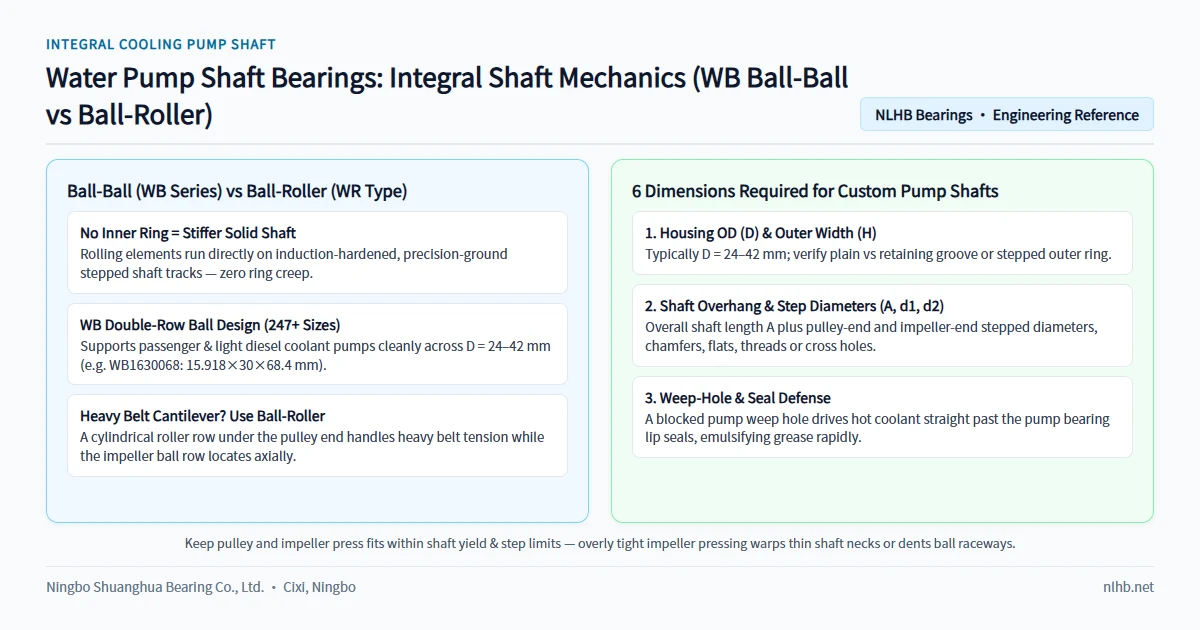
Short answer. An integral shaft water pump bearing eliminates the separate inner ring by grinding two rolling raceways directly onto a solid induction-hardened stepped shaft. Choose WB (ball-ball double row) for passenger cars and light commercial pumps running moderate belt loads at high speed, and choose WR (cylindrical roller on the pulley drive end plus deep groove ball on the impeller end) for heavy-duty diesel, truck, agricultural, and construction engines carrying high multi-rib belt tension and heavy cooling-fan overhang.
Front engine packaging leaves tight radial space, yet a water pump shaft carries cantilevered belt pull at one end and impeller hydraulic thrust at the other. Standard two-bearing shaft layouts lose bending stiffness to thin hollow shafts and inner-ring bore creep—which is why cooling pumps standardize on unitized shaft bearings.
Integral Shaft-Bearing Mechanics
A unitized water pump bearing uses a single outer ring (D = 24–42 mm across common automotive sizes) wrapping two widely spaced rolling rows riding directly on induction-hardened, ground raceways machined into the solid stepped shaft. Removing the separate inner ring yields three immediate structural gains:
- Larger, stiffer shaft diameter for the same outer ring OD
D, reducing pulley-end deflection under belt pull. - Zero inner-ring bore creep, because raceways are integral with the rotating shaft.
- Wider row spacing within outer ring width
H, increasing moment resistance against cantilevered pulley and fan loads.
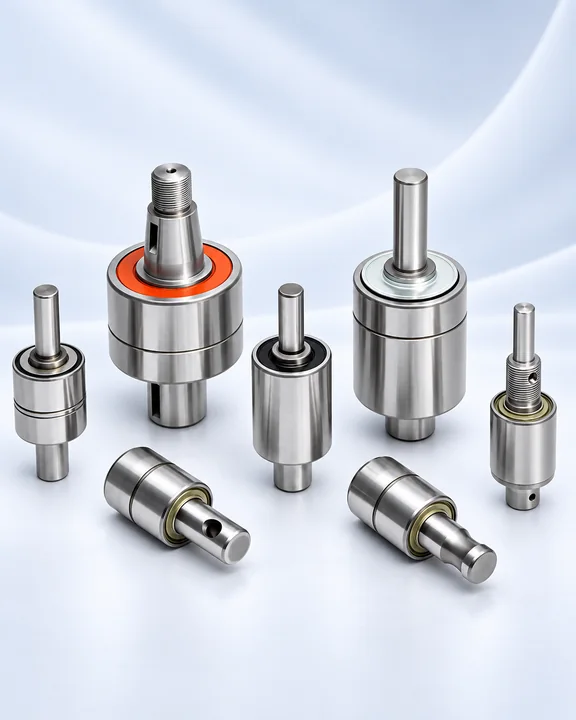
WB (Ball-Ball) vs WR (Ball-Roller) Construction
| Engineering Feature | WB Type (Ball-Ball Double Row) |
WR Type (Ball-Roller Combination) |
|---|---|---|
| Rolling elements | Two rows of balls on integral shaft raceways | Cylindrical roller row (pulley end) + deep groove ball row (impeller end) |
| Pulley radial capacity | Moderate; fits standard serpentine belt tension | High; line-contact roller row carries heavy belt pull & viscous fan overhang |
| Axial location | Bidirectional thrust shared by both ball rows | Impeller ball row locates axially in both directions while roller end allows thermal axial float |
| Speed & drag | Lower rolling drag; favors higher passenger-car rpm | Higher radial stiffness for diesel & industrial rpm bands |
| Typical engines | Passenger car & light commercial coolant pumps | Heavy diesel, trucks, agricultural & construction machinery |
On our auto water pump bearings line, NLHB carries 247 WB double-row ball catalog configurations across 10 OD and overall-length groups, alongside custom ball-roller executions and custom shaft-end machining to drawing.
Representative Catalog WB Sizes
All 247 WB models with full shaft steps (AH, B, C, d1, d2) appear in the NLHB auto water pump bearing size chart (PDF). Four catalog entries show the dimensional range:
| Catalog Model | Outer OD D (mm) |
Shaft Dia. d (mm) |
Overall Length A (mm) |
Outer Width H (mm) |
Size Group |
|---|---|---|---|---|---|
WB1024081 |
24 |
10 |
81 |
31.5 |
Compact D 24 / 26 mm |
WB1226086 |
26 |
12 |
86.5 |
39 |
Compact D 24 / 26 mm |
WB1630068 |
30 |
15.918 (5/8 in) |
68.4 |
38.89 |
Passenger car D 30 mm |
WB1940122 |
40 |
19 |
121.5 |
46 |
Heavy commercial D 40 / 42 mm |
Legacy 15.918 mm (5/8 inch) and 18.961 mm shaft diameters remain common even when D, A, and H are metric—never round them to 16 mm or 19 mm without checking the print.
Custom Shaft-End & Outer-Ring Executions
NLHB supplies both catalog WB units and customer-specific drawing configurations:
- Shaft ends (
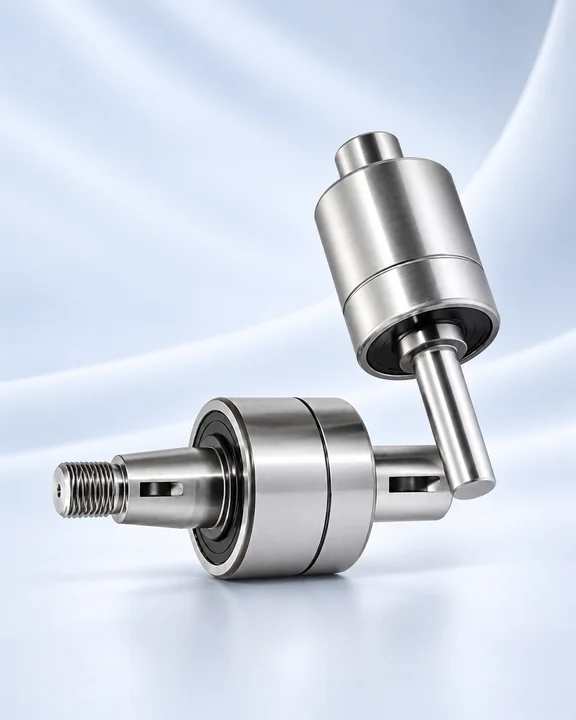
L1 / L2extensions, notedAH / Con charts): plain, stepped (d1,d2), threaded, slotted, milled flats, and cross holes. - Outer rings: plain cylindrical, circumferential snap/lock grooves, and stepped outer rings.
- Seals & grease: double-sided rubber lip seals paired with high-temperature polyurea grease.
Critical Field Failure Modes
Most early failures trace to coolant drainage or pressing mistakes rather than steel fatigue—see also our water pump and tensioner replacement guide:
- Mechanical-seal weep-hole clogging. Bearing lip seals keep grease in and road splash out; the pump's mechanical face seal holds back pressurized coolant. If sludge or excess sealant clogs the housing drain weep hole between the seal and bearing, seepage builds pressure behind the impeller-side lip seal, forces coolant into the bearing cavity, emulsifies the polyurea grease, and corrodes the raceways。
- Excessive hub or impeller press-fit interference. Pressing a pulley hub or impeller onto thin stepped ends without supporting the opposite shaft end forces impact load through the balls or rollers (instant Brinelling) and can crack thin shoulders or distort adjacent raceways.
Also verify alignment across adjacent tensioner pulley bearings, as belt vibration accelerates shaft overhang fatigue.
Water Pump Bearing Quote Checklist
- Outer diameter
Dand housing bore fit. - Outer ring width
H / Cand profile (plain, grooved, or stepped). - Overall shaft length
A. - Pulley-end and impeller-end projections (
L1 / L2orAH / C). - Shaft step diameters (
d,d1,d2) and end details (threads, slots, flats, cross holes). - Structure:
WBball-ball orWRball-roller, plus coolant temperature and seal style. - Pulley and fan overhang load, belt tension, and peak speed.
Frequently asked questions
What is the difference between WB and WR water pump bearings?
WB uses two ball rows for moderate belt loads, low friction, and bidirectional axial location. WR replaces the pulley-side ball row with a cylindrical roller row for heavy diesel belt tension and viscous fan overhang.
Why do water pump bearings omit a separate inner ring?
Grinding raceways directly on the solid stepped shaft increases shaft diameter and stiffness inside the same OD D, prevents inner-ring bore creep, and widens the rolling-row span.
Can I replace a water pump bearing using only D, d, and overall length A?
No. Identical D, d, and A numbers often differ in outer width H, outer grooves, L1 / L2 shaft projections, step diameters (d1 / d2), or threaded/slotted shaft ends.
Does fluid at the weep hole mean the bearing has failed? No. The weep hole drains mechanical face-seal seepage away from the bearing. Bearing damage occurs when a clogged weep hole traps coolant and forces it past the bearing lip seals into the grease.
What assembly error damages new water pump bearings most often? Pressing an impeller or hub onto the shaft while supporting the outer ring passes heavy axial force through the rolling elements, denting the raceways before the pump ever runs.
Can NLHB produce custom shaft-end features and ball-roller water pump bearings?
Yes. In addition to 247 catalog WB double-row ball configurations across 10 size groups, we manufacture custom ball-roller units and custom shaft ends (plain, stepped, threaded, slotted, flats, cross holes) to drawing.
Sources and Data Boundary
- NLHB Auto Water Pump Bearing Catalog (
247 WBmodels across 10 groups) — nlhb-auto-water-pump-bearing-size-chart.pdf. - DIN 5419 / integral shaft water pump bearing dimension conventions (
D,H,A,AH,B,C,d,d1,d2). - Automotive mechanical face-seal drainage and polyurea grease engineering guidelines.
Send your OEM part number, dimensions, or sample to request a quote for a water pump shaft bearing drawing review.