Short answer. Choose LR track rollers (LR5000, LR5200, LR5300) for flat tracks or channels—using a crowned OD (R500) to avoid edge stress under tilt, or a cylindrical OD (X / KDD) on rigid, aligned rails. Choose LFR gothic-arch rollers or SG circular-arc compact rollers for hardened round shafts. Never size a roller from catalog internal ratings (C, C0) alone; effective track ratings (Cr_w, C0r_w) are lower because the unsupported outer ring bends under concentrated track contact.
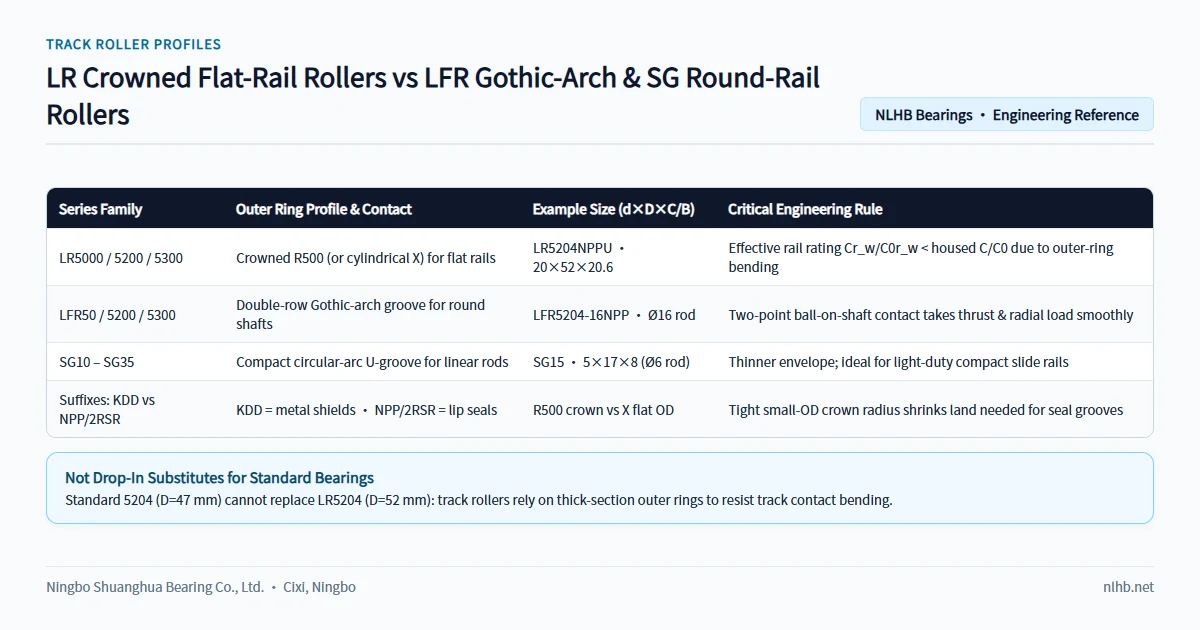
Engineers often confuse LR and LFR designations because both share 5200-series bore codes and bolted mounting. In service, they mate with completely different rails and fail through different mechanisms when misapplied.
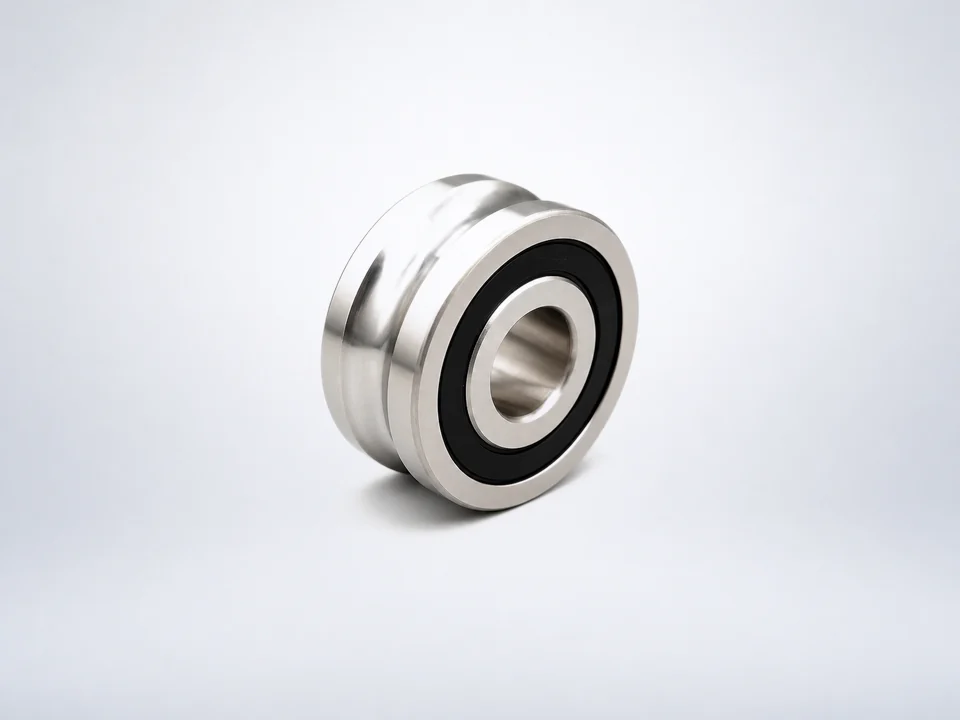
LR series vs LFR and SG series: match the rail first
Every track roller bearing uses its outer ring as a wheel without a surrounding housing bore, requiring thicker outer walls and a profile shaped for the mating rail.
LR5000, LR5200, and LR5300: thick outer rings for flat rails and cams
The LR track roller family spans three wall-thickness tiers:
- Single-row
LR5000(LR5000–LR5007,10–35 mmbore): Compare6004(20 × 42 × 12 mm) against LR5004NPPU (20 × 47 × 16 mm) in our LR5000 series chart for light flat tracks and cams. - Double-row
LR5200(LR5200–LR5208,10–40 mmbore): Compare5204(20 × 47 × 20.6 mm) againstLR5204NPPU(20 × 52 × 20.6 mm) in the LR5200 series chart for higher radial shock and overturning moment. - Heavy double-row
LR5300(LR5301–LR5308,12–40 mmbore): Adds extra wall section (LR5304NPPUat20 × 62 × 22.2 mm) in the LR5300 series chart.
On flat rails, a crowned OD (R500 standard radius on LR) relieves edge stress when brackets tilt under load. A cylindrical (flat) OD widens the line contact patch only where stiff, precision-ground rails maintain tight alignment.
LFR gothic-arch vs SG circular-arc compact rollers for round shafts
For hardened round shafts, two grooved families exist—and sharing boundary dimensions does not make them interchangeable:
- LFR series (double-row gothic arch): Offset circular arcs form a pointed groove contacting the round shaft (
dw) at two lines60°apart with a root gap. LFR track rollers stabilize carriages laterally and allow eccentric preload adjustment. - SG series (compact single-row circular-arc groove): Built on a compact single-row footprint, SG track rollers fit tight radial/axial envelopes on
5–12 mmguide shafts (always confirm groove geometry by drawing).
Compare LFR50/5KDD against SG15 below: both measure 5 × 17 × 8 mm for a 6 mm shaft (dw), yet differ in contact center L (21 mm vs 20.46 mm), outer width Bo (7 mm vs 8 mm), and inner-ring protrusion.
| Model | Type | d × D × B (mm) |
Outer Bo (mm) |
Rail dw (mm) |
Center L (mm) |
Key Difference |
|---|---|---|---|---|---|---|
LR5004NPPU |
Single-row crowned | 20 × 47 × 16 |
16 |
Flat | — | Light flat rail / cam (R500) |
LR5204NPPU |
Double-row crowned | 20 × 52 × 20.6 |
20.6 |
Flat | — | Heavier flat rail; higher moment stiffness |
LFR50/5KDD |
Double gothic arch | 5 × 17 × 8 |
7 |
6 |
21 |
Ø6 mm shaft; inner ring +0.5 mm/side |
LFR5201NPP |
Double gothic arch | 12 × 35 × 15.9 |
15.9 |
10 |
41.3 |
Standard double-row guide on Ø10 mm rail |
LFR5204-16NPP |
Double gothic arch | 20 × 52 × 22.6 |
20.6 |
16 |
63 |
Ø16 mm rail; inner ring +1.0 mm/side |
LFR5206-20NPP |
Double gothic arch | 25 × 72 × 25.8 |
23.8 |
20 |
87 |
Heavy slide on Ø20 mm shaft; +1.0 mm/side |
SG10 |
Compact single-row | 4 × 13 × 6 |
6 |
5 |
16.08 |
Compact Ø5 mm rail support |
SG15 |
Compact single-row | 5 × 17 × 8 |
8 |
6 |
20.46 |
Compact Ø6 mm rail (differs from LFR50/5) |
SG20 |
Compact single-row | 6 × 24 × 11 |
11 |
8 |
28.62 |
Compact Ø8 mm rail support |
See our track roller selection by rail profile guide and track roller size chart for V-groove LV/VW profiles.
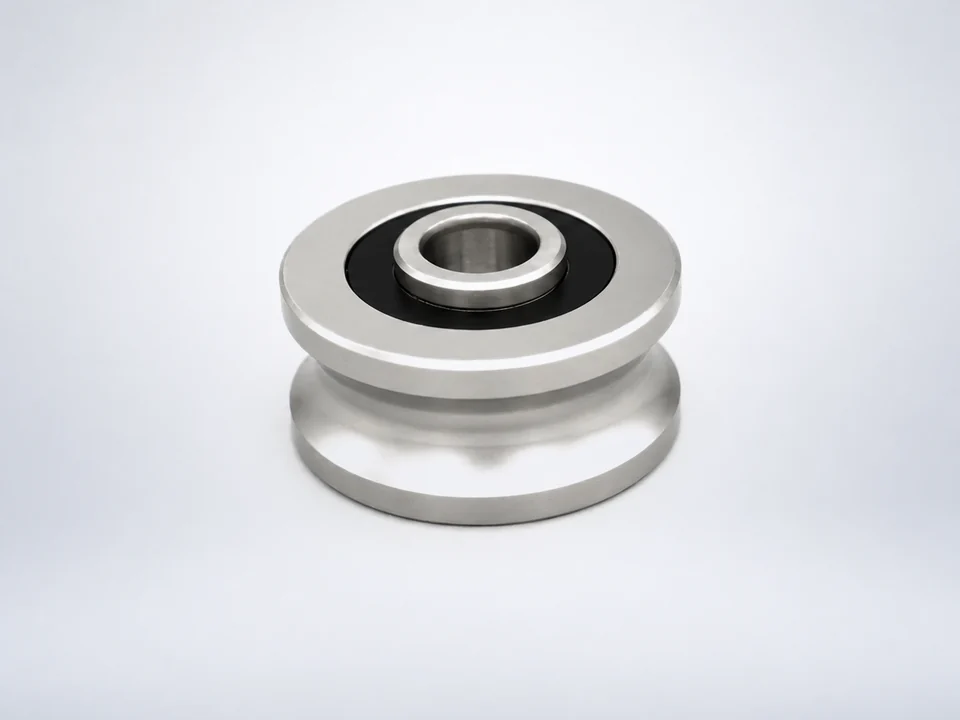
Track roller suffix decoder
| Suffix | Closure | Outer Profile | Typical Use & Checkpoints |
|---|---|---|---|
KDD |
Metal shields | Cylindrical on LR; grooved on LFR |
Low drag in clean enclosures; LR KDD = flat OD unless U added |
KDDU |
Metal shields | Crowned (R500 on LR) |
Low drag plus misalignment tolerance on flat rails |
NPP / 2RSR |
Rubber lip seals | Grooved (LFR) or per series (LR) |
Dusty or wet lines; check seal-lip speed limit |
NPPU |
Rubber lip seals | Crowned (R500 on LR) |
Standard sealed flat-track roller with edge-stress relief |
X (or no U) |
Match base suffix | Flat cylindrical OD | Stiff, precision-aligned rails needing wide line contact |
Confirm both closure type and crown radius on the drawing since suppliers differ on X vs U.
Two physics traps engineers miss on track rollers
Trap 1: Confusing internal catalog ratings (C, C0) with effective track ratings (Cr_w, C0r_w)
Standard bearings sit inside rigid steel housing bores; track roller outer rings receive no radial support outside the single contact zone on the rail. Under load, the outer ring flexes oval, creating cyclic bending stress.
Thus effective track load ratings (Cr_w, C0r_w) are lower than internal catalog ratings (C, C0). Sizing LR5204NPPU with a 5204 rating risks outer-ring fatigue cracking. Rails should also be hardened to 58–62 HRC so the track does not dent first.
Trap 2: Tight crown radius (R) destroying seal-retention land on small-OD custom rollers
Specifying a tight crown radius (R50–R150) on small-OD rollers (D ≤ 24 mm) drops the outer edges sharply (drop = (Bo/2)² / (2R)), cutting into the seal retention groove (密封槽) and leaving insufficient wall above the groove bottom—causing grinding cracks or NPP/2RS seal pop-out.
Track roller quotation checklist
Send these five details via request a quote:
- Part number or dimensions:
d,D, outer widthBo, and inner widthB/C. - Rail profile: Flat track (
R500crowned vsXflat) or round shaft diameterdwand center distanceL, plus rail hardness. - Sealing & mounting:
KDDshields vsNPP/NPPUseals; through-bolt vs eccentric stud; inner-ring protrusion. - Effective load & duty: Radial/axial loads, shock factor, speed (
m/sorrpm), and contamination. - Drawing or sample: CAD files or rail photos for legacy replacements.
Frequently asked questions
What is the difference between LR5204NPPU and LFR5204-16NPP?
Both share d = 20 mm, D = 52 mm, and Bo = 20.6 mm, yet serve different rails. LR5204NPPU uses a crowned R500 outer face for flat tracks; LFR5204-16NPP has a gothic-arch groove for a 16 mm round shaft and a 22.6 mm extended inner ring.
When should I choose a crowned outer ring (NPPU / KDDU) over a cylindrical flat ring (KDD / X)?
Choose crowned (R500) on welded or cantilevered frames where bracket tilt would cause edge loading. Choose cylindrical only on stiff, ground rails with high parallelism.
Can an SG15 roller replace an LFR50/5KDD directly?
Not blindly. Both measure 5 × 17 × 8 mm on a 6 mm shaft, but SG15 has a different contact center (L = 20.46 mm vs 21 mm), outer width (8 mm vs 7 mm), and single-row vs double-row construction.
Why does a track roller need a thick outer ring? With no housing supporting the OD, concentrated track loads bend thin rings oval, distorting the internal ball raceway and accelerating fatigue.
Why is the effective track load rating (Cr_w) lower than a bearing's internal C rating?
Because Cr_w and C0r_w factor in outer-ring bending fatigue and permissible deformation on a point/line rail contact rather than assuming full housing support.
What happens if a custom crown radius R is too small on a compact sealed roller?
The sharp edge drop thins the steel wall above the seal retention groove, risking grinding cracks or seal detachment.
Sources and standards
- ISO 76 / GB/T 4662 — Rolling bearings: Static load ratings.
- ISO 281 / GB/T 6391 — Rolling bearings: Dynamic load ratings and rating life.
- DIN 620 / GB/T 307.1 — Rolling bearings: Tolerances and geometrical specifications.
- NLHB Track Roller Catalogs — LR Track Roller Series, LFR Gothic-Arch Track Rollers, and SG Track Rollers.
Related products, tools and guides
- LR5000, LR5200 & LR5300 Complete Track Roller Chart
- LR5000 Single-Row Track Roller Bearings
- LR5200 Double-Row Track Roller Bearings
- LR5300 Heavy Double-Row Track Roller Bearings
- LFR Gothic-Arch Track Roller Bearings
- SG Compact Grooved Track Roller Bearings
- Complete Track Roller Size Chart (SG, LFR, LV, VW)
- All Track Roller Bearings Hub
- How to Match a Track Roller by Rail Profile
- Request a Track Roller Drawing Review or Quote