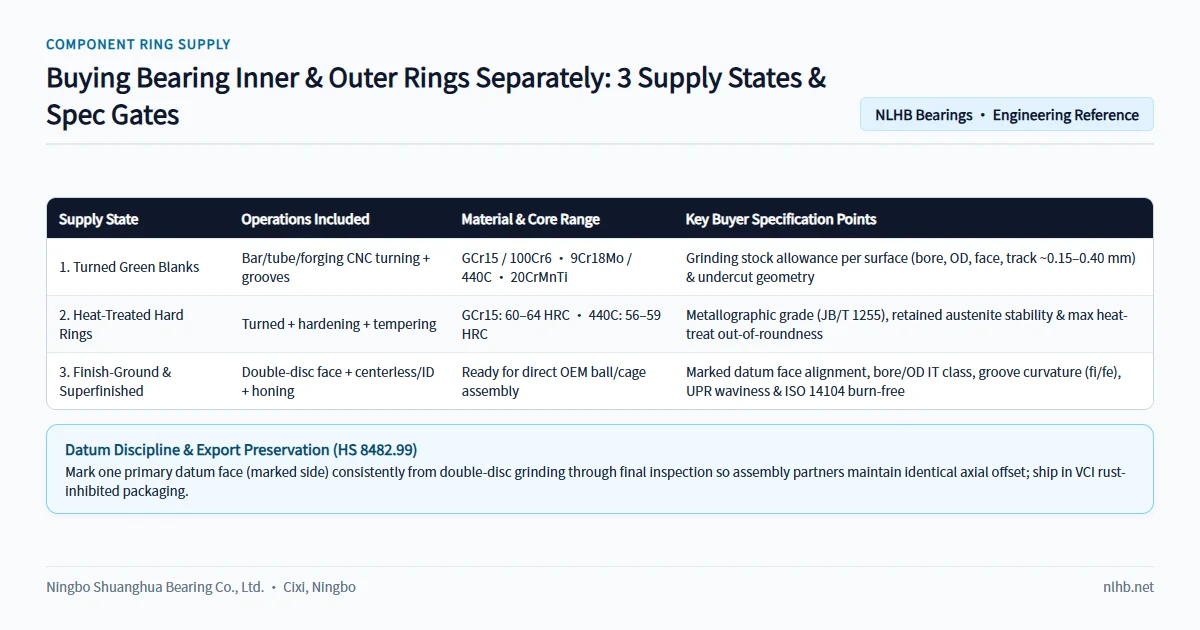
Short answer. Custom bearing inner and outer rings can be sourced separately in three distinct delivery states—CNC turned blanks, through-hardened and tempered rings, or finish-ground and superfinished rings—depending on which downstream operations you perform in-house. Boundary dimensions (d × D × B) alone never define a ring: every order must lock per-surface grinding stock allowances, datum marking faces, heat-treatment microstructure limits, raceway curvature and roughness targets, and burn-free inspection criteria.
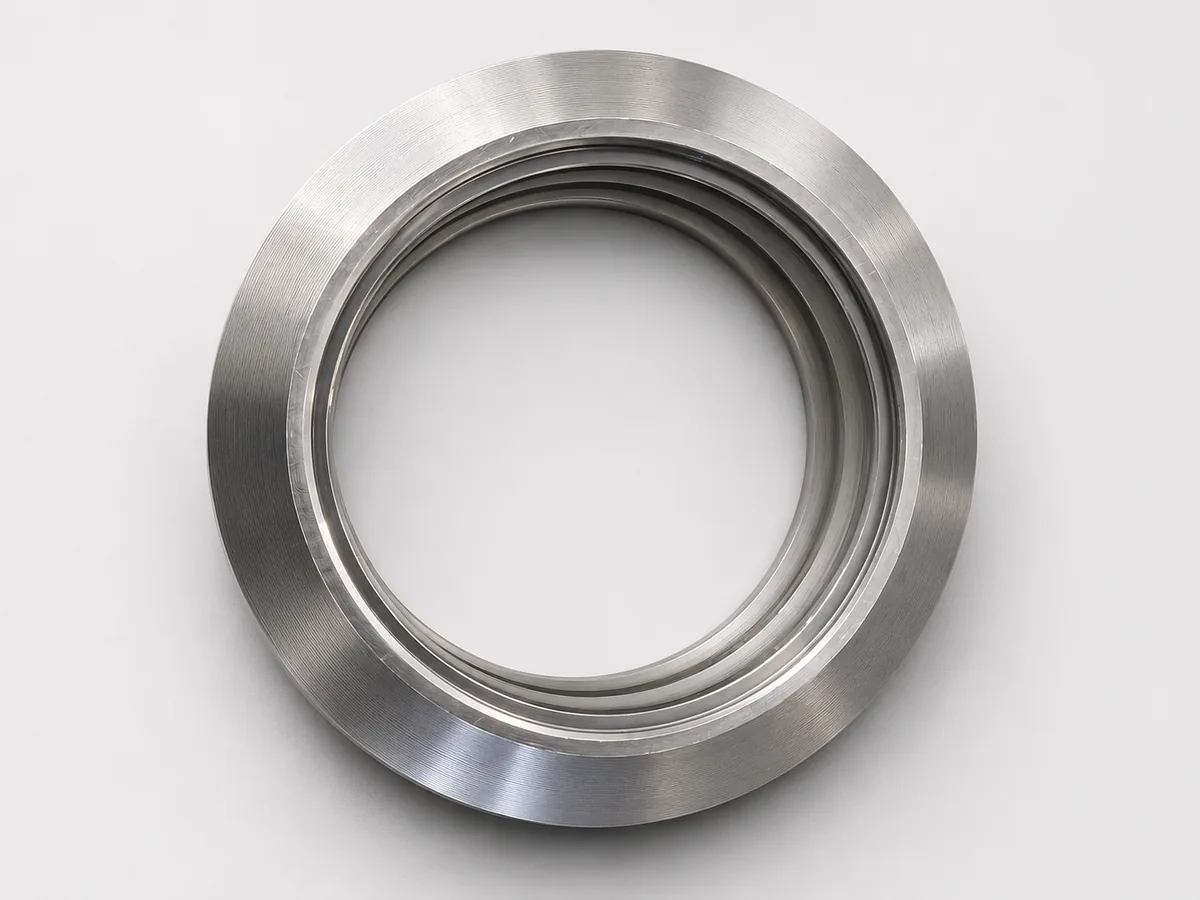
Assembly houses, specialized equipment OEMs, and aftermarket bearing rebuilders frequently purchase standalone bearing rings rather than complete bearings—pairing custom races with separate chrome steel balls or stainless steel balls to match proprietary housings or niche clearances. When ring drawings copy finished-bearing dimensions onto green or heat-treated blanks without separating process datums and stock allowances, scrap rates spike at grinding.
Three Procurement States on One Process Chain
As outlined on our bearing inner and outer rings page, every ball bearing ring passes sequentially from bar, tube, or forging through turning, hardening, face/OD/bore grinding, raceway grinding, superfinishing, and ultrasonic washing. Selecting a delivery condition simply sets the handoff point along that line:
| Delivery State | Operations Completed by Supplier | Buyer's Downstream Steps | Critical Drawing Callouts |
|---|---|---|---|
1. CNC Turned Blanks (green rings) |
Bar/tube cutting or forging, CNC turning of bore, OD, faces, raceway, chamfers, and grooves | Heat treatment, rough & finish grinding, superfinishing, assembly | Steel grade & cert, per-surface grinding stock allowance, turning datum face, seal/snap groove profile |
| 2. Through-Hardened & Tempered Rings | Turning + austenitizing, quench, sub-zero/tempering, hardness & structure checks | Double-disc face grinding, OD/bore grinding, raceway grinding & superfinishing | Target HRC window, heat-treat standard (JB/T 1255 / ISO 683-17), post-quench distortion ceiling, remaining stock allowance |
| 3. Finish-Ground & Superfinished Rings | Complete grinding, raceway superfinishing, demagnetization, ultrasonic wash | Direct ball-set matching, cage insertion, greasing & closure | Final IT tolerances, datum marking face, fi / fe curvature ratio, UPR roundness harmonics, Ra, ISO 14104 burn-free check |
State 1: CNC Turned Blanks (Green Rings)
Turned blanks can be machined from solid bar stock, seamless bearing-grade tubing, or forged rings in GCr15 / 100Cr6 high-carbon chromium steel, 9Cr18Mo / 440C martensitic stainless steel, or 20CrMnTi case-hardening carburizing steel where tough shock-absorbing cores are specified.
Two print details govern turned-blank success:
- Per-surface grinding stock allowance (
0.15–0.40 mmtypical). Bore, OD, end faces, and raceway groove cannot share a blind single offset. Thin-wall or large-diameter rings distort more during quenching and require higher turning stock than thick, compact sections. Leave too little stock and quench ovality leaves unground black spots ("witness marks"); leave too much and downstream grinding burns the raceway or wrecks cycle time. - Chamfer and undercut geometry. Seal grooves, snap-ring grooves, and retaining steps are usually finished cleanly at the turning stage (or finished with dedicated form tools) because finish grinding stones cannot reach sharp undercut corners. Specify groove radii, burr removal, and whether chamfers are left turned or ground.
State 2: Through-Hardened & Tempered Rings
If you grind rings in your own shop but outsource blanking and thermal processing, ordering heat-treated rings eliminates heat-treat distortion surprises on your floor—provided the thermal spec goes beyond a single hardness number.
- Hardness targets (
58–64 HRC). StandardGCr15rings typically run60–64 HRCwhile9Cr18Mo / 440Cstainless rings run around~58 HRC。Specify both surface hardness range and core-to-surface uniformity on thick-walled rings. - Metallurgical control (
JB/T 1255/ISO 683-17/GB/T 34891). Fine, uniform cryptocrystalline martensite, dispersed carbides, and bounded retained austenite govern rolling contact fatigue and dimensional stability at temperature. Uncontrolled retained austenite transforms slowly in service and causes rings to grow out of tolerance. - Out-of-roundness distortion ceiling. Even properly racked rings warp slightly during oil or salt quenching. Your print must pair minimum remaining grinding stock with a maximum acceptable post-quench out-of-roundness limit so your rough grinders never crash into heavy high spots.
For complete furnace-lot traceability and thermal inspection protocols, see our heat treatment traceability and grinding burn inspection guide.
State 3: Finish-Ground & Superfinished Rings
When purchasing ready-to-assemble inner and outer rings, surface geometry and datum consistency determine bearing clearance spread, vibration, and acoustic grade:
| Parameter Group | Key Specification Items | Why It Governs Assembly Yield |
|---|---|---|
| Datum marking face | Reference end face (stamp / marking face) established on first double-disc face grinding pass |
Axial runout (Sia / Sea), raceway axial offset, and duplex-pair flush grinding depend on grinding both faces flat and locking one permanent datum face |
| Fit & boundary tolerances | Bore d, OD D, width B per ISO 492 (P0 / P6 / P5 / P4 IT grades) |
Controls shaft/housing interference fit and prevents ring creep |
| Raceway geometry | Groove curvature ratio (fi / fe around 0.515–0.53 typical), groove position, radial runout (Kia / Kea) |
Sets contact stress ellipse, ball-set clearance matching, and axial stiffness |
Roundness harmonics (UPR) |
Multi-band waviness filtering (e.g. 2–15, 15–500 undulations per revolution) |
High 15–500 UPR chatter drives Z/V noise failures even when overall diameter passes |
| Surface roughness & burn | Honed groove roughness (Ra ≤ 0.05–0.10 µm typical after superfinishing) + burn-free per ISO 14104 |
Removes amorphous grinding skin, lowers torque, and prevents early spalling from temper/re-hardening burn |
| Cleanliness & magnetism | Demagnetization ceiling + multi-stage ultrasonic wash | Residual magnetism traps steel grit in grease; unwashed honing sludge pits polished races |
A mirror-bright ground raceway can still hide severe thermal damage. Acid-etch inspection (ISO 14104) or Barkhausen noise testing verifies that aggressive wheel feeds did not soften or re-harden the subsurface layer.
Export Packing, Rust Protection & Customs Notes
Finished and semi-finished bearing steel rings corrode rapidly during ocean transit if packaged like general machined hardware:
- Corrosion protection: Clean, dry rings receive filtered rust-preventive oil compatible with downstream grinding coolant (for blanks/hardened rings) or final assembly grease (for finished rings), wrapped in volatile corrosion inhibitor (VCI) paper or sealed in vacuum VCI barrier bags.
- Customs classification (
HS 8482.99): Separate bearing inner and outer rings—whether turned, heat-treated, or ground—are commonly classified underHS 8482.99(parts of ball or roller bearings: inner and outer rings/races), distinct from steel balls (8482.91). Confirm the exact national tariff subheading with your customs broker before dispatch, as also noted on our bearing components hub and quality & sourcing overview.
Frequently asked questions
Can I order custom bearing rings using only bore d, OD D, and width B?
No. Identical boundary dimensions can hide completely different raceway groove diameters, curvature ratios (fi / fe), shoulder heights, seal slots, and snap grooves. Supply a detailed drawing or a physical sample for measurement.
How much grinding stock allowance should be left on CNC turned bearing ring blanks?
Typical per-surface allowances fall around 0.15–0.40 mm depending on ring diameter, wall thickness ratio, and heat-treatment distortion risk. State separate allowances for bore, OD, faces, and raceway groove rather than a single generic note.
Why must a datum marking face be specified on finish-ground rings? Double-disc face grinding establishes parallelism, and every subsequent bore, OD, and raceway setup indexes off one reference face. Marking that datum face ensures radial and axial runout measurements align between supplier QC and your assembly line.
Does a bright, shiny raceway mean the ring has no grinding burn?
No. Visual brightness does not reveal grinding burn. Excessive grinding heat can create a thin re-hardened white layer or softened over-tempered zone beneath a smooth finish, requiring ISO 14104 nital-etch inspection or non-destructive burn testing to detect.
What steels are commonly used for custom standalone bearing rings?
GCr15 (100Cr6 / 52100) is the standard through-hardened chrome bearing steel, 9Cr18Mo (440C) is used for hardened corrosion-resistant rings, and 20CrMnTi carburizing steel is selected where heavy shock calls for a hard case over a tough core.
What HS code applies when importing separate bearing rings?
Inner and outer bearing rings shipped independently commonly classify under HS 8482.99 (bearing parts other than balls, needles, and rollers). Always verify the exact destination subheading with your licensed customs broker.
Sources and Standards
- ISO 683-17 — Heat-treated steels, alloy steels and free-cutting steels: Ball and roller bearing steels.
- JB/T 1255-2014 / GB/T 34891-2017 — Heat treatment quality technical specifications for high-carbon chromium rolling bearing parts.
- ISO 14104 — Surface temper etch inspection after grinding (
nital etch). - ISO 492 — Rolling bearings: Radial bearings — Geometrical product specifications (
GPS) and tolerance values. - NLHB Bearing Components Specification — Bearing Inner & Outer Rings.
Sourcing turned blanks, hardened races, or superfinished inner and outer rings to drawing? Upload your print and target delivery state to request a quote for an engineering and allowance review.