624UU and 625UU are trade designations used for miniature guide wheels: a small ball bearing whose outer ring is enlarged and turned with a U-shaped groove, so that wire, thread, cable or a round rail can run in the groove. They are used in large numbers on winding machines, traverse units and wire and cable lines. The designation is widely used but not standardised, so two parts sold under the same name can differ. This guide explains how these guide bearings work, how to match the groove to the wire, and how to identify a replacement by measurement. NLHB makes U-groove and V-groove guide wheels to designation, sample or drawing.
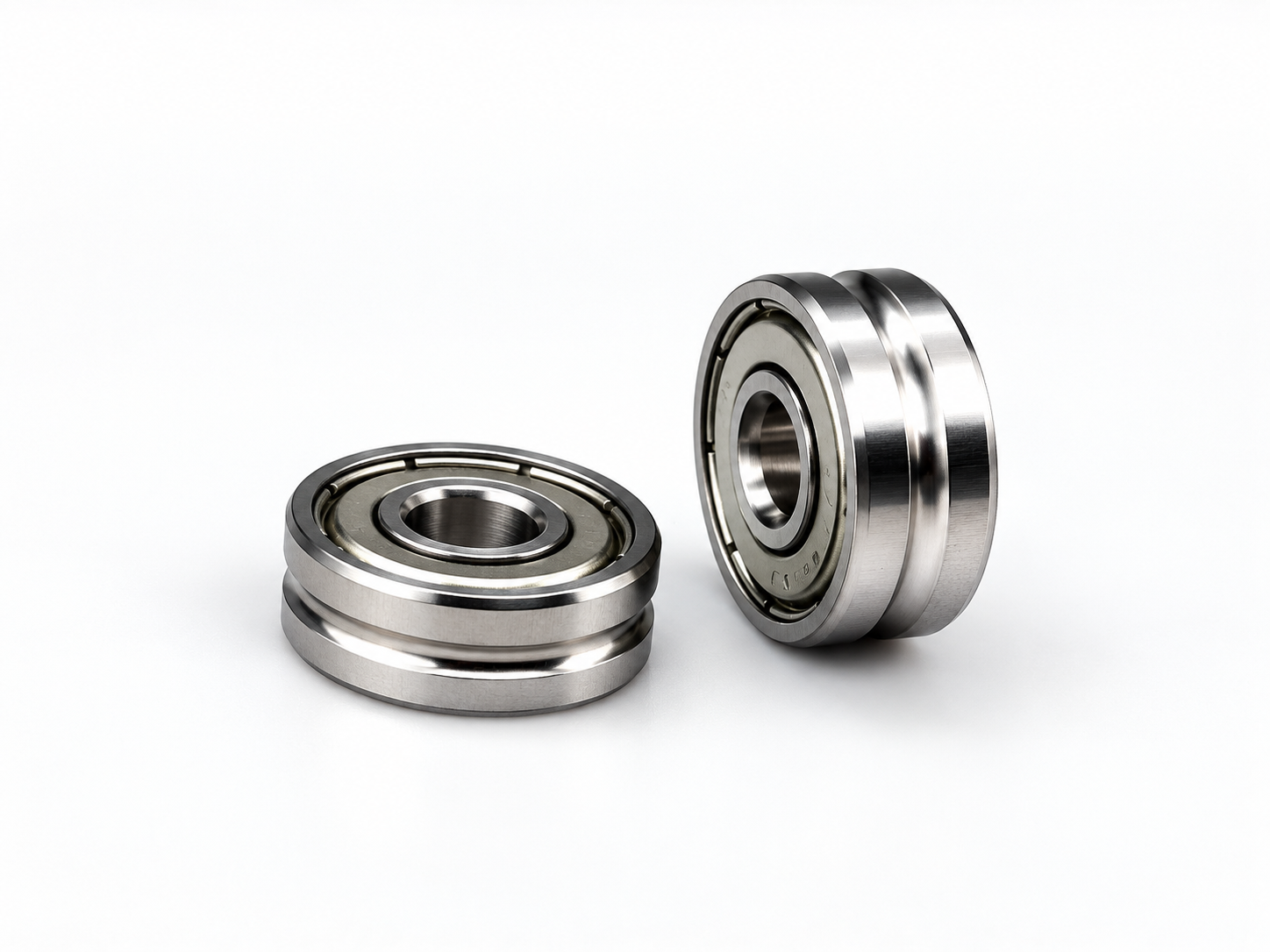
The groove is the working surface
In a U-groove guide bearing the wire runs directly in the outer ring. Groove radius, groove depth, surface finish and radial runout of the groove determine wire guidance, wire surface quality and noise; the internal bearing determines speed and running smoothness.
What the designation means
In common trade use, the number 624 or 625 refers to the miniature deep groove ball bearing size family on which the guide wheel is based. The outer ring is made thicker than on the plain bearing so that a U-shaped groove can be turned and ground into it. As a result, the outside diameter and sometimes the width of a 624UU-type guide wheel are not the same as those of a plain 624 bearing.
| Part of the name | Common use | What to confirm |
|---|---|---|
| 624 / 625 | Internal bearing size family (bore and internal design) | Measured bore and width |
| U | U-shaped groove on the outer ring | Groove radius, groove depth, groove position |
| UU / ZZ / 2RS | Varies between suppliers: may indicate the groove form, shields on both sides, or seals on both sides | Shield or seal type by inspection of the sample |
| Other prefixes and suffixes | Supplier-specific: material, groove variant, precision | Supplier's documentation or sample |
Because the suffix system is not uniform, the name alone does not define the part. For suffix conventions on standard bearings in general, see bearing suffix guide. Dimensions are confirmed per designation or sample before quotation; we do not publish a generic dimension table for these guide wheels.
Where 624UU / 625UU-type guide wheels are used
Winding machines
Guide the wire or thread onto the bobbin; low mass and low friction reduce tension variation.
Traverse units
Wire guides or rail guides on reciprocating traverse mechanisms; frequent direction changes.
Wire and cable lines
Pulleys and guides on drawing, stranding and take-up equipment, and small straightening units.
The same form is also used as a small track roller on round rails or shafts, for example on light linear guides and 3D printer carriages. For larger cable, copper wire and PV ribbon guides, see guide rollers for cable, copper wire and PV ribbon.
Matching the groove to the wire
The groove is designed around the diameter of the wire, thread or rail that runs in it. The groove radius is usually made somewhat larger than the wire radius so that the wire is guided without being pinched; the exact relationship depends on the wire material, the wire tolerance and the required guidance accuracy, and is agreed per application.
| Groove condition | Effect on the wire | Effect on the guide wheel |
|---|---|---|
| Groove radius too small for the wire | Wire rides on the groove edges; two-point pinching; surface marking of soft wire | Edge wear, higher local contact stress |
| Groove radius matched | Wire seats in the groove bottom; stable guidance | Even wear in the groove bottom |
| Groove radius too large | Wire wanders sideways in the groove; tension variation; poorer winding pattern | Wear track moves; possible noise |
| Groove too shallow | Wire can jump out of the groove at direction changes or tension loss | — |
| Rough or damaged groove surface | Scratches or coating damage on fine or coated wire | Accelerated wear, especially with hard wire |
Wire lines that run several wire diameters on the same machine sometimes use one groove size for a range; in that case state the full range of wire diameters so that the groove can be checked for both the smallest and the largest wire.
Shields, seals and speed
| Closure | Advantages | Limits |
|---|---|---|
| Open | Lowest friction | No protection; relies on clean environment and external lubrication |
| Metal shields (ZZ) | Low friction; suitable for higher speed; retains grease | Non-contact: fine dust and wire drawing lubricant can still enter |
| Rubber contact seals (2RS) | Better exclusion of dust and fluid | Higher friction and starting torque; lip speed limits the maximum speed |
On winding and traverse units the guide wheel is often driven only by the wire. Low starting torque then matters: a high-friction seal can make the wheel hesitate or skid, which marks the wire. Shields are therefore common on these positions; contact seals are used where dust or fluid would otherwise enter. See seal lip speed limits and ZZ vs 2RS for the general trade-off. Grease type also influences starting torque, particularly in cold conditions.
Identifying a replacement by measurement
| Dimension / feature | How to measure | Why it matters |
|---|---|---|
| Bore d | Pin gauge or bore gauge on the inner ring | Fit on the shaft or pin |
| Outside diameter at the flanges | Micrometer across the groove flanges | Space envelope and clearance to adjacent parts |
| Width (inner ring and outer ring) | Micrometer; note if inner and outer ring widths differ | Axial position of the groove |
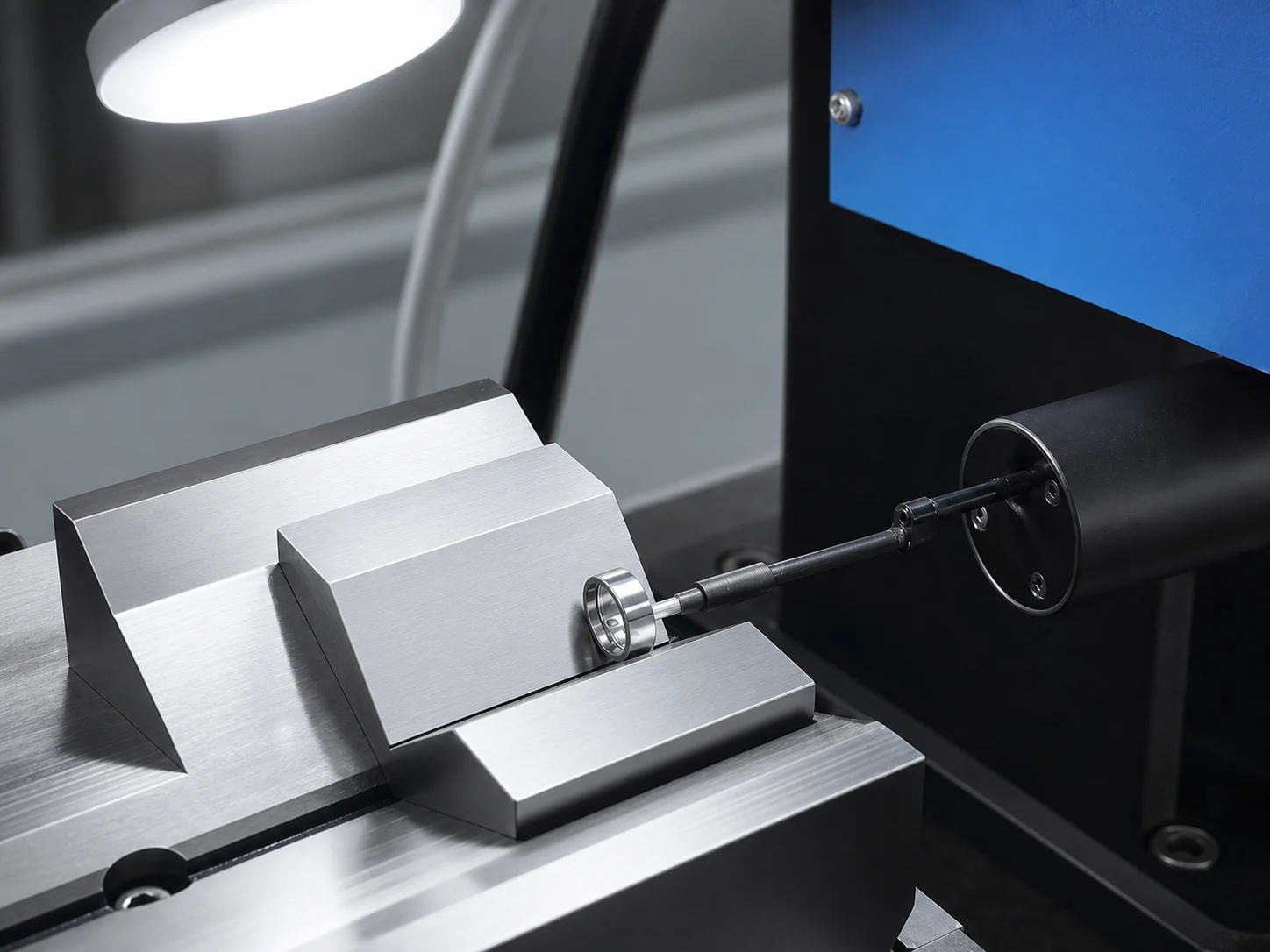
| Groove radius | Radius gauge, profile projector or profile measurement | Determines wire guidance |
| Groove bottom diameter | Measured at the groove bottom | Sets the wire path and effective pulley diameter |
| Groove position | Distance from the groove centre to a reference face | Wire alignment on the machine |
| Closures and material | Visual inspection; material from the marking, supplier documentation or a material check | Sealing, friction, corrosion resistance |
Measure on an unused sample where possible. A worn guide wheel has a deepened, widened groove that no longer represents the original profile. Send measured values together with the wire diameter, wire material and line speed.
Common problems on guide wheels
| Symptom | Likely cause | Check |
|---|---|---|
| Groove worn into a step or deep track | Hard or abrasive wire; wheel not turning freely; groove too small | Bearing rotation by hand, wire material, groove radius |
| Wire scratched or coating damaged | Rough groove, embedded particles, wheel hesitating | Groove surface, starting torque of the bearing |
| Noise or vibration | Contaminated bearing, groove runout, worn groove | Rotate by hand; compare with a new wheel |
| Wire jumping out of the groove | Groove too shallow or too wide; alignment | Groove depth and position, machine alignment |
U-groove and V-groove guide wheels
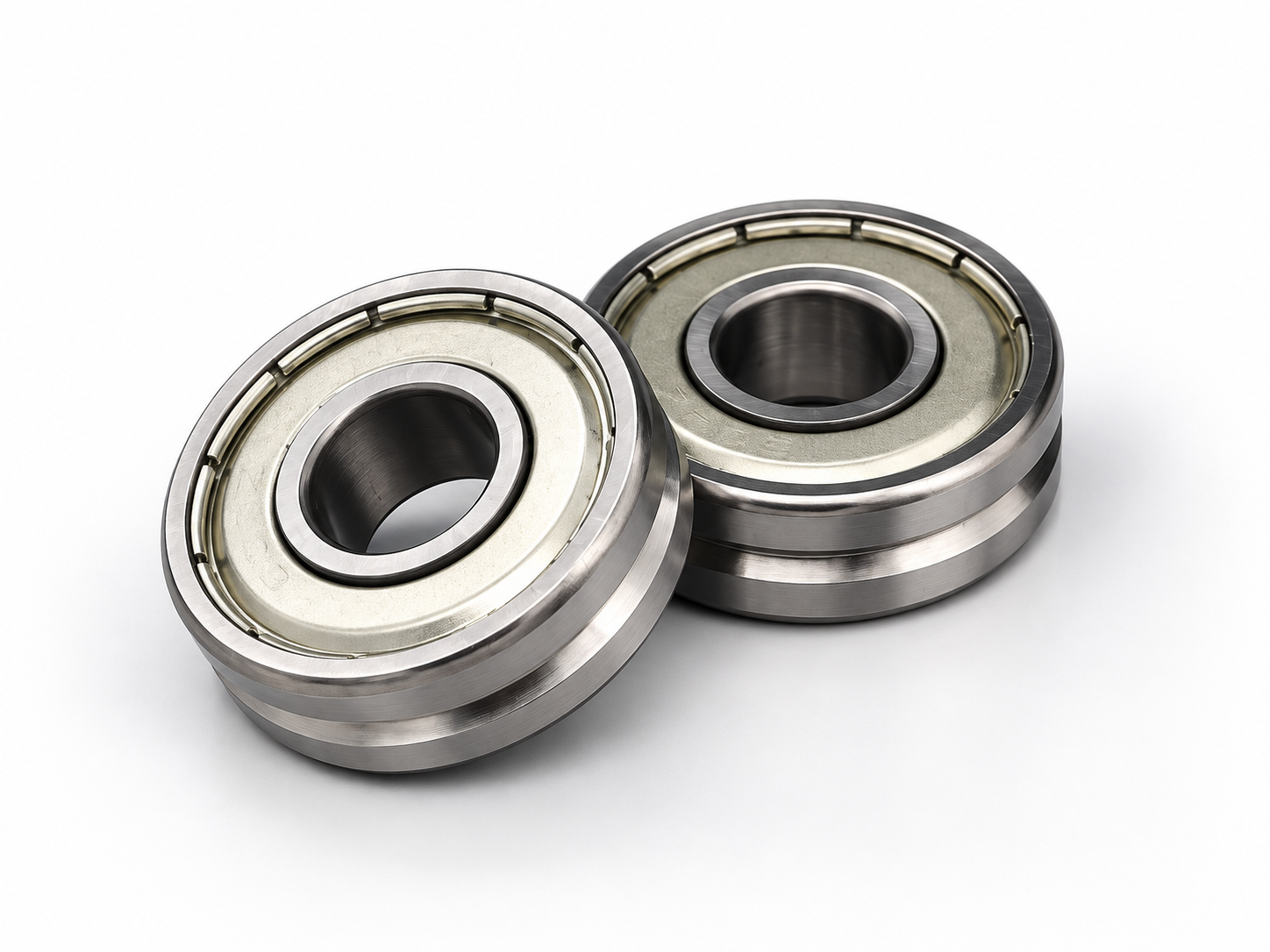
We make U-groove and V-groove guide wheels, including 624U / 625U-type miniature designs, to designation, sample or drawing, with dimensions, groove profile, closures and material confirmed before quotation. NLHB manufactures miniature and deep groove ball bearings up to P4 precision, and double row angular contact bearings and track rollers up to P6.
Evidence from our workshop
What to send for a quotation
- Designation and supplier of the current part, with photos; a sample if available.
- Measured bore, outside diameter, widths, groove radius, groove bottom diameter and groove position.
- Wire or rail diameter (or range), wire material and coating.
- Line speed, whether the wheel is wire-driven, and environment (dust, drawing lubricant, humidity).
- Closure type, material (chrome or stainless steel), quantity and sample requirements.
Frequently Asked Questions
What is a 624UU bearing?
It is a common trade name for a miniature U-groove guide wheel based on the 624 bearing size family, with an enlarged outer ring carrying a U-shaped groove. Suffix meanings vary between suppliers, so confirm the dimensions on the sample.
Is a 624UU the same size as a 624 bearing?
No, not on the outside. The bore family is the same, but the outer ring is enlarged to carry the groove, so the outside diameter and sometimes the width differ from a plain 624.
How do I choose the groove size for my wire?
The groove radius should be matched to the wire diameter so the wire seats in the groove bottom without being pinched on the edges or wandering sideways. State the wire diameter or range and the wire material; the groove is agreed per application.
Should I choose shields or rubber seals?
Shields give lower friction and starting torque, which suits wire-driven wheels and higher speeds. Rubber contact seals exclude dust and fluid better but add friction. Choose by environment and by whether the wheel is driven only by the wire.
Can you make U-groove guide wheels to our sample?
Yes. We measure the sample, confirm the dimensions and groove profile, and quote. An unused sample gives the most accurate groove form.
Related guides
Published 2026-09-25. Images show our own workshop and representative products. Final dimensions, grades, inspection limits and supply conditions are confirmed against the requested model, drawing and order.