Short answer. Treating every row of a 100–300+ line plant MRO bearing BOM the same way either stalls purchasing for months or causes costly line-down mismatches. The reliable method is a four-tier engineering triage: standardize common ISO metric bearings first (Tier 1), lock down suffix-critical motor, snap-ring, inch, and agricultural items (Tier 2), pull physical samples or drawings on proprietary OEM house numbers (Tier 3), and retain or PPAP-validate safety-critical assemblies (Tier 4).
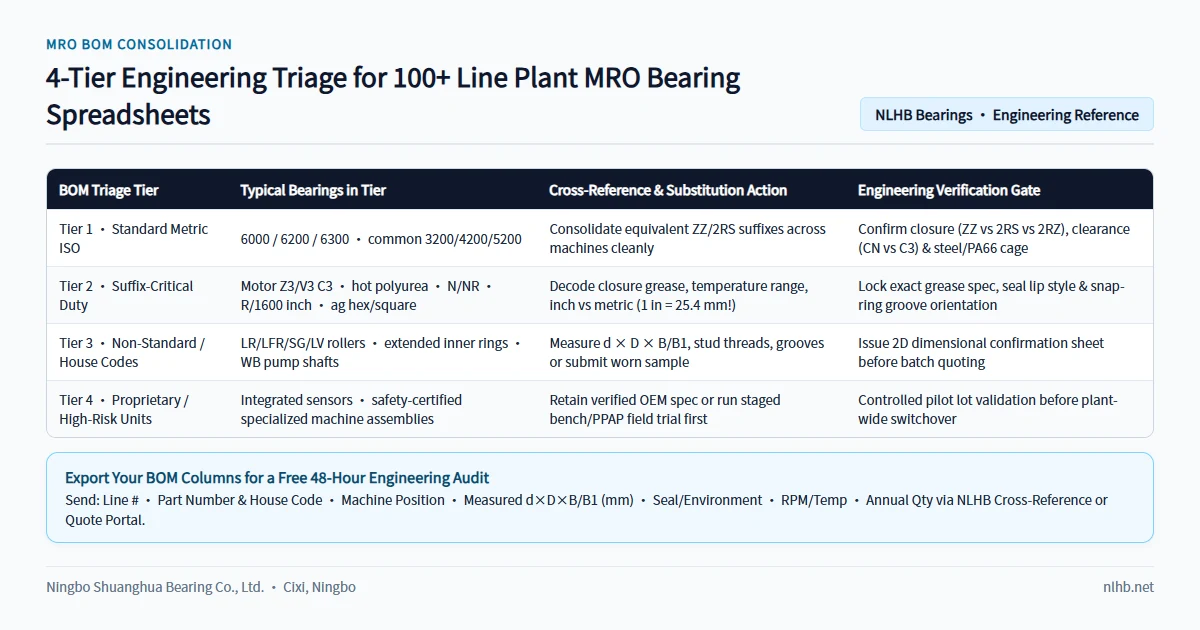
Across multi-line factories, duplicate legacy part numbers for the exact same 6205-2RS or 6306 ZZ C3 routinely inflate SKU counts by 20–40%. Cleaning the list by physical function rather than surface label cuts inventory complexity while preventing accidental clearance, seal, or inch/metric mix-ups.
Why raw plant MRO BOMs fail blind cross-referencing
Spare-parts exports exported from ERP or CMMS databases rarely arrive clean enough for one-click conversion:
- Duplicate closure notations hide identical bearings. A maintenance store often stocks
6204-2RS1,6204-DDU,6204-LLU, and6204-2RSRas four separate SKUs even when every machine uses a standard20 × 47 × 14 mmcontact-sealed deep groove bearing. - Truncated suffixes destroy critical specs. Buyers who strip
C3,Z3V3,NR, or high-temp polyurea grease suffixes down to the four-digit base number receiveCNgeneral-purpose bearings that seize on hot electric motor shafts. - Inch and metric look-alikes break housings. Rounding
1.000 in(25.400 mm) down to25 mmduring manual spreadsheet cleanup creates immediate shaft interference failures or loose spinning races. - OEM equipment numbers bypass standard catalogs. Track rollers, cam followers, water-pump integral shafts (
WB), extended inner rings (B1 ≠ B), and agricultural square/hex-bore units rarely match generic metric number decoders.
The 4-tier engineering BOM triage framework
Sort every line item on your plant list into four engineering buckets before requesting quotes or converting suppliers:
| Triage Tier | Typical bearing types | Consolidation & conversion rule | Verification gate before stocking |
|---|---|---|---|
| Tier 1: Standard ISO Metric Drop-Ins | 6000 / 6200 / 6300, standard 3200 / 5200 / 4200 double-row ball bearings |
Normalize legacy vendor closure codes (2RS1 / DDU / LLU / 2RSR → 2RS contact seal; 2Z / 2ZR → ZZ; VV / LLB → 2RZ); verify CN vs. C3 and cage (J steel vs. TN nylon) |
Confirm dimensions, seal type, clearance, and grease class on catalog sheet |
| Tier 2: Suffix-Critical Application Items | Electric motor C3 + Z3/V3 + polyurea grease, N/NR snap-ring bearings, inch R / 1600 series, agricultural square/hex-bore triple-lip units |
Never strip suffixes or convert inch bores loosely (1.000 in = 25.4 mm, not 25 mm); keep application environment tied to the SKU |
Verify vibration grade, grease temperature rating, groove dimensions, and exact inch/mm units |
| Tier 3: Non-Standard / OEM House Numbers | Cam/track rollers (LR / LFR / SG / LV / VW), extended inner rings (B1 ≠ B), water pump WB shafts, custom groove/flange bearings |
Do not guess from generic web cross-charts; match measured d × D × B / B1 drawing or send one used sample for dimensional teardown |
Physical measurement drawing sign-off and dimensional first-article samples |
| Tier 4: Safety-Critical / Proprietary OEM Assemblies | Integrated sensor bearings, ultra-high-precision spindles above P4, OEM-certified safety assemblies |
Retain verified original supply until an engineering change and bench/line trial justify qualification | Staged bench testing, trial run, and PPAP / incoming QC approval |
Handling agricultural and mobile-equipment lines inside a plant BOM
Processing plants, grain terminals, feed mills, and fleet workshops frequently carry heavy agricultural bearing lines alongside standard plant motors. Rather than guessing off worn housing stamps, cross-check specialized mobile-equipment hubs directly:
- Harvester bearings for high-debris threshing, straw-chopper, and feeder drives.
- Tillage bearings for disc harrows and shock-loaded square/hex-bore hubs.
- Tractor bearings for PTO, axle, and clutch positions.
- Seeding and planter bearings for opener discs and metering shafts.
Step-by-step workflow to clean a 100+ line spreadsheet
Follow this five-step sequence with maintenance, stores, and purchasing aligned:
- Export active SKUs with annual usage and equipment location. Flag dead parts versus high-turn motors, conveyors, and process drives first so engineering reviews the highest-impact 20–30% of lines immediately.
- Run initial matching with NLHB online lookup tools. Screen recognizable standard and legacy house numbers through our brand cross-reference tool, filter exact metric/inch sizes in the bearing size finder or bearing number search, and pull PDF dimension sheets from technical downloads.
- Normalize Tier 1 duplicates by functional spec. Merge identical
2RS1 / DDU / LLU / 2RSRlines into one controlled functional specification (model + seal function + clearance + cage + grease class), noting legacy aliases for storeroom bin labels. - Pull physical samples or prints for Tier 3 unknowns. Measure bore (
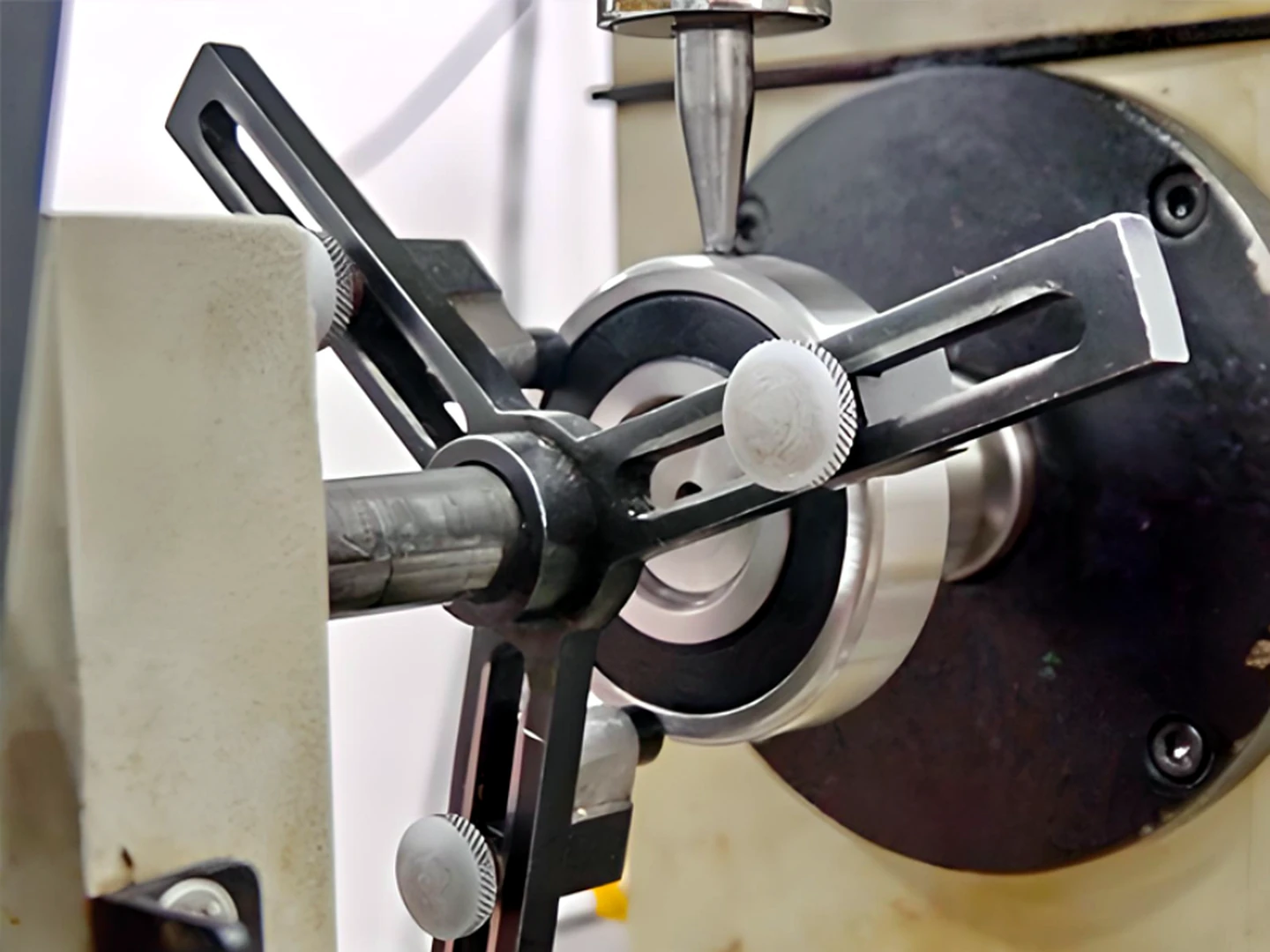
d), outside diameter (D), outer width (B), inner width (B1), chamfers, flange/snap-ring positions, and bore geometry (round, square, hexagonal). - Run a staged qualification on critical Tier 2/3 switches. Follow our verification steps in qualifying replacement bearings from a Chinese factory before committing plant-wide bin replacements.
Ready-to-use Excel BOM submission template
Before sending a multi-line inquiry, structure your spreadsheet with these seven columns so engineering can return a line-by-line triage matrix instead of generic guesswork:
| Line ID | Original part number | Equipment / position | Measured d × D × B / B1 (mm) |
Seal & grease environment | RPM / temp | Annual usage |
|---|---|---|---|---|---|---|
MRO-001 |
6205-2RSH / LLU / C3 (legacy) |
Process exhaust fan motor | 25 × 52 × 15 |
Dust/moisture; high-temp polyurea | 2,950 r/min / 85 °C |
120 pcs |
MRO-002 |
6306NR-Z |
Gearbox input shaft | 30 × 72 × 19 (snap ring) |
Oil splash; single shield | 1,480 r/min / 75 °C |
40 pcs |
MRO-003 |
OEM-TR-4418 (house code) |
Packaging line guide rail | 12 × 35 × 15.9 (V-groove) |
Dry dust; contact seal | 300 r/min / 35 °C |
60 pcs |
MRO-004 |
R12-ZZ (inch bore) |
Light conveyor idler | 19.05 × 41.275 × 11.112 |
Clean indoor; shielded | 900 r/min / 40 °C |
200 pcs |
Frequently asked questions
Can I safely consolidate 2RS1, DDU, LLU, and 2RSR onto one MRO stock code?
Functionally, those notations all indicate double contact elastomer seals (2RS), which lets many general-machinery storerooms consolidate duplicate 6000/6200/6300 SKUs. Before merging high-speed or hot positions, confirm internal clearance (CN vs. C3), seal lip material, and factory grease fill match the machine requirement.
Why should motor bearing C3 and vibration suffixes never be stripped in BOM cleanup?
Motors run warm with interference fits on the inner ring. Replacing a specified 6205-2RS-C3 with a default CN bearing removes operating clearance and leads to overheating, noise, and early seizure. Vibration suffixes (Z3 / V3) also protect quiet motor assemblies.
How should I handle an inch bearing like 1.000 in bore during BOM consolidation?
Keep inch dimensions exact (1.000 in = 25.400 mm) and never round down to 25 mm. A 0.4 mm bore error prevents shaft assembly or causes severe damage; verify both original inch markings and exact millimeter measurements.
What if 15% of our plant BOM consists of OEM equipment house numbers with no standard code?
Move those lines into Tier 3 instead of forcing a catalog guess. Record d × D × B / B1 measurements, bore shape, flange or groove geometry, and sealing style—or send a worn sample for teardown—so dimensions and internal features are verified before quoting.
Does NLHB offer full line-by-line engineering review on 100+ item Excel BOMs? Yes. Send your structured Excel BOM (including original part numbers, equipment positions, measured dimensions where known, and operating conditions) and NLHB will triage standard equivalents, suffix-critical parts, and custom drawings before sampling.
Which precision and bearing families can NLHB supply for consolidated industrial BOMs?
NLHB manufactures miniature, thin-section, and 6000/6200/6300 deep groove ball bearings up to P4, double-row angular contact and track rollers up to P6, plus agricultural, pulley, water-pump (WB), and custom non-standard bearings from Cixi, China.
Sources and data boundary
Cross-reference matches align external geometry (d, D, B, snap-ring/flange features) and functional closure/clearance categories. Differences in ball complement, cage material, seal lip interference, and grease chemistry can still affect load rating and life; critical machinery must be validated by sample inspection and machine trial prior to full rollout.
- ISO 15, Rolling bearings — Radial bearings — Boundary dimensions, general plan.
- ISO 492 / GB/T 307.1, Rolling bearings — Radial bearings — Tolerances.
- ISO 5753 / GB/T 4604, Rolling bearings — Internal clearance.
- GB/T 272, Rolling bearings — Identification code.
Related guides
- Brand cross-reference tool
- Bearing size finder
- Bearing number search
- Technical downloads and PDF size charts
- Qualifying replacement bearings from a Chinese factory
Upload or send your Excel MRO BOM with original part numbers, equipment positions, and operating conditions to receive a line-by-line cross-reference and triage review: request a quote.