High-speed motors in cordless vacuum cleaners and hair dryers run far faster than conventional appliance motors, in a small housing, with an impeller on the shaft and the user holding the product. The two rotor bearings must stay quiet, cool and stable over thousands of start-stop cycles. This guide explains the choices that decide whether they do: precision grade, cage, grease, ball material, balancing, preload and heat management.
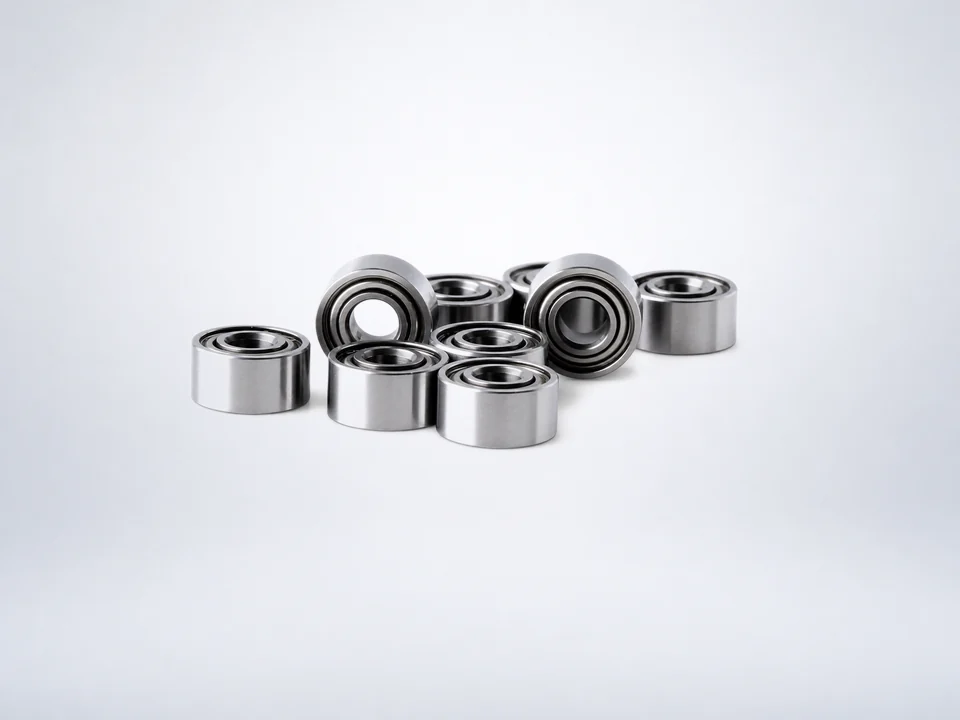
Small bearings, high dynamic load
At high speed, centrifugal force on the balls, cage stability, grease churning and runout-induced vibration dominate. The rated load of the bearing is rarely the limit; heat and dynamics are.
Why these motors are demanding
| Condition | Effect on the bearing | What to specify |
|---|---|---|
| Very high rotor speed | Centrifugal load on balls, cage stress, grease churning heat | Precision grade, cage type, high-speed grease, ball material |
| Compact housing near the winding and electronics | High bearing temperature, thermal growth of shaft and housing | Clearance, fits, grease temperature range |
| Impeller mounted on the shaft | Unbalance forces transmitted to the bearings | Runout grade, rotor balancing after assembly |
| Handheld use, frequent start-stop | Noise and vibration are felt directly; grease must recover after each start | Z/V grade or agreed noise test, grease with stable low-noise behaviour |
| Dust (vacuum) or hot air (hair dryer) in the flow path | Contamination or extra heat at the bearing seat | Shields, sealing of the motor housing, heat path from the bearing seat |
Precision grade: P5 or P4
At high speed, radial runout of the inner ring and small geometric errors of the raceways become forcing frequencies that the rotor and housing amplify. Moving from P6 to P5 or P4 tightens dimensional tolerances and, more importantly, running accuracy. We produce miniature and deep groove ball bearings up to P4; tolerance values are defined in GB/T 307.1 and ISO 492. See P4, P5 and P6 deep groove bearings.
- P5 is a common starting point for high-speed appliance motors; P4 is considered when noise, vibration or balance targets are not met at P5.
- The shaft and housing seats must match the bearing grade. A P4 bearing on an out-of-round seat behaves like a lower grade.
- Agree running accuracy and vibration acceptance together; precision grade alone does not define noise.
Cage and grease
| Item | Options | High-speed considerations |
|---|---|---|
| Cage | Pressed steel · nylon (polyamide) | Nylon is light and quiet and suits many high-speed miniature bearings, but has a temperature limit that must cover the bearing seat temperature. Steel cages tolerate higher temperatures. We fit steel or nylon cages to the customer's requirement. |
| Grease type | High-speed low-noise grease · general-purpose grease | High-speed greases use lower-viscosity base oils to reduce churning friction; the temperature range must cover motor operation and storage. |
| Grease fill | Agreed percentage of free volume | Excess grease is the most frequent cause of high temperature at start-up. Fill quantity is written on the order and held constant between batches. |
| Closure | Open · ZZ | Shields keep grease in and dust out without adding lip friction. Contact seals are normally avoided at the highest speeds. |
Hybrid ceramic balls (Si₃N₄)
Silicon nitride balls have a density of roughly 40% of bearing steel, so centrifugal force on each ball is correspondingly lower at the same speed. They are also harder and stiffer than steel balls and electrically insulating. In high-speed motors this typically means lower heat generation and better tolerance of marginal lubrication. We produce miniature bearings with silicon nitride balls, with bearing steel or stainless steel rings. For a general comparison, see our high-speed bearing selection guide.
- Hybrid bearings cost more; use them where tests show a temperature, noise or life problem with steel balls, not by default.
- Ceramic balls change contact stiffness; noise and preload settings validated with steel balls must be re-checked.
Rotor balancing and the bearing
The motor maker balances the rotor with its impeller; the bearing influences how well that balance holds in service.
- Specify the bearing runout grade before setting the rotor balance target; bearing runout appears as a once-per-revolution error that balancing cannot remove.
- Control the fits. A loose inner-ring fit lets the rotor shift and the balance change after running; an excessive interference fit reduces clearance.
- Balance the rotor in its bearings, or on a fixture that reproduces the bearing seats, where the process allows.
- Re-check balance and vibration after run-in, when the grease has distributed.
Preload and clearance
Two deep groove ball bearings on a high-speed rotor are usually given a light axial preload, commonly with a wave spring or spring washer acting on the outer ring of one bearing, which then needs a sliding fit in the housing. Preload removes axial play, keeps the balls rolling instead of skidding, and reduces noise. Too much preload raises friction and temperature; too little allows skidding and axial movement.
- Select radial clearance together with the preload and the fits; see C3, CN and C4 clearance.
- Keep the spring force consistent from motor to motor; spring tolerance is as important as the nominal value.
- The sliding outer ring must be able to move as the shaft grows with temperature, or preload rises during operation.
Heat: where it comes from and how to validate
- List the heat sources at the bearing seat: winding and electronics, grease churning, seal friction, preload, and hot air in hair dryers.
- Measure bearing seat temperature on prototype motors across the full operating cycle, not only at steady state.
- Check that clearance, cage and grease temperature limits all cover the measured temperature with margin agreed by the design team.
- Run start-stop and endurance tests and record noise, vibration and temperature at intervals.
- Inspect tested bearings: grease condition, cage wear and raceway marks show the actual limiting factor.
Our scope for high-speed motor bearings
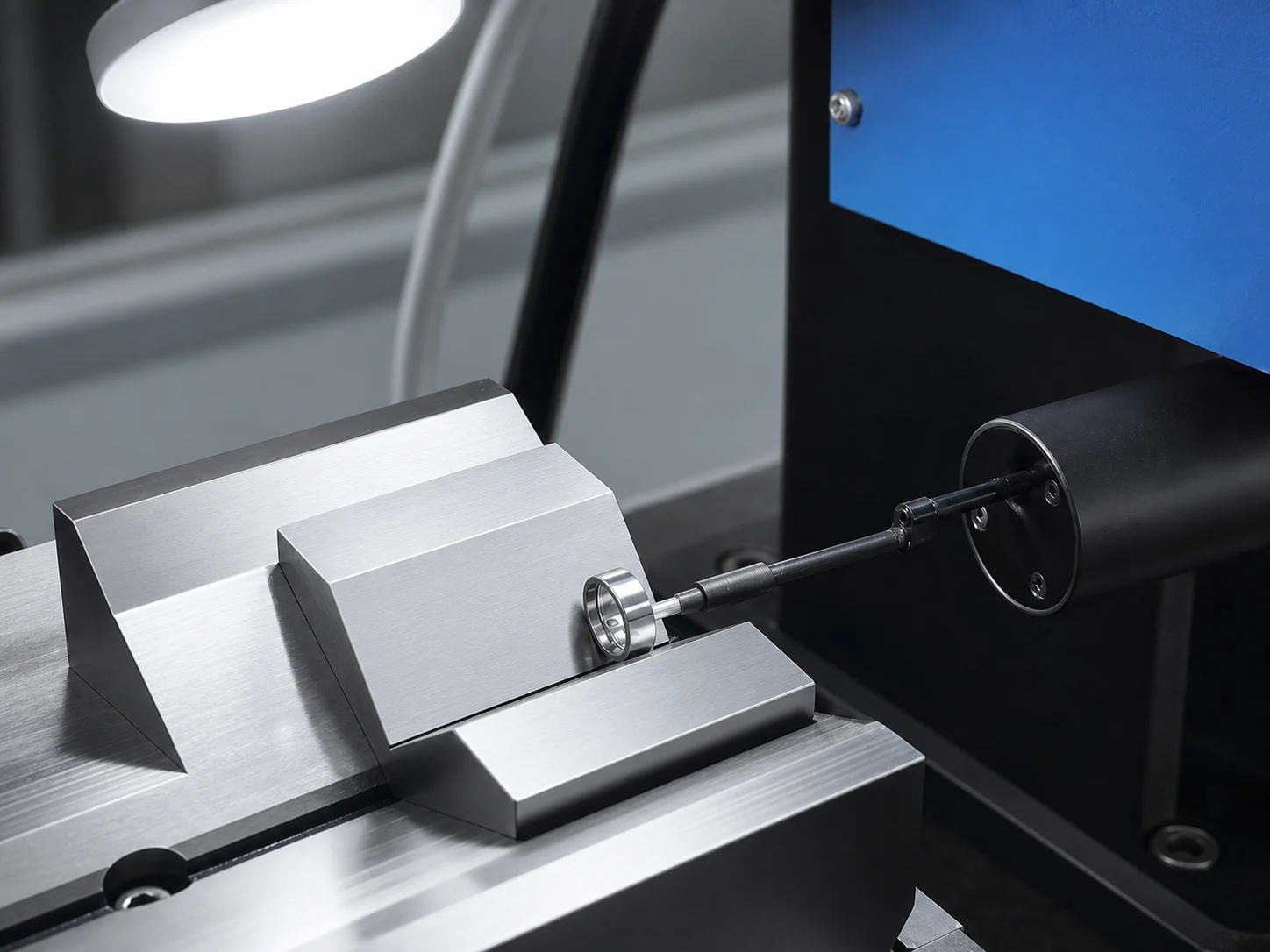
We produce miniature and deep groove ball bearings up to P4, with bearing steel or stainless rings, steel or silicon nitride ceramic balls, and steel or nylon cages to the customer's requirement, and sort finished bearings on our own vibration testers. NLHB manufactures miniature and deep groove ball bearings up to P4 precision, and double row angular contact bearings and track rollers up to P6.
Evidence from our workshop

What to send for a quotation
- Bearing size or drawing, and quantity.
- Motor type (vacuum suction or hair dryer), speed range as a design value, and bearing seat temperature.
- Precision grade, radial clearance and noise acceptance method.
- Cage, ball material (steel or Si₃N₄), closure and grease with fill quantity.
- Preload arrangement and fits, if already defined.
Frequently Asked Questions
What precision grade is used for high-speed vacuum motor bearings?
P5 is a common starting point and P4 is used where noise, vibration or balance targets require it. The shaft and housing seats must be made to a matching accuracy.
Are ceramic ball bearings necessary for cordless vacuum motors?
Not always. Hybrid bearings with silicon nitride balls reduce centrifugal load and heat, so they are used where steel-ball bearings show temperature, noise or life problems in testing.
Nylon or steel cage for a hair dryer motor?
Nylon cages are light and quiet, but the bearing seat temperature must stay within the cage material's limit. Where the seat runs hot, a steel cage is the safer choice.
Why are high-speed motor bearings preloaded?
A light axial spring preload removes axial play and keeps the balls rolling rather than skidding, which reduces noise and wear. The preload must be light and consistent to avoid extra heat.
Can NLHB supply P4 miniature bearings with ceramic balls?
Yes. We produce miniature bearings up to P4 with silicon nitride ceramic balls and bearing steel or stainless rings, with steel or nylon cages as required.
Related guides
Published 2026-09-25. Images show our own workshop and representative products. Final dimensions, grades, inspection limits and supply conditions are confirmed against the requested model, drawing and order.