A mast roller is a bearing whose outer ring runs directly on the mast channel. It carries the fork carriage load, takes shock when the load is set down or the truck crosses uneven floor, and works in dust without much maintenance. This guide explains the construction options, what decides load capacity and life, how to identify a replacement by dimensions, and how to judge wear. NLHB manufactures forklift mast and lift carriage rollers to sample or drawing.
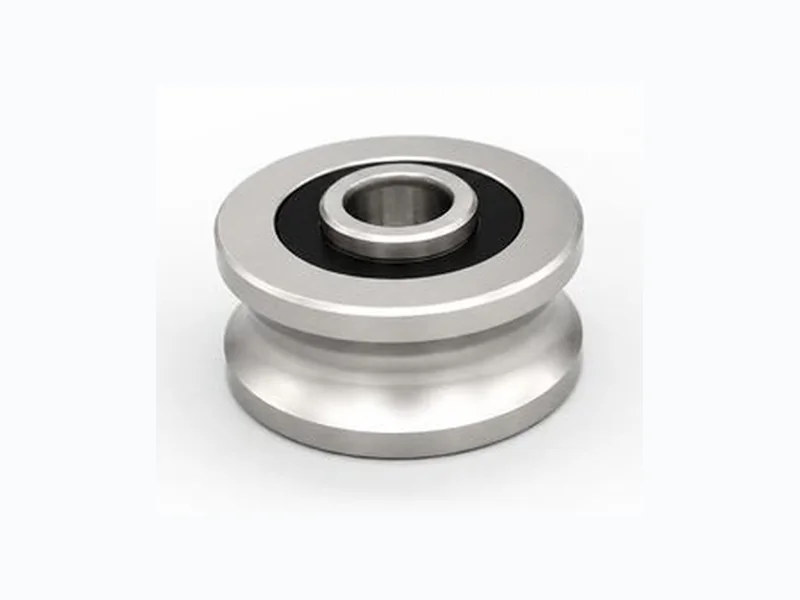
The outer ring is the running wheel
Unlike a housed bearing, a mast roller has no housing to support the outer ring. The ring wall must carry line contact on the channel, bending from concentrated load and repeated shock, so wall thickness, OD profile and ring hardness matter as much as the internal rolling elements.
Where mast rollers and carriage rollers work
Main mast rollers
Guide the inner mast sections inside the outer channels during lifting and lowering.
Carriage rollers
Carry the fork carriage and the load moment in the inner mast channel.
Side and combined rollers
Take lateral load from off-centre loads and side-shift, keeping the carriage aligned in the channel.
Construction options
| Feature | Options | Engineering effect |
|---|---|---|
| Outer ring wall | Standard wall · thick wall | A thick wall spreads load along the ring and reduces ring bending under concentrated contact on the channel |
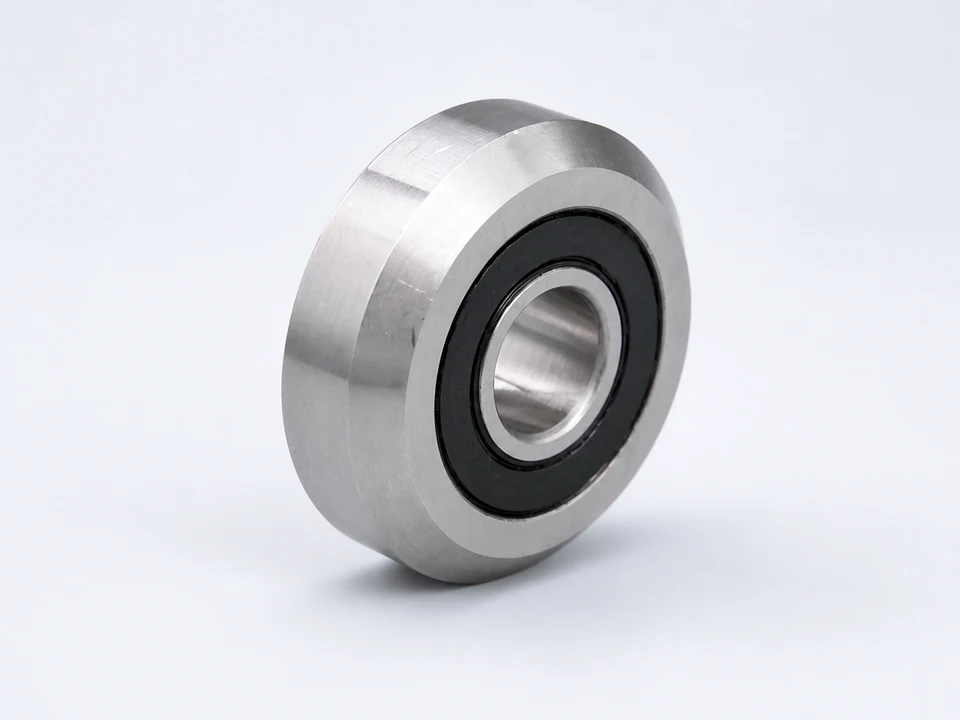
| OD profile | Flat (cylindrical) · crowned | Flat OD gives line contact on a flat flange; a crowned OD tolerates misalignment and channel deflection and reduces edge loading |
| Rolling elements | Full-complement cylindrical rollers · caged rollers · caged balls | Full complement maximises radial capacity for slow, heavily loaded motion; caged designs run with less friction and suit higher speed |
| Rows | Single row · double row | Double row increases capacity and resists tilting of the outer ring |
| Side guidance | Plain radial roller · separate side roller · combined radial + axial roller | A combined roller carries radial load and lateral thrust in one unit on one mounting |
| Sealing | Shields · contact seals · labyrinth | Contact seals keep out channel dust; they add some friction, which is acceptable at mast speeds |
| Mounting | Through-bore · welded or bolted stub shaft · eccentric adjustment | Shims or eccentric adjustment set the running clearance between roller and channel |
For the difference between full-complement and caged internal designs in general, see full complement vs caged bearings. The final construction of a given roller is confirmed against the drawing or sample.
Load and shock: what decides roller life
- Load distribution. The load moment of the carriage is shared unevenly between upper and lower rollers. Check which position is most heavily loaded rather than dividing the capacity by the number of rollers.
- Shock. Setting a load down hard, driving over dock plates and uneven floors produce peak loads well above the static load. Static load rating (ISO 76) and ring wall strength are the limiting factors, not only dynamic life (ISO 281).
- Contact geometry. Edge loading on a flat OD from channel deflection or misalignment wears the ring edge first. A crowned OD or corrected shimming moves the contact back to the centre.
- Running clearance in the channel. Too much clearance lets the carriage rock and hammer the rollers; too little causes binding and skidding of the rollers.
- Contamination and lubrication. Channel dust and water reach the seals directly. Seal type and grease should suit the working environment, including cold stores and outdoor yards.
Replacing a mast roller by dimensions
Many mast rollers carry an OEM part number that does not appear in bearing catalogues. Replacement is done by measuring the roller and matching the functional dimensions, not only the bore and OD.
| Dimension / feature | How to measure | Why it matters |
|---|---|---|
| Bore d (or stub shaft diameter) | Micrometer or bore gauge on the inner ring or shaft | Fit on the mounting pin or shaft |
| Outer diameter D | Micrometer at several positions on an unworn area | Sets the running clearance in the channel |
| Outer ring width C | Caliper across the outer ring | Must fit the channel flange width |
| Inner ring width B | Caliper across the inner ring; often wider than the outer ring | Sets axial position and clamping on the mounting |
| OD profile | Flat or crowned; check with a straight edge or profile gauge | Changes contact pattern on the channel |
| Side roller or thrust face | Diameter, width and position of the axial element | Required for combined rollers |
| Seals, lubrication holes, mounting features | Visual check and photos | Affect sealing, relubrication and assembly |
Send these measurements with photos of the roller, its mounting position and any marking. Cross-referenced numbers are dimensional equivalents only and do not imply brand authorisation.
Inspecting mast rollers for wear
| Symptom | Likely cause | Action |
|---|---|---|
| Flat spots on the OD | Roller skidding because of seized bearing or binding in the channel | Replace the roller; check channel alignment and running clearance |
| Ring edge wear or step on the OD | Edge loading from misalignment or channel deflection | Check shimming; consider a crowned OD |
| Radial play felt by hand | Worn rolling elements or raceways | Replace; compare with a new roller of the same design |
| Rough rotation or noise | Contamination, lost grease, seal damage | Replace; review seal type for the environment |
| Cracked or chipped outer ring | Shock overload or insufficient wall section | Replace and review wall thickness and load case |
| Worn channel surface | Rollers stopped turning or wrong OD profile | Correct the roller problem before the channel is damaged further |
Wear limits for OD, play and channel clearance are defined by the truck manufacturer's service documentation. Replace rollers on the same position in sets so that clearance and load sharing stay balanced.
Mast and carriage rollers to sample or drawing
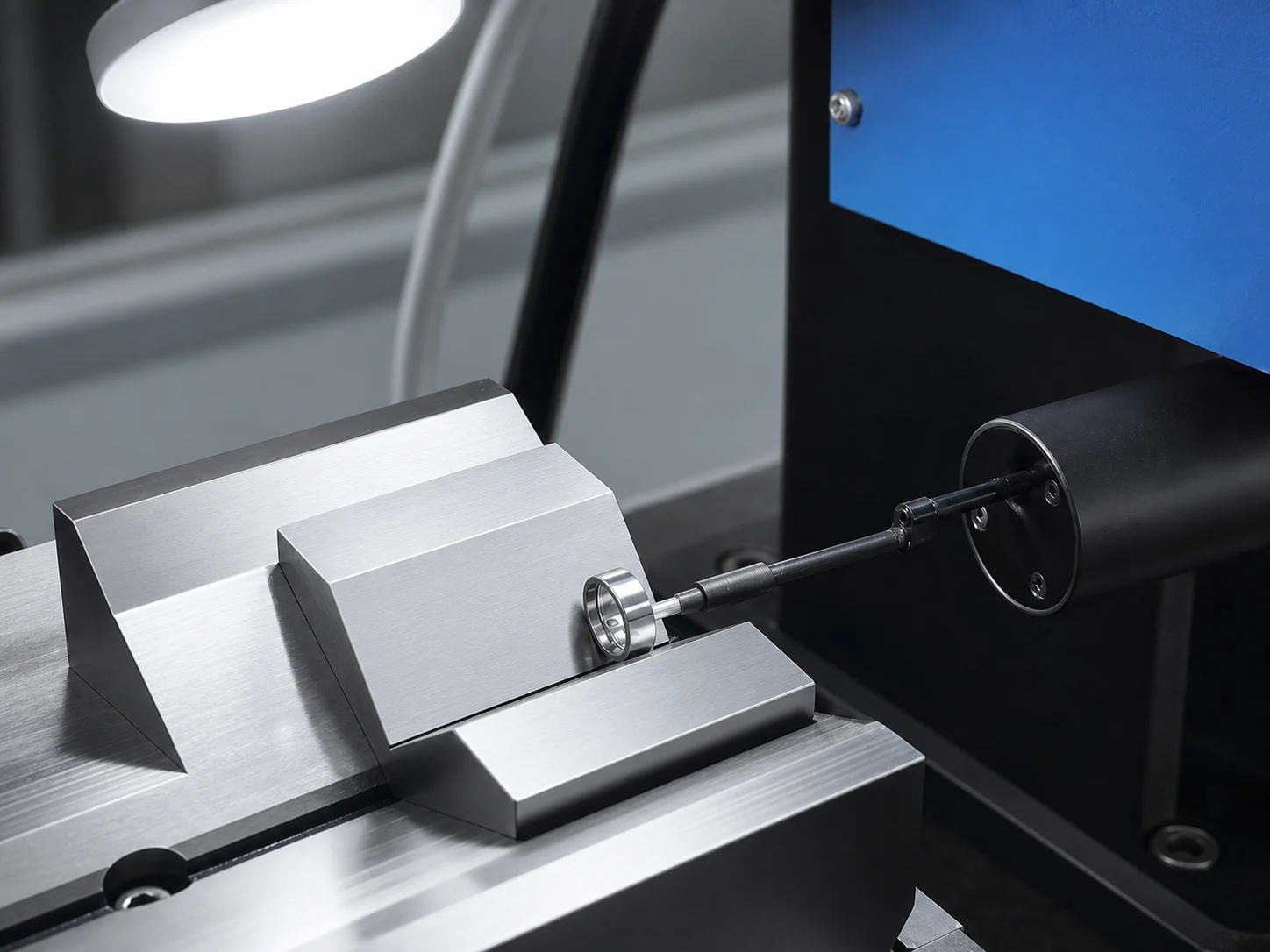
We produce forklift mast and lift carriage rollers, including thick-walled flat and crowned designs, and can measure a worn roller to reproduce it. Turning, raceway grinding and assembly are done in our Cixi factory; heat treatment is done by long-term partners. NLHB manufactures miniature and deep groove ball bearings up to P4 precision, and double row angular contact bearings and track rollers up to P6.
Evidence from our workshop
What to send for a quotation
- OEM part number or existing roller marking, with photos of the roller and mounting.
- Measured d, D, outer and inner ring widths, OD profile (flat or crowned).
- Roller type: radial, side or combined; seal and lubrication features.
- Truck or mast type, rated capacity and working environment (dust, cold store, outdoor).
- Quantity, and whether samples are required before volume.
Frequently Asked Questions
What is a forklift mast roller?
It is a heavy-section bearing whose outer ring runs directly on the mast or carriage channel. It guides the mast sections and carries the carriage load during lifting.
Why do mast rollers have a thick outer ring?
The outer ring has no housing to support it. A thick wall reduces ring bending under concentrated contact on the channel and improves shock resistance.
Flat or crowned outer diameter — which is better?
A flat OD gives line contact on a well-aligned flat channel. A crowned OD tolerates misalignment and channel deflection and reduces edge wear. Use the profile of the original design unless wear shows edge loading.
Can I replace a mast roller without the OEM number?
Yes, by measuring bore, OD, outer and inner ring widths, OD profile and any side roller, and sending photos of the mounting. We confirm a drawing before production.
How do I know when a mast roller is worn out?
Look for flat spots, edge wear, radial play, rough rotation, cracks or a worn channel. Apply the wear limits in the truck manufacturer's service documentation.
Related guides
Published 2026-09-25. Images show our own workshop and representative products. Final dimensions, grades, inspection limits and supply conditions are confirmed against the requested model, drawing and order.