A miniature bearing that feels rough, notchy or tight after assembly is rarely a random defect. Small balls and thin rings make miniature bearings sensitive to forces, particles and handling that a larger bearing would tolerate. Most causes leave recognisable traces. This guide describes the common causes, a step-by-step diagnosis that separates assembly damage from supply problems, and the assembly practices that prevent them.

Rough, notchy and tight are different symptoms
Notchy rotation with regular detents usually points to raceway indentations at ball spacing. Random roughness or crunching points to particles or corrosion. Uniformly tight rotation points to lost clearance or grease. Describing the symptom accurately is the first diagnostic step.
Symptoms and likely causes
| Symptom | Likely cause | Typical trace on teardown | Where it usually starts |
|---|---|---|---|
| Regular notches at ball spacing | True brinelling: plastic indentation of the raceway | Indentations at ball pitch on one or both raceways | Pressing through the balls, hammering, dropping |
| Notches after transport, no impact on record | False brinelling from vibration without rotation | Polished or discoloured marks at ball pitch | Transport or storage of assembled units on a vibrating vehicle |
| Random roughness or crunching | Contamination: particles in the raceway | Small dents at random positions, debris in grease | Machining chips, dust at the assembly station, unclean shafts |
| Roughness with brown or dark spots | Corrosion | Rust or etch marks on raceways or ring faces | Perspiration, humidity, water-based cleaners, condensation |
| Tight all round, worse after mounting | Lost radial clearance | No specific raceway damage in early stage | Interference fits on both rings, oversize shaft, heat |
| Stiff when cold, drag at start | Grease: type, quantity or temperature | Grease condition visible when opened | Unsuitable grease, over-fill, mixed greases |
| Intermittent catching, noise | Cage or shield damage | Deformed cage pockets, dented shield touching the inner ring | Pressing on the shield, handling with tools |
Brinelling from impact or improper press-fit
When the fitting force is applied to the ring that is not being fitted, it passes through the balls. In a miniature bearing the ball-to-raceway contact area is very small, so the contact stress under that force can exceed the limit for plastic deformation and leave shallow dents at every ball position. The result is a regular notch felt at ball spacing. The same effect occurs when a bearing is dropped, hammered onto a shaft, or tapped into a housing. The static load rating (ISO 76) describes the load that causes a permissible amount of permanent deformation; assembly forces transmitted through the balls should be treated as a static load against that rating, with shock loads considered separately.
- Pressing onto a shaft: apply force to the inner ring only.
- Pressing into a housing: apply force to the outer ring only.
- Pressing onto a shaft and into a housing at the same time: use a tool that bears on both rings simultaneously.
- Never press on shields or seals.
Contamination
Particles smaller than can be seen easily are large relative to the contact width in a miniature bearing. Each particle rolled over creates a small dent, and the dents produce random roughness and V-band vibration peaks. Sources include machining chips on shafts and housings, dust at the assembly bench, dirty gloves, and opening packages long before assembly. Open bearings are more exposed than ZZ or 2RS types, but shields do not fully protect a bearing that is handled in a dusty area.
Corrosion
Chrome bearing steel corrodes quickly on a bare surface. Fingerprints, humid storage, condensation when cold parts enter a warm room, and water-based cleaning fluids all cause spots that turn into roughness. Keep bearings in their original packaging until use, handle with gloves or finger cots, and allow cold-stored stock to reach room temperature before opening. Where the environment is wet or corrosive, stainless steel rings are an option; see stainless bearing steels.
Over-tight fit and loss of clearance
An interference fit expands the inner ring or contracts the outer ring and reduces radial clearance. Miniature bearings have small clearance to begin with, so an oversize shaft, an undersize housing, or interference on both rings can remove the clearance entirely. Heat from a motor increases the effect. The bearing then feels uniformly tight rather than notchy. Check the actual shaft and housing sizes, confirm that only the rotating ring has interference unless the design requires otherwise, and select a clearance group suited to the fits; see clearance groups.
Grease problems
Grease can make a sound bearing feel poor. A grease with high base-oil viscosity or a stiff consistency feels heavy at room temperature and more so when cold. Over-filling increases drag and heat. Mixing an added grease with the factory grease can change consistency. Drying out after long storage at high temperature increases torque and noise. These cases feel like drag rather than distinct notches, and the raceways are undamaged.
Cage and shield damage
Pressed-steel cages in miniature bearings are thin and deform if a tool or pin is pushed into the bearing. A shield that has been pressed or struck can deflect and touch the inner ring. Both give intermittent catching or scraping rather than a regular notch.
Diagnosis in six steps
- Record the symptom precisely: notchy, rough, tight or intermittent, and whether it appears before or after mounting.
- Test unmounted bearings from the same batch and package. If they are smooth, the cause is in handling or assembly.
- If unmounted bearings are also rough, check the batch report and retained samples, and involve the supplier.
- Measure shaft and housing diameters of the rejected assemblies against the drawing.
- Remove a rejected bearing without adding new damage, open it if possible, and inspect raceways under magnification: regular dents, random dents, corrosion or debris.
- Review the assembly process: fitting tools, the ring the force acts on, cleanliness of the station, glove use, storage time of opened packages.
Prevention in assembly
| Area | Practice |
|---|---|
| Fitting tools | Sleeves or fixtures that bear on the ring being fitted; guided presses instead of hammers |
| Fits | Shaft and housing tolerances checked on incoming parts; interference on one ring unless designed otherwise |
| Cleanliness | Clean shafts and housings, deburred edges, a dedicated clean assembly area |
| Handling | Gloves or finger cots; bearings kept in original packaging until use |
| Lubrication | No additional grease unless specified; no washing of sealed bearings; no spinning with compressed air |
| Transport of assemblies | Secure rotating parts or reduce vibration to avoid false brinelling |
| Checks | Rotation feel after fitting on a sample; vibration test of the assembly where required |
Miniature bearings from our own production
All our miniature bearings are produced in our Cixi factory, with ZZ steel shields, stainless steel rings, silicon nitride ceramic balls and steel or nylon cages available on request. Finished bearings are inspected for appearance and sorted on our vibration testers before packing. NLHB manufactures miniature and deep groove ball bearings up to P4 precision, and double row angular contact bearings and track rollers up to P6.
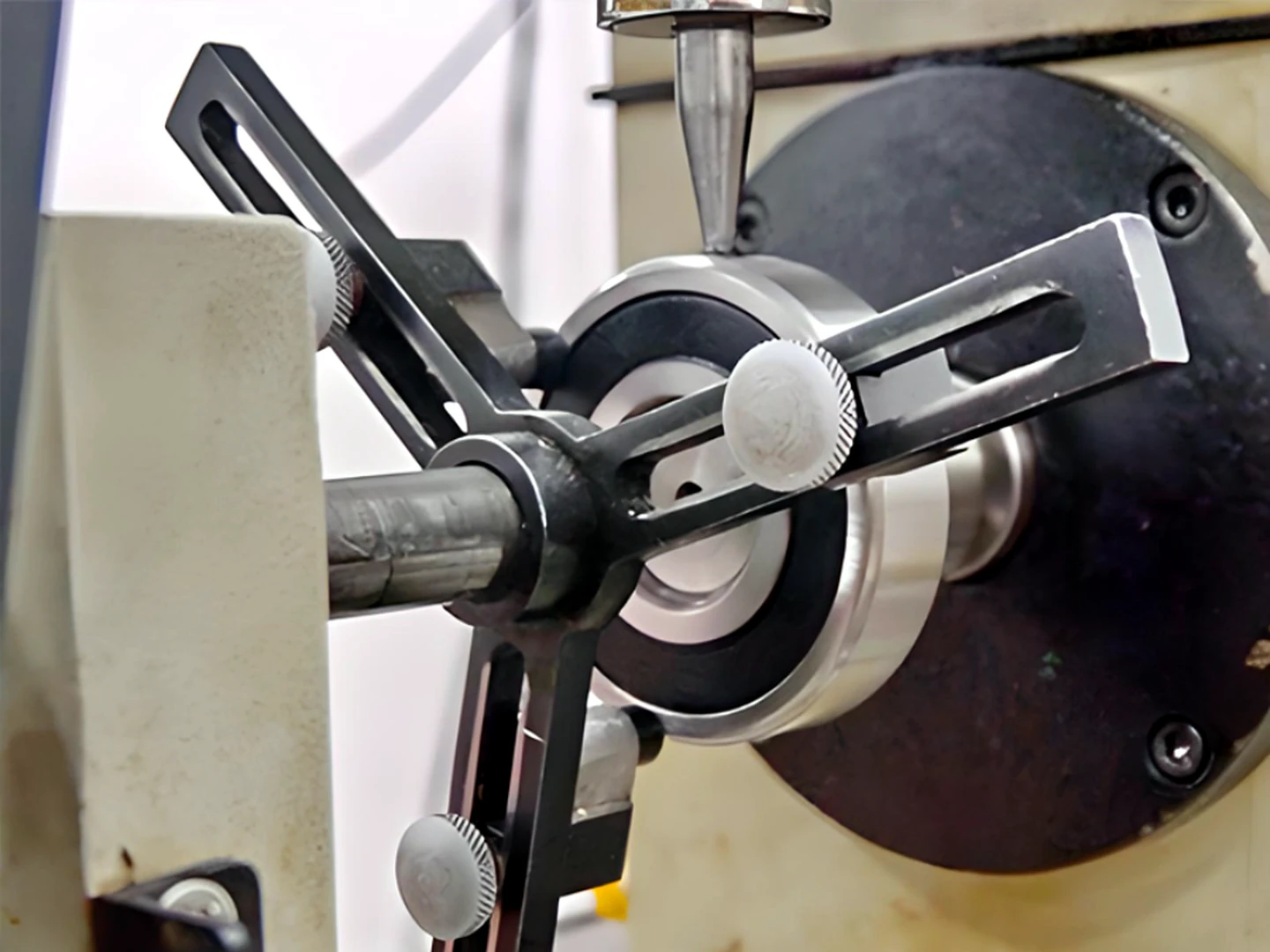
Evidence from our workshop

What to send for a quotation
- Designation, precision class, clearance and vibration grade.
- Description of the symptom and when it appears.
- Shaft and housing dimensions and fits.
- Assembly method and tools used.
- Samples of rough bearings and, if possible, unmounted bearings from the same batch.
Frequently Asked Questions
Why does my new miniature bearing feel notchy after pressing it in?
The most common reason is fitting force passing through the balls, which dents the raceways at ball spacing. Press only on the ring being fitted and never on the shield.
How can I tell brinelling from contamination?
Brinelling gives regular notches at ball spacing and evenly spaced dents on the raceway. Contamination gives random roughness and dents at irregular positions, often with debris in the grease.
Why does a bearing feel tight but not rough after mounting?
Usually the fit has reduced the radial clearance: an oversize shaft, undersize housing or interference on both rings. Stiff grease can feel similar, especially when cold.
Can I clean a rough sealed miniature bearing and reuse it?
It is not recommended. Washing removes the grease and rarely removes particles from behind the seals; dents already in the raceway remain.
Does a higher precision class prevent roughness?
No. Precision class controls dimensions and runout. Brinelling, contamination, corrosion and fit problems occur in assembly regardless of class.
Related guides
Published 2026-09-25. Images show our own workshop and representative products. Final dimensions, grades, inspection limits and supply conditions are confirmed against the requested model, drawing and order.