A double row angular contact ball bearing is stiff and compact, and that is exactly why it is sensitive to mounting errors. Tight fits remove its internal clearance, misalignment loads one row more than the other, and a mounting force through the wrong ring dents both raceways at once. This guide lists the common symptoms, links them to root causes, and gives a diagnosis table and prevention checklist for maintenance and design engineers.
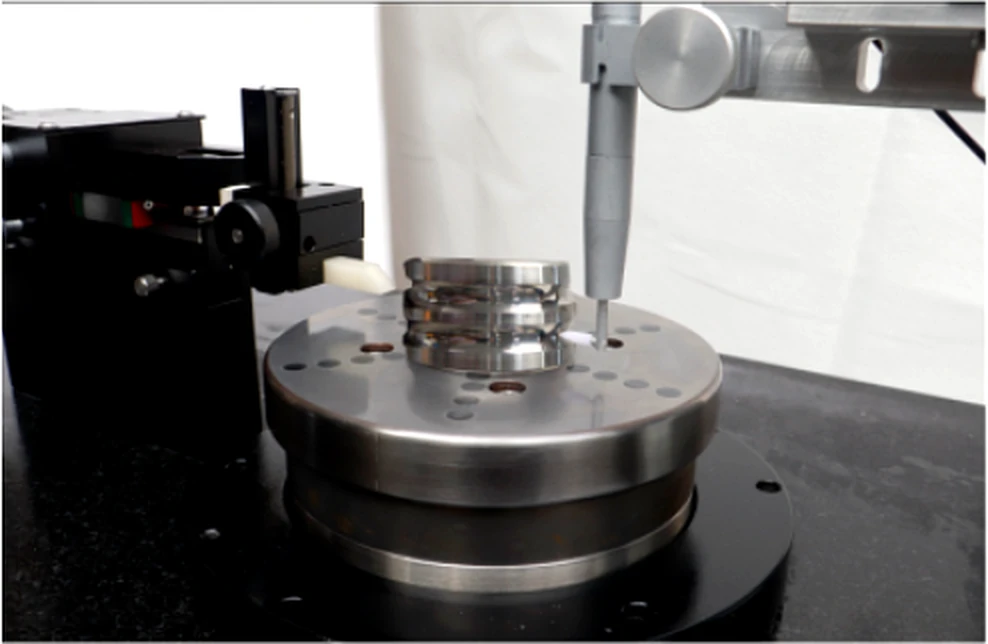
Most early failures start outside the bearing
Fits, alignment, lubrication and handling decide how a bearing runs. Reading the damage pattern on the raceways usually identifies which of these went wrong, before a replacement bearing repeats the failure.
Why this bearing type is sensitive
- Two rows share one pair of rings. A small tilt between shaft and housing shifts load strongly onto one row.
- Internal clearance is fixed at manufacture. Interference fits and temperature difference between rings reduce it; there is no adjustment during assembly.
- Moment stiffness is high. The bearing resists misalignment instead of accommodating it, which raises contact stress.
- Designs with filling slots have a direction in which heavy axial load should not be applied; follow the maker's mounting guidance. See double row groove design.
Diagnosis table: symptom, likely cause, what to check
| Symptom | Likely root cause | What to check | Corrective action |
|---|---|---|---|
| Hot running soon after start-up | Fits too tight, internal clearance consumed, bearing preloaded | Shaft and housing diameters, measured axial play after mounting | Correct fits; select a larger axial clearance if the fit must stay |
| Hot running with grease leakage | Grease overfill in open bearing, or grease unsuitable for temperature | Fill quantity, grease type and temperature rating | Adjust fill; use grease rated for the operating temperature |
| Regular clicking or rumble from new | Brinelling from mounting force through the wrong ring or impact | Dents on raceways spaced at ball pitch | Press only on the ring being fitted; use proper tools, no hammering |
| Rough, gritty noise that grows over time | Contamination through damaged or unsuitable seals | Seal lips, particles in grease, raceway indentations | Improve sealing; consider 2RS; clean assembly environment |
| Wear band on one row only, or offset across the raceway | Misalignment or moment overload | Shaft deflection, housing bore alignment, belt or pulley alignment | Correct alignment; review moment load and bearing size |
| Flaking (spalling) on raceways | Fatigue from overload, or from a lubrication or clearance problem that raised contact stress | Load case, operating hours, clearance, lubricant condition | Recalculate life per ISO 281; correct the underlying cause |
| Rust or corrosion marks | Water ingress, condensation, or storage without protection | Seal condition, environment, storage conditions | Improve sealing and storage; consider corrosion-resistant options |
| Wear on bore or outside diameter (creep marks) | Loose fit on the rotating ring | Fit class of the rotating ring, surface of shaft or housing | Use an interference fit on the ring that rotates relative to the load |
Root causes in more detail
Fits and clearance. The ring that rotates relative to the load direction needs an interference fit; the other ring can be looser. On a double row bearing, each interference fit reduces the axial clearance. If the shaft is at the top of its tolerance and the housing is tight too, a bearing with normal clearance can end up preloaded. Clearance choices are explained in axial clearance of double row angular contact bearings.
Lubrication. Too little grease or grease that has aged thermally leads to metal contact and surface distress. Too much grease in an open bearing causes churning and temperature rise. For sealed bearings the grease is chosen at manufacture, so the application temperature must be stated when ordering.
Contamination. Hard particles create dents that start noise and later spalling. Water causes corrosion and grease emulsification. The seal choice between 2RS and ZZ is covered in 2RS vs ZZ for double row bearings.
Misalignment and overload. Shaft bending, housing bores machined out of line, or belt pulleys out of plane place a moment on the bearing that the design may not have considered. The damage appears as a load zone on one row or a track running towards one shoulder.
Installation damage. Pressing the outer ring onto a shaft through the inner ring (or the reverse) transmits the force through the balls and dents both rows. Heating the bearing unevenly or striking it directly has the same effect.
Prevention checklist
- Specify shaft and housing fits on the drawing, and check the resulting axial clearance against the bearing's clearance group.
- State the operating temperature and speed so that grease and seal can be selected before production.
- Check alignment of shaft, housing and any belt drive after assembly.
- Mount by pressing on the ring that receives the interference fit, using a sleeve that contacts the full ring face.
- Keep bearings in original packaging until mounting; assemble in a clean area.
- When a bearing fails, keep it and record the position and operating hours before replacing it.
Send us the failed bearing
A failed or noisy bearing carries evidence that is lost if it is thrown away. We can section and measure returned samples, check raceway profile, roundness and clearance, and compare them with a new part. The process we use is described in double row bearing sample teardown. Findings are confirmed per sample; we do not state a cause before measurement.
Root-cause work backed by our own inspection
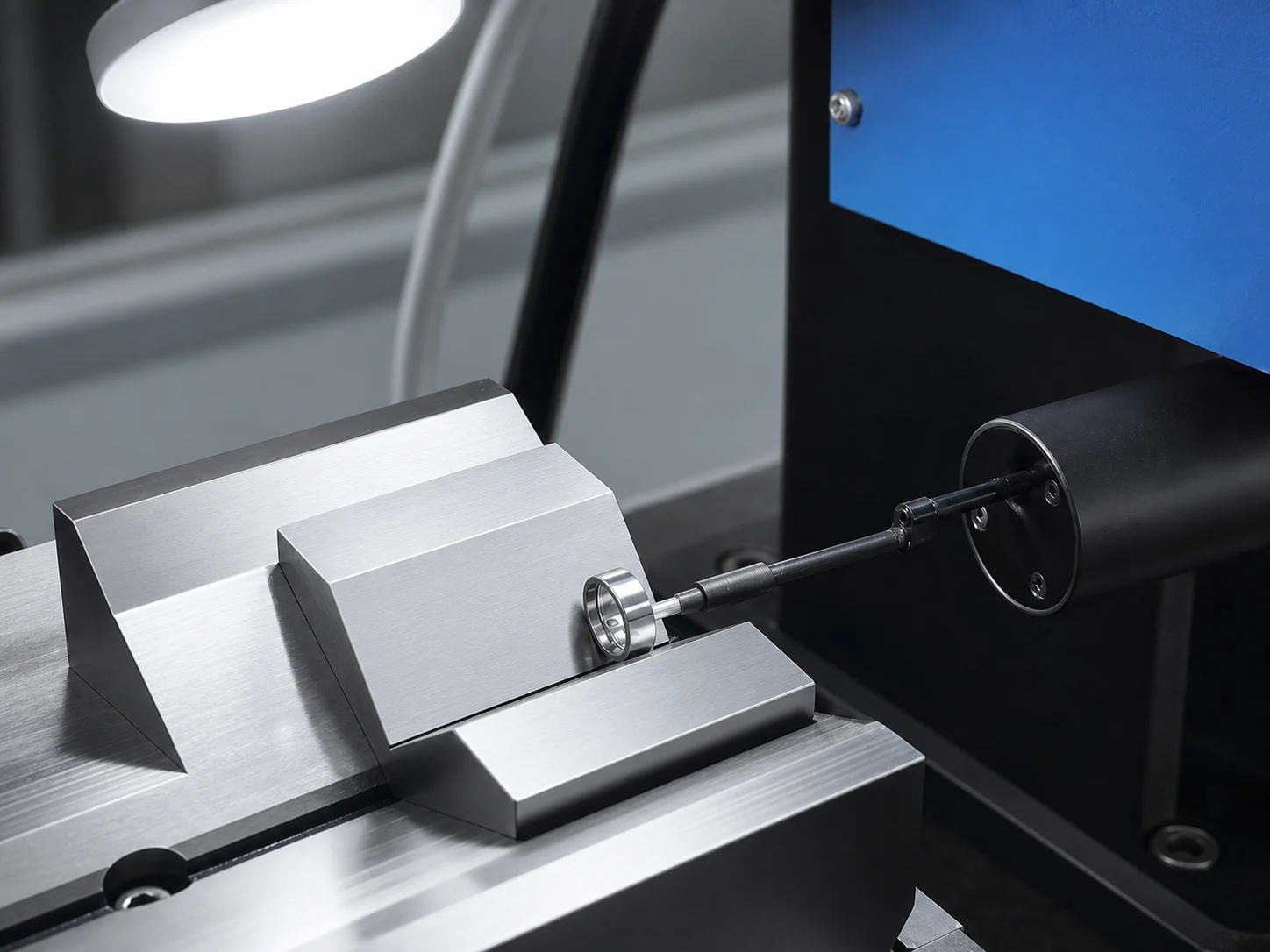
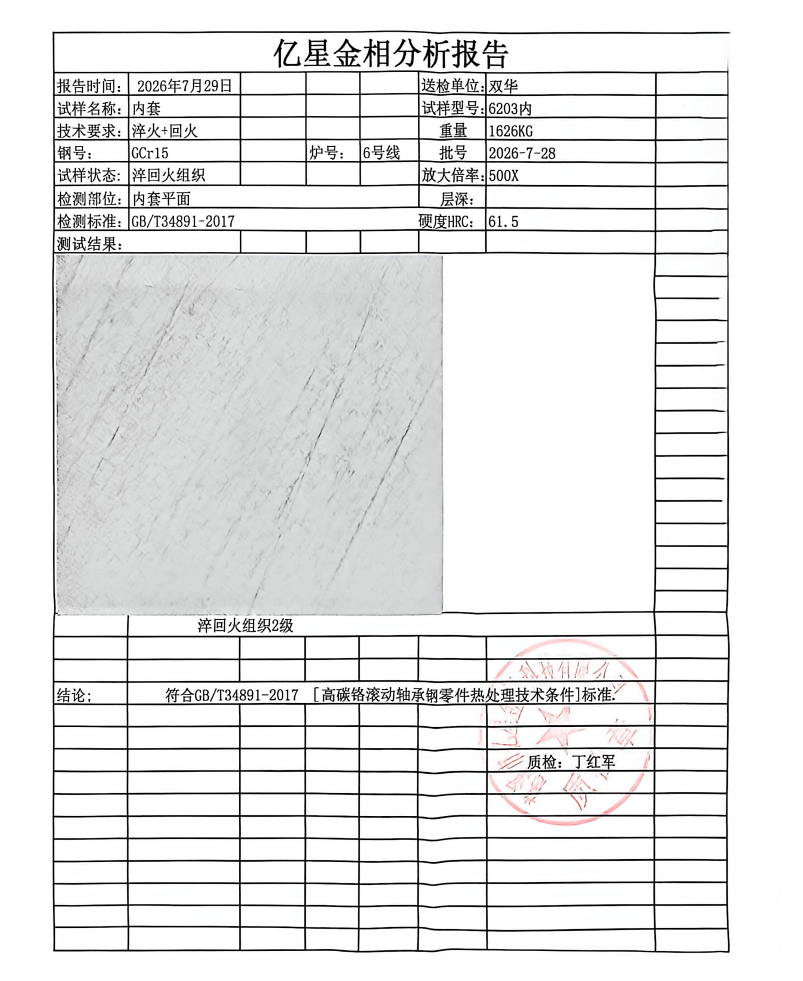
Roundness, raceway profile, roughness, clearance and vibration are measured on our own instruments, and metallographic reports are available for heat-treated rings. NLHB manufactures miniature and deep groove ball bearings up to P4 precision, and double row angular contact bearings and track rollers up to P6.
Evidence from our workshop
What to send for a quotation
- Bearing designation and quantity in the failure.
- Symptom: noise, temperature, running time to failure.
- Shaft and housing dimensions and fits.
- Load, speed, temperature and lubrication details.
- The failed bearing or clear photos of raceways, balls and seals.
Frequently Asked Questions
Why does a new double row angular contact bearing run hot?
The most common reason is that the mounting fits consumed the internal clearance and the bearing is running preloaded. Excess grease and misalignment are the next causes to check.
What causes regular clicking in a new bearing?
Regular noise from new usually indicates dents on the raceways at ball spacing, caused by mounting force transmitted through the balls or by impact during handling.
How do I tell misalignment from overload on a failed bearing?
Misalignment typically shows a load zone on one row or a ball track running towards one shoulder. Pure overload shows a wide load zone and early spalling on both rows.
Is a sealed double row bearing better against contamination?
Contact seals (2RS) give better protection against dust and water than shields (ZZ), at the cost of higher friction and lower speed capability.
Can NLHB analyse a failed bearing?
We can measure returned samples for raceway profile, roundness, clearance and dimensions and compare them with a new part. Conclusions are given after measurement, per sample.
Related guides
Published 2026-09-25. Images show our own workshop and representative products. Final dimensions, grades, inspection limits and supply conditions are confirmed against the requested model, drawing and order.