Full-complement angular contact ball bearings carry the maximum possible number of balls by omitting the cage. In the DW6 — a metric double-row, extra-wide design — that means twenty-four 3/16″ (4.763 mm) steel balls in two rows, running between an extended inner ring and a compact outer ring. This article explains how full-complement bearings work, how the balls are assembled without a cage, and how we developed the DW6 from a customer drawing to first samples.
What “full complement” means
Most rolling bearings use a cage to separate the balls. A full-complement (max-type) bearing removes the cage and fills the annular space between the rings with as many balls as the geometry allows. Two rows of twelve balls — twenty-four in total — fit inside the DW6’s small envelope.
The trade-off is well understood in bearing engineering: more balls increase static capacity and stiffness within the same outline, while cage designs leave more room for speed. Full-complement construction is chosen when space is tight, loads are mostly static or slow-moving, and the envelope cannot grow.
Loading notches — how 24 balls go in without a cage
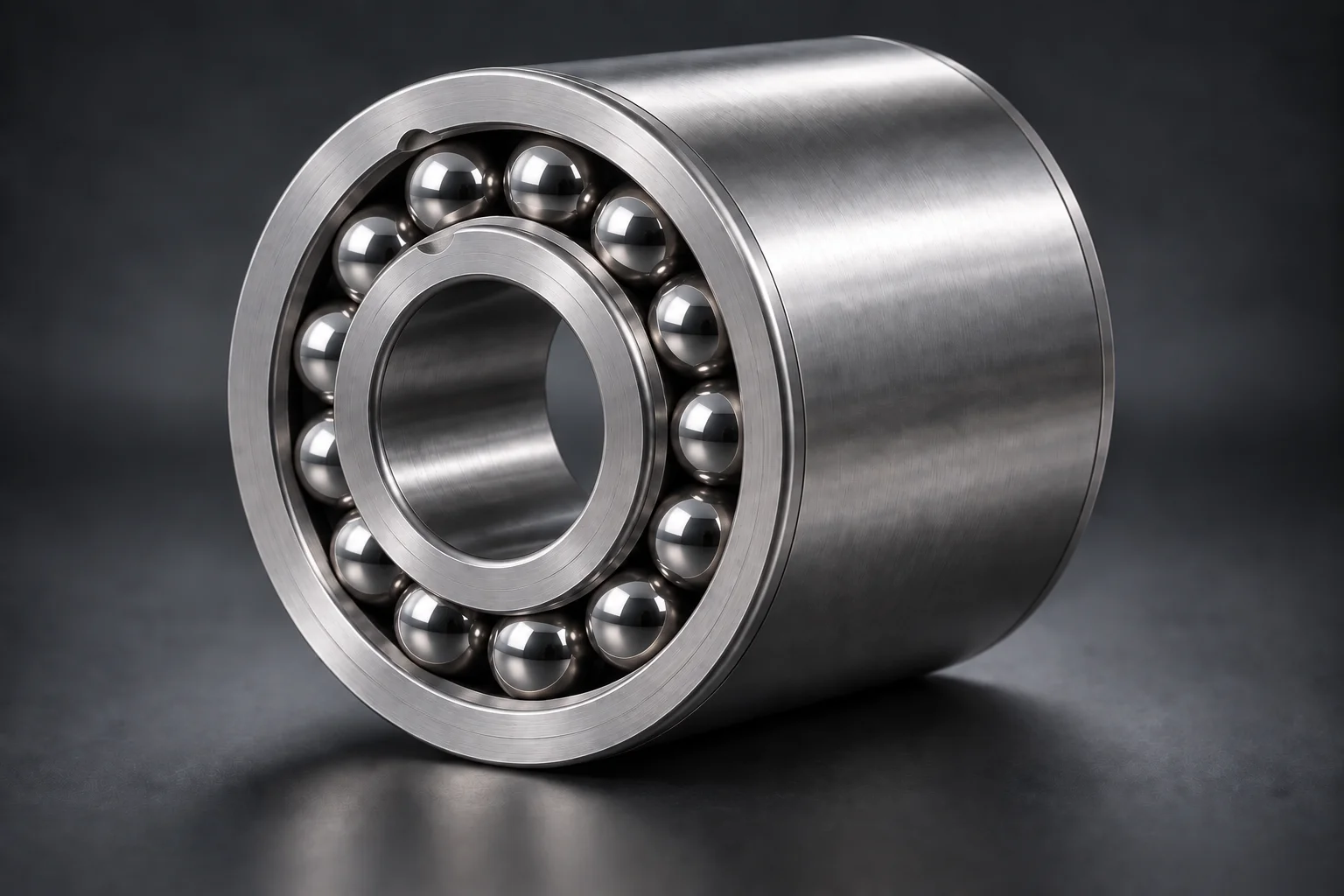
You cannot simply push oversized balls past the shoulders. The solution is machined into the rings themselves: on both the inner- and the outer-ring shoulder, a small, rounded loading notch is ground at one position. The notches on the two rings face each other and form an assembly window; balls are loaded through this window, then distributed evenly around the raceways.
Notch size matters. A smaller, carefully radiused notch keeps more of the shoulder intact and disturbs the raceway less — ours are specified as small-radius scoops rather than wide slots.
Why the inner ring is wider than the outside diameter
The DW6 is an extra-wide double-row design: outer ring width 27 mm, inner ring width 30.18 mm, outside diameter 26.988 mm. The inner ring is wider than the outer ring — and wider than the bearing is in diameter.
In practice, the extended inner ring acts as its own locating face inside the assembly. Both ball rows sit near the ends of the rings, so the two rows support the shaft across a longer span — useful in control linkages, rocker arms and other compact mechanisms where the bearing must handle radial and axial movement in very little space.
Developing the DW6 from a customer drawing
The DW6 started the way most of our non-standard projects do: a customer drawing, a set of application conditions, and a short feasibility review. First-article production then follows a fixed process chain:
- Dedicated tooling — the extra-wide, double-row geometry needs its own workholding
- Bore grinding — the reference surface first
- Raceway grinding, two rows — outer and inner rings, both grooves
- Raceway superfinishing — after grinding, each raceway
- Loading notch grinding — the last material-removal step
Every raceway is measured after grinding; if a reading is out of range, the machine is adjusted and the raceway re-ground before the part moves on.
DW6 key dimensions
| Item | Metric | Inch | Tolerance |
|---|---|---|---|
| Bore (d) | 9.525 mm | 0.3750″ | 0 / −0.013 mm |
| Outside diameter (D) | 26.988 mm | 1.0625″ | 0 / −0.013 mm |
| Outer ring width | 27 mm | 1.063″ | 0 / −0.13 mm |
| Inner ring width | 30.18 mm | 1.188″ | 0 / −0.13 mm |
| Balls | 4.763 mm (3/16″), 24 total — 12 × 2 rows, full complement, no cage | ||
| Rows | 2, angular contact | ||
Dimensions per NLHB sample-development drawing; final values confirmed at design freeze.
Frequently asked questions
What is a full-complement bearing?
A bearing without a cage: the space between the rings is filled with the maximum number of balls the geometry allows.
How are the balls loaded without a cage?
Through paired loading notches — small rounded scoops in the inner- and outer-ring shoulders that face each other and form an assembly window.
Are full-complement bearings suitable for high speed?
Cage designs generally allow higher speeds. Full-complement designs are chosen for compact envelopes and a higher ball count where speeds are moderate.
Can you develop a double-row bearing to my drawing?
Yes — send outline dimensions or a drawing with application conditions; sample development starts from a feasibility review.