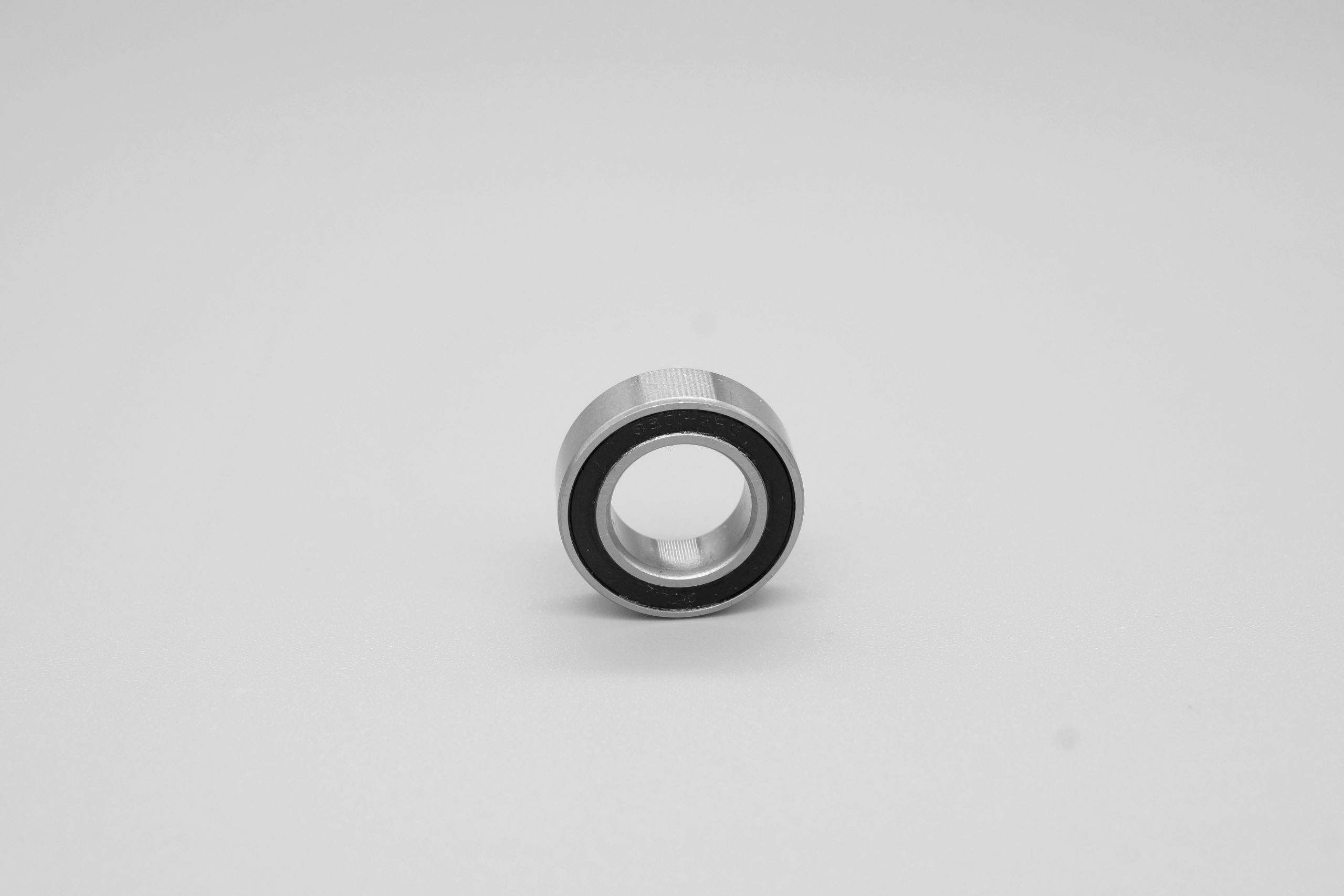
What Is the 3000 Series Double Row Angular Contact Ball Bearing?
The 3000 series double row angular contact ball bearing is engineered to carry combined loads — simultaneous radial and axial forces acting in both directions. Internally it works like two single-row angular contact ball bearings arranged back-to-back (the “O” configuration), yet it fits within the envelope of a single bearing. That combination of bidirectional thrust capacity and high rigidity in a compact footprint makes it the default choice wherever a shaft must be held firmly against loads from either side.
NLHB manufactures the complete 3000 series, together with the dimensionally related 3800 and 3900 series, in three executions: Open, ZZ (metal shields) and 2RS (contact rubber seals). Every part is precision-ground to standard ISO boundary dimensions and is fully interchangeable with SKF, NSK, NTN, FAG, Timken and INA equivalents.
Key Features
- Bidirectional axial capacity — accommodates thrust in both directions without a second bearing.
- High rigidity — the back-to-back duplex design minimizes shaft deflection under combined loads.
- Compact — replaces a pair of single-row angular contact bearings, saving width and weight.
- Three sealing options — Open, ZZ and 2RS cover the full range of speed and contamination environments.
- Low noise and long life — precision-ground raceways and balls with controlled internal clearance.
Technical Specifications (3000 Series)
Below is the standard dimension catalog for the 3000, 3800 and 3900 series. Dynamic (Cr) and static (Cor) load ratings are in kN and speed limits in r/min. For customized sizes (such as the 2153114 series) please contact our engineering team.
| Bearing No. | Bore (d)mm | O.D. (D)mm | Width (B)mm | Dynamic Load (Cr)KN | Static Load (Cor)KN | Speed (Grease)r/min | Speed (Oil)r/min | Weightkg |
| 30/5 | 5 | 14 | 7 | 2.02 | 0.93 | Consult | Consult | 0.008 |
| 30/6 | 6 | 17 | 9 | 3.09 | 1.5 | 17000 | 22000 | 0.011 |
| 30/7 | 7 | 19 | 10 | 3.77 | 1.99 | Consult | Consult | 0.012 |
| 30/8 | 8 | 22 | 11 | 5.07 | 2.58 | 14500 | 18000 | 0.025 |
| 3800 | 10 | 19 | 7 | 2.05 | 1.35 | Consult | Consult | 0.019 |
| 3000 | 10 | 26 | 12 | 5.65 | 3.2 | 12500 | 16000 | 0.022 |
| 3801 | 12 | 21 | 7 | 2.11 | 1.5 | 13000 | 14000 | 0.008 |
| 3001 | 12 | 28 | 12 | 6.54 | 4.21 | 12000 | 13200 | 0.025 |
| 3802 | 15 | 24 | 7 | 2.34 | 1.88 | 11000 | 13000 | 0.009 |
| 3002 | 15 | 32 | 13 | 8.49 | 5.3 | Consult | Consult | 0.036 |
| 3803 | 17 | 26 | 7 | 2.48 | 2.1 | Consult | Consult | 0.015 |
| 3003 | 17 | 35 | 14 | 9.07 | 6.05 | Consult | Consult | 0.042 |
| 3804 | 20 | 32 | 10 | 4.9 | 3.9 | Consult | Consult | 0.020 |
| 3904 | 20 | 37 | 13 | 9.3 | 6.6 | Consult | Consult | 0.046 |
| 3004 | 20 | 42 | 16 | 14.2 | 9.6 | Consult | Consult | 0.080 |
| 3805 | 25 | 37 | 10 | 5.5 | 4.9 | 11500 | 12700 | 0.025 |
| 3905 | 25 | 42 | 13 | 9.6 | 7.5 | 11000 | 12300 | 0.062 |
| 3005 | 25 | 47 | 16 | 15.2 | 11 | 9500 | 12000 | 0.100 |
| 3806 | 30 | 42 | 10 | 5.7 | 5.5 | 10000 | 11000 | 0.030 |
| 3906 | 30 | 47 | 13 | 9.9 | 8.3 | 9500 | 10500 | 0.095 |
| 3006 | 30 | 55 | 19 | 20.3 | 15.5 | 8000 | 10000 | 0.160 |
| 3807 | 35 | 47 | 10 | 6.1 | 6.2 | 8500 | 10000 | 0.035 |
| 3907 | 35 | 55 | 15 | 12.9 | 11.3 | 8000 | 9500 | 0.138 |
| 3007 | 35 | 62 | 20 | 24.2 | 20.4 | 6500 | 8500 | 0.240 |
| 3808 | 40 | 52 | 10 | 6.4 | 6.9 | 7000 | 8500 | 0.040 |
| 3908 | 40 | 62 | 16 | 17.4 | 15.8 | 6500 | 8000 | 0.040 |
| 3008 | 40 | 68 | 21 | 24.5 | 20.8 | 6000 | 7800 | 0.279 |
| 3809 | 45 | 58 | 10 | 6.7 | 7.7 | 6300 | 7000 | 0.055 |
| 3909 | 45 | 68 | 16 | 17.9 | 17.2 | 6000 | 6800 | 0.183 |
| 3009 | 45 | 75 | 23 | 39.9 | 36.4 | 5600 | 6200 | 0.364 |
| 3810 | 50 | 65 | 12 | 7 | 8.4 | 6000 | 7500 | 0.075 |
| 3910 | 50 | 72 | 16 | 19.1 | 19.6 | 5800 | 7200 | 0.189 |
| 3010 | 60 | 80 | 23 | 42.3 | 41.9 | 5300 | 6600 | 0.395 |
| 3811 | 55 | 72 | 13 | 12.8 | 14.4 | 5500 | 6500 | 0.010 |
| 3911 | 55 | 80 | 19 | 20 | 21.7 | 5300 | 6200 | 0.282 |
| 3011 | 55 | 90 | 26 | 43.7 | 44.7 | 4800 | 5800 | 0.581 |
| 2153114 | 21.5 | 31 | 14 | 3.4 | 3 | 11000 | 10000 | 0.019 |
Sealing Options: Open vs ZZ vs 2RS
- Open — no seals; lowest friction and highest speed limit; for oil-bath or relubricated service in clean environments.
- ZZ (metal shields) — non-contact steel shields that exclude coarse contamination while retaining grease; a good general-purpose option at moderate speeds.
- 2RS (rubber seals) — contact seals giving the best protection against moisture and fine dust; factory-lubricated and effectively maintenance-free, at a reduced speed limit.
Selection Guide
- Loads — confirm both magnitude and direction of radial and axial loads; the 3000 series is built for combined loads, not pure thrust.
- Speed — Open > ZZ > 2RS. Pick seals by your speed and contamination profile.
- Clearance — C3 is standard for most electric-motor and general applications; specify C2 or C4 where thermal conditions require.
- Accuracy — standard ABEC-1 / P0 for general use; upgrade to P6 or P5 for precision or quiet-running needs.
- Fits — the rotating ring normally takes an interference fit; ask NLHB for recommended shaft and housing tolerances.
Typical Applications
- Water pumps and washing-machine drive units
- Textile and spinning machinery
- Gearboxes and power transmission
- Crane hooks and lifting sheaves
- Agricultural equipment
- Elevators, escalators and industrial fans
Cross-Reference & Interchangeability
NLHB 3000 series bearings are dimensionally and functionally interchangeable with the major global brands — migration requires no redesign, as bore, O.D., width and load ratings all match:
- SKF — 3200 A, 3300 A, 3200-2RS1, 3300-2RS1
- NSK — 3200, 3300, 3200DDU, 3300DDU
- NTN — 3200X, 3300X, 3200LLU
- FAG / INA — 3200-B-2RSR, 3300-B-2RSR
- Timken / Koyo — equivalent 3200 / 3300 double-row angular contact types
Need a cross-reference for a specific part number? Send us your list and we will return the exact NLHB equivalents.
Installation & Maintenance
- Clean all mating parts and keep the bearing in its protective packaging until the moment of mounting.
- Apply the interference fit to the rotating ring; never press through the balls.
- For larger sizes use induction heating or a thermal differential — never strike the rings directly.
- Keep misalignment within the bearing’s allowance; double-row angular contacts are sensitive to skew.
- 2RS units are lubricated for life; do not force extra grease past the seals.
Frequently Asked Questions
What does the “A” in 3200 A mean?
The “A” denotes the standard ~30 degree contact angle.
ZZ vs 2RS — which should I pick?
Choose ZZ for clean, higher-speed service; choose 2RS for wet, dusty or maintenance-free applications.
Can one 3000 series bearing replace two single-row angular contact bearings?
Yes — that is its core advantage; just verify the speed limit and internal preload against the original pair.
What is the difference between 3200, 3300 and 3800/3900?
3200 and 3300 are standard-width double-row series (3300 is larger for a given bore); 3800 and 3900 are narrow-width series for limited axial space.