
Deep groove ball bearings are the most widely used rolling bearings in electric motors, household appliances, and precision machinery. For these noise-sensitive applications, the bearing’s vibration acceleration level (measured in decibels, dB) is the single most important indicator of running quietness, surface finish quality, and overall manufacturing precision. This guide explains the Chinese Z1–Z4 vibration grading system, shows the standard dB limit table for bore diameters from 3 mm to 60 mm, and helps overseas buyers and engineers select the correct low-noise bearing grade for their application.
Why Vibration Acceleration Level Matters
In a deep groove ball bearing, vibration is generated by geometrical imperfections of the raceways, balls, and cage — primarily waviness, roundness error, and surface roughness. The vibration acceleration level (dB) quantifies this. A lower dB value means a quieter, smoother-running bearing. The Z-grade system therefore gives buyers a direct, comparable metric for bearing noise and finishing quality across suppliers.
Vibration Quality Grades and Typical Applications
Per the Chinese vibration standard, deep groove ball bearings are classified into the following grades, where higher numbers indicate quieter (lower-dB) bearings:
- Z (Basic grade): General-purpose machinery, agricultural equipment, and applications with no special noise requirement.
- Z1 / Z2 (Low-noise grade): Standard electric motors, power tools, pumps, and household-appliance bearings.
- Z3 / Z4 (Ultra-quiet grade): Premium quiet motors, silent fans, precision instruments, and any application demanding minimal audible noise or vibration.
Higher grades demand tighter control of raceway roundness, waviness, and ball sorting, which directly translates into longer service life and quieter operation.
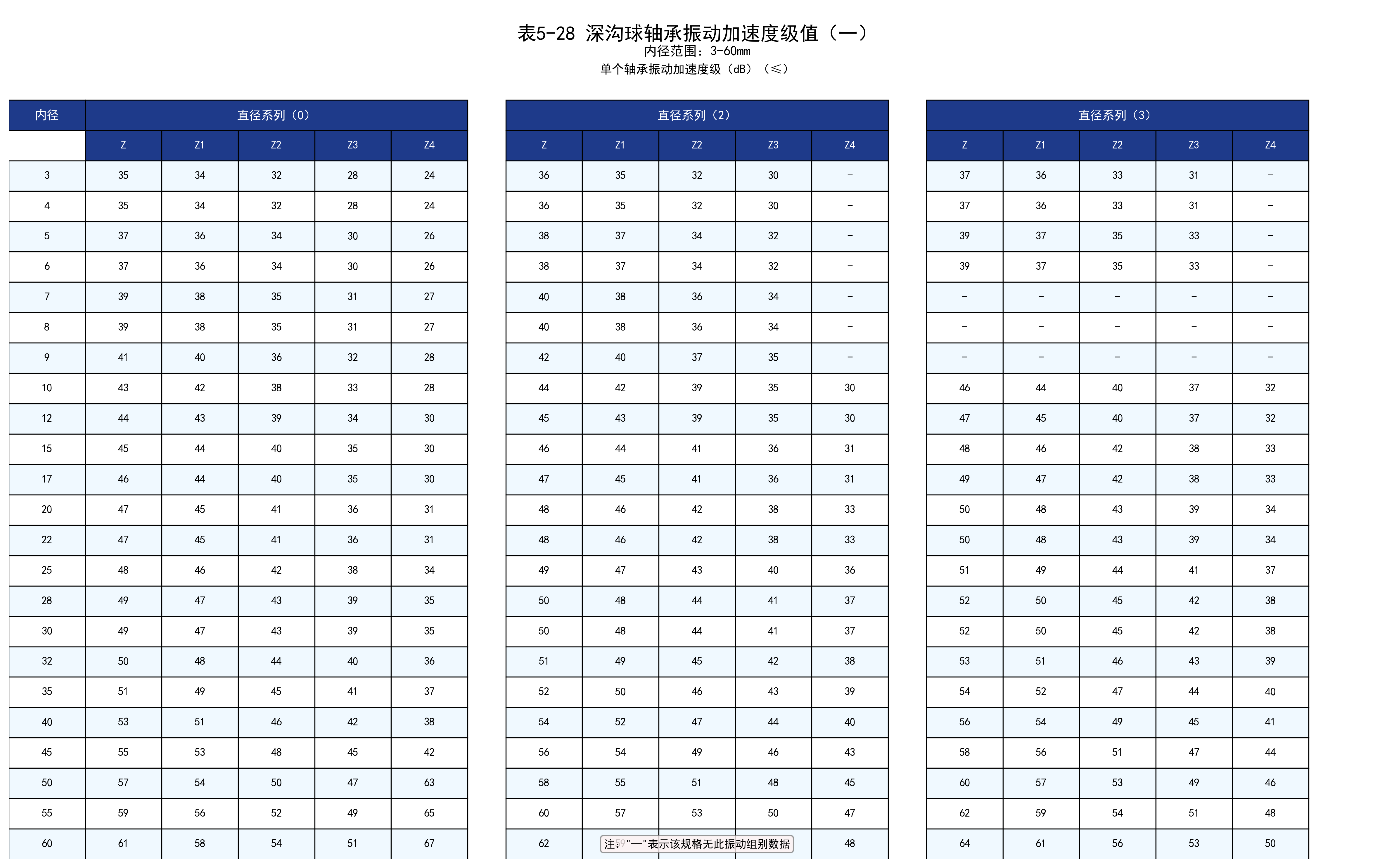
Deep Groove Ball Bearing Vibration Acceleration Level Standard Table (dB)
The reference table below lists the maximum permissible vibration acceleration level (dB) for each bore diameter and Z-grade. A bearing is judged compliant when its measured value is less than or equal to the figure in the table. The table applies to deep groove ball bearings with bore diameters from 3 mm to 60 mm; units are decibels (dB).
How to Choose the Right Noise Grade
- Match the grade to the end product’s noise target. A standard industrial motor typically requires Z1 or Z2; a bedroom-quiet appliance fan or a high-end instrument spindle requires Z3 or Z4.
- Confirm bore diameter first. The dB limit for each grade depends on the bearing’s bore diameter, so always select by both bore size and grade — never by grade alone.
- Specify the grade in your RFQ. Stating “Z3” or “Z4” explicitly ensures the supplier selects steel, controls the super-finishing process, and 100% tests each bearing to the correct limit.
- Balance cost and silence. Each step up in grade increases processing cost. Over-specifying (e.g., Z4 for a non-noise-sensitive drive) raises price without functional benefit.
Typical Applications
- Electric motors (general-purpose, premium-efficiency, and ultra-quiet models)
- Household appliances — washing machines, air-conditioner fans, range hoods, vacuum cleaners
- Quiet fans and blowers
- Power tools and hand-held equipment
- Precision instruments and small gear units
Why Choose NLHB Low-Noise Bearings
NLHB (Ningbo Shuanghua Bearing Co., Ltd.) is based in Cixi, one of China’s established bearing-industry clusters. We focus on high-precision, long-life low-noise deep groove ball bearings, with particular strength in Z2, Z3, and Z4 quiet grades. Our advantages include:
- Strict raw-material selection — high-purity bearing steel that minimizes vibration sources from the very first process.
- Super-finishing process — raceways are super-finished to reduce waviness, which directly raises the Z3/Z4 pass rate.
- 100% noise testing — every quiet-grade bearing is individually checked on a vibration tester to confirm it meets the required dB limit, with no abnormal tones.
Cross-Reference & Interchangeability
Our Z-graded low-noise deep groove ball bearings follow standard metric boundary dimensions (bore, outer diameter, width) per ISO 15, so they are dimensionally interchangeable with the equivalent part numbers from SKF, NSK, NTN, FAG, INA, and Timken. To find a match, convert the bore code to the full bearing number (for example, bore code “06” = 30 mm bore -> 6206-series), then add the required internal clearance (C3 is the most common for electric-motor applications) and Z-noise grade. The 62xx and 63xx series are the most frequently interchanged low-noise motor bearings worldwide.
Frequently Asked Questions
What does the “Z” grade mean on a bearing?
The Z grade (Z1-Z4) is a Chinese vibration-acceleration classification. A higher number indicates a lower dB value and therefore a quieter, more precisely finished bearing. Z3 and Z4 are considered ultra-quiet grades.
What is a good vibration level for an electric motor bearing?
Most standard motors use Z1 or Z2 grade; premium quiet motors and appliance fans benefit from Z3 or Z4. The exact dB limit also depends on the bearing’s bore diameter.
Does a lower dB value mean a better bearing?
For noise-sensitive applications, yes — a lower dB value indicates superior raceway finishing and quieter running. For non-noise-critical machinery, a basic grade is sufficient and more cost-effective.
Can NLHB supply Z3 and Z4 grades consistently?
Yes. Z2, Z3, and Z4 low-noise grades are our core strength, with 100% individual vibration testing on every quiet-grade bearing before shipment.
Need a specific low-noise deep groove ball bearing grade or bore size? Contact NLHB with your requirements (bore diameter, Z-grade, and clearance) for a competitive quote from the Cixi bearing cluster.