
The chamfer (corner radius, denoted r or r1) of a ball bearing is the rounded transition between the bore or outside diameter and the bearing face. Although it is not a load-carrying surface, chamfer geometry is a controlled dimension: it must be large enough to clear the shaft and housing fillet radii during mounting, yet small enough to preserve an adequate bearing face width for axial support. This page presents the chamfer measurement and tolerance tables that NLHB BEARING (Ningbo ShuangHua Bearings Co., Ltd.) applies to deep groove ball bearings and tapered roller bearings, with the minimum (rs min) and maximum (rs max) values for both the radial and axial directions.
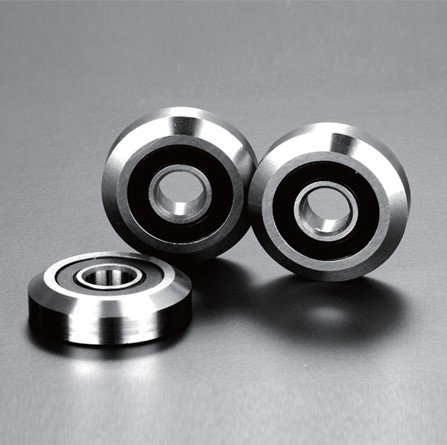
Key Features of Bearing Chamfers
- Dual-direction control. Each chamfer is specified by a single minimum value (rs min, defining the usable mounting clearance) and two maximum values (rs max) measured separately in the radial and axial directions.
- Bore- and size-dependent. Allowable chamfer dimensions scale with the nominal bore diameter d (or outside diameter D), so larger bearings carry correspondingly larger chamfers.
- Standardized interchangeability. The rs min values follow ISO 15 / GB/T 273.3 boundary dimensions, ensuring drop-in compatibility with international brand equivalents.
- Fillet-clearance guarantee. The shaft and housing fillet radius must not exceed rs min, otherwise the bearing face will not seat correctly against the shoulder.
Technical Specifications – Deep Groove Ball Bearing Chamfer Tolerances
The table below lists the permissible chamfer dimensions for deep groove ball bearings. All values are in millimeters (mm).
| rs min1 | Nominal bore diameter d | rs max or r1s max | ||
| or | d | Radial | Axial | |
| r1s min | Over | Incl. | ||
| 0.1 | – | – | 0.2 | 0.4 |
| 0.15 | – | – | 0.3 | 0.6 |
| 0.2 | – | – | 0.5 | 0.8 |
| 0.3 | – 40 |
40 – |
0.6 0.8 |
1 1 |
| 0.6 | – 40 |
40 – |
1 1.3 |
2 2 |
| 1 | – 50 |
50 – |
1.5 1.9 |
3 3 |
| 1.1 | – 120 |
120 – |
2 2.5 |
3.5 4 |
| 1.5 | – 120 |
120 – |
2.3 3 |
4 5 |
| 2 | – 80 220 |
80 220 – |
3 3.5 3.8 |
4.5 5 6 |
| 2.1 | – 280 |
280 – |
4 4.5 |
6.5 7 |
| 2.5 | – 100 280 |
100 280 – |
3.8 4.5 5 |
6 6 7 |
| 3 | – 280 |
280 – |
5 5.5 |
8 8 |
Note: The minimum permissible chamfer dimension “r” is given in the table above.
Technical Specifications – Tapered Roller Bearing Chamfer Dimensions
The table below lists the permissible chamfer dimensions for tapered roller bearings, specified against either the nominal bore diameter d or the nominal outside diameter D. All values are in millimeters (mm).
| rs min2 | Nominal bore d or nominal outside diameter D |
rs max or r1s max | ||
| or | Radial | Axial | ||
| r1s min | Over | Incl. | ||
| 0.3 | – | 40 | 0.7 | 1.4 |
| 40 | – | 0.9 | 1.6 | |
| 0.6 | – | 40 | 1.1 | 1.7 |
| 40 | – | 1.3 | 2 | |
| 1 | – | 50 | 1.6 | 2.5 |
| 50 | – | 1.9 | 3 | |
| 1.5 | – | 120 | 2.3 | 3 |
| 120 | 250 | 2.8 | 3.5 | |
| 250 | 3.5 | 4 | ||
| 2 | – | 120 | 2.8 | 4 |
| 120 | 250 | 3.5 | 4.5 | |
| 250 | – | 4 | 5 | |
| 2.5 | – | 120 | 3.5 | 5 |
| 120 | 250 | 4 | 5.5 | |
| 250 | – | 4.5 | 6 | |
| 3 | – | 120 | 4 | 5.5 |
| 120 | 250 | 4.5 | 6.5 | |
| 250 | 400 | 5 | 7 | |
| 400 | – | 5.5 | 7.5 | |
| 4 | – | 120 | 5 | 7 |
| 120 | 250 | 5.5 | 7.5 | |
| 250 | 400 | 6 | 8 | |
| 400 | – | 6.5 | 8.5 | |
Note: The minimum permissible chamfer dimension “r” or “r1” is given in the table above.
How to Use the Chamfer Tolerance Tables
- Identify the bore diameter d (for deep groove ball bearings) or the relevant diameter d/D (for tapered roller bearings) from your bearing drawing.
- Find rs min for that size class. The shaft or housing shoulder fillet radius must be smaller than this value to guarantee proper seating.
- Check rs max in both radial and axial directions. These define the maximum permissible material removal and are used for incoming-inspection gauging.
- Confirm the bearing face width remains within tolerance after chamfer – if rs max approaches the inner or outer ring width, request a non-chamfered or reduced-chamfer variant.
Typical Applications
Controlled chamfer tolerances matter wherever bearings are mounted against a shaft or housing shoulder:
- Electric motors and fans (deep groove ball bearings, rs = 1 to 1.5 mm size class)
- Automotive gearboxes, wheel hubs and agricultural transmissions (tapered roller bearings)
- Industrial fans, pumps and conveyor systems
- Mining and material-handling equipment carrying combined radial and axial loads
- Textile and packaging machinery requiring repeatable bore-to-shaft fit
Cross-Reference and Interchangeability
The chamfer tolerances listed above follow the same ISO 15 boundary-dimension system used by the major international brands, so NLHB bearings are dimensionally interchangeable with equivalents from SKF, NSK, NTN, FAG, INA and Timken of the same bore x outside diameter x width envelope. When specifying a replacement, quote the original part number plus its bore d, outside diameter D and width B/T; the chamfer class (rs min) is then read directly from these tables. For sealed or shielded variants (suffix 2RS / ZZ), confirm that the rs min in the seal groove matches the open-bearing value.
Measurement Method
Chamfers are verified with a profile projector, contour tracer, or dedicated chamfer gauges. The rs min is the single guaranteed minimum dimension; the rs max values are measured separately in the radial direction (toward the bearing axis) and the axial direction (along the bearing axis). Both maxima must be respected for the part to pass incoming inspection.
FAQ
1. What is the difference between rs min and rs max on a bearing chamfer?
rs min is the guaranteed minimum usable chamfer that must clear the shaft or housing fillet radius during mounting. rs max is the upper limit of the chamfer, measured separately in the radial and axial directions, beyond which too much face material would be removed.
2. Why does my shaft fillet radius need to be smaller than rs min?
If the shoulder fillet radius exceeds rs min, the bearing face cannot seat flush against the shoulder, causing misalignment, edge loading and premature failure.
3. Are NLHB chamfer tolerances interchangeable with SKF / NSK / NTN bearings?
Yes. Because the rs min/max values are taken from the ISO 15 / GB/T 273.3 boundary dimension system, NLHB bearings of an equivalent size are drop-in interchangeable with SKF, NSK, NTN, FAG, INA and Timken equivalents.
4. Do sealed (2RS) bearings use different chamfer tolerances?
The structural chamfer on the ring normally follows the same table; however, the seal groove introduces an additional r1 dimension that should be confirmed against the seal specification when ordering.
Ningbo ShuangHua Bearings Co., Ltd. (NLHB BEARING) manufactures deep groove ball bearings, tapered roller bearings and custom bearing solutions to ISO boundary dimensions. Contact us for technical support, bearing interchange assistance and OEM supply.